


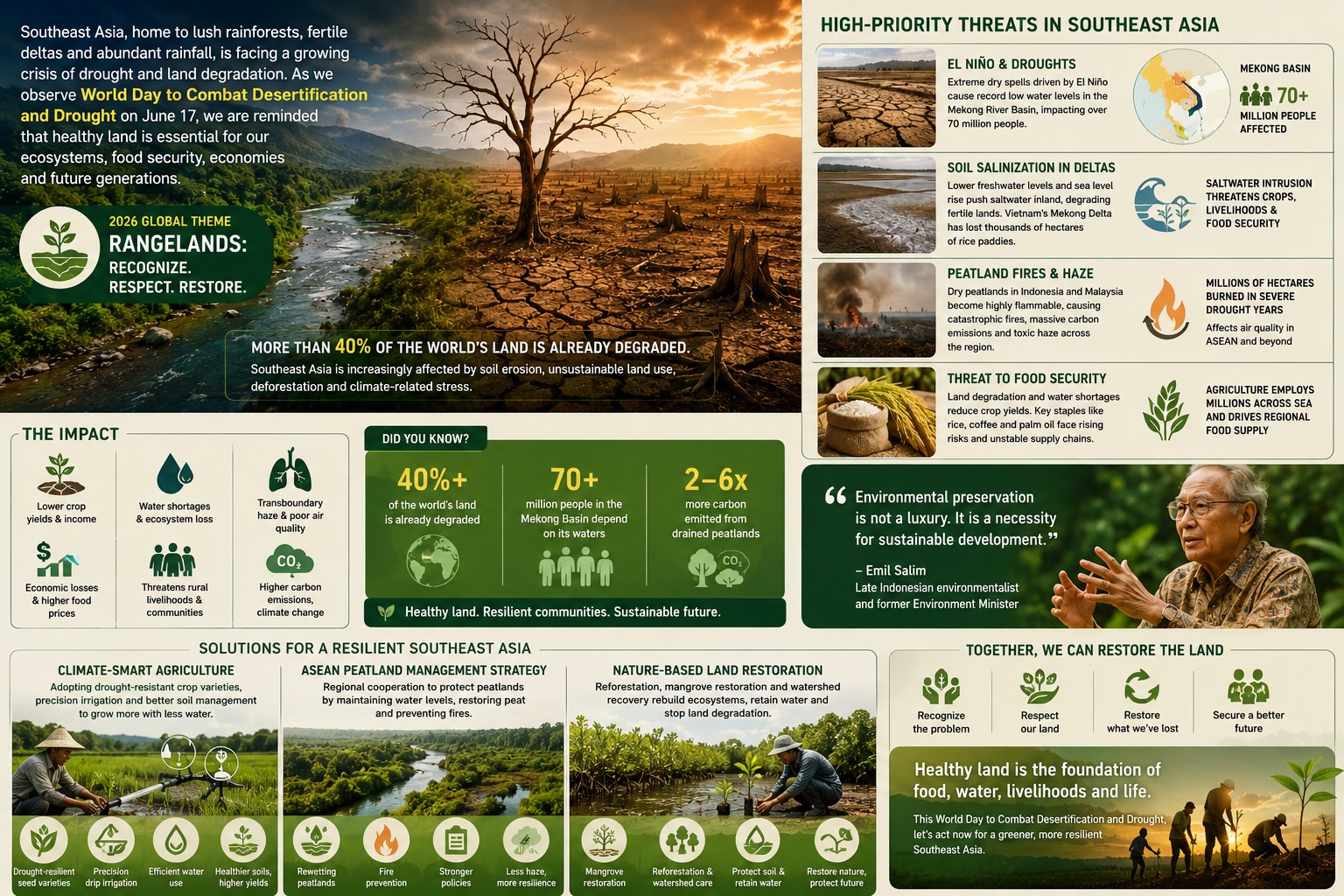
On June 17 each year, the world observes the World Day to Combat Desertification and Drought, a global reminder that healthy land is one of humanity's most valuable resources. For many people, desertification evokes images of expanding deserts in Africa or the Middle East. Yet in Southeast Asia, a region renowned for its tropical rainforests, fertile river deltas, and abundant rainfall, the threat is becoming increasingly real in a different form.
Across the region, prolonged droughts, degraded agricultural land, drying peatlands, and shifting weather patterns are placing growing pressure on ecosystems, food production, and rural livelihoods. As countries commemorate the 2026 theme, "Rangelands: Recognize. Respect. Restore.", Southeast Asia finds itself confronting an environmental challenge that is no longer distant, but deeply local.
A Region at a Climate Crossroads
Southeast Asia has long depended on predictable monsoon cycles. Farmers in Indonesia, Thailand, Vietnam, Cambodia, and Myanmar have traditionally planned planting and harvesting seasons around reliable rainfall patterns. Today, however, climate change is disrupting those rhythms.
Recent El Niño events have intensified drought conditions across much of the region. The Mekong River Basin, which supports more than 70 million people, has experienced some of its lowest water levels in decades. Reduced rainfall and upstream water pressures have affected fisheries, irrigation systems, and agricultural production throughout Thailand, Laos, Cambodia, and Vietnam.
The consequences extend beyond water shortages. In Vietnam's Mekong Delta, one of the world's most productive rice-growing regions, drought has allowed seawater to penetrate further inland. Saltwater intrusion has damaged thousands of hectares of farmland, threatening both local livelihoods and regional food security.
According to the United Nations Convention to Combat Desertification (UNCCD), more than 40 percent of the world's land is already degraded. Southeast Asia is increasingly contributing to this statistic through soil erosion, unsustainable land use, deforestation, and climate-related stress.
Peatlands Under Pressure
Perhaps nowhere is land degradation more visible than in the peatland ecosystems of Indonesia and Malaysia.
Under normal conditions, peatlands act as enormous carbon sinks, storing vast quantities of organic matter accumulated over thousands of years. However, prolonged dry seasons can transform these landscapes into highly flammable tinderboxes.
The devastating Southeast Asian haze episodes of recent decades have frequently been linked to peatland fires. During severe drought years, millions of hectares have burned across parts of Sumatra and Kalimantan, releasing enormous amounts of carbon dioxide while affecting air quality across Indonesia, Malaysia, Singapore, and southern Thailand.
The late environmentalist and former Indonesian environment minister Emil Salim once observed, "Environmental preservation is not a luxury. It is a necessity for sustainable development." His words remain highly relevant as Southeast Asia continues balancing economic growth with ecological protection.
Beyond their climate impact, degraded peatlands threaten biodiversity, water retention, and community livelihoods. Protecting these ecosystems has therefore become both an environmental and economic priority.
Food Security Begins with Healthy Land
The challenge of drought is ultimately a challenge of food security.
Agriculture remains a major employer across Southeast Asia, supporting millions of families and contributing significantly to national economies. Rice fields, coffee plantations, palm oil estates, and fruit farms all depend on healthy soils and reliable water supplies.
When droughts become longer and more frequent, crop yields decline. When land degradation reduces soil fertility, farmers face rising costs and lower productivity. These pressures can ripple throughout supply chains and contribute to higher food prices.
Recognizing these risks, governments and agricultural institutions are increasingly promoting climate-smart agriculture. Across the region, farmers are adopting drought-resistant crop varieties, precision irrigation technologies, and improved soil-management techniques designed to maintain productivity under changing climate conditions.
In Indonesia, several provinces have expanded the use of climate-resilient rice varieties capable of surviving both floods and droughts. In Thailand and Vietnam, pilot projects are helping farmers reduce water consumption while maintaining harvest levels through more efficient irrigation systems.
Restoring Nature, Strengthening Resilience
Encouragingly, solutions are emerging throughout Southeast Asia.
The ASEAN Peatland Management Strategy has strengthened regional cooperation to prevent peatland degradation and reduce transboundary haze risks. Governments are increasingly investing in peatland rewetting programmes, restoring natural water levels to prevent fires before they start.
Nature-based solutions are also gaining momentum. Across coastal communities, mangrove restoration projects are helping protect shorelines, improve groundwater retention, and enhance biodiversity. Reforestation programmes in degraded watersheds are restoring tree cover while improving soil health and water storage capacity.
These efforts demonstrate that combating land degradation is not simply about preventing environmental damage. It is about building resilience, protecting livelihoods, and securing a sustainable future.
Restoring the Land, Securing the Future
The World Day to Combat Desertification and Drought serves as a reminder that healthy land underpins every aspect of human wellbeing. It supports food production, stores water, protects biodiversity, and sustains economic development.
For Southeast Asia, the challenge is particularly urgent. A region famous for its lush landscapes can no longer take those landscapes for granted. Droughts are becoming more intense, ecosystems are under pressure, and climate uncertainty is reshaping traditional ways of life.
Yet there is reason for optimism. Across farms, forests, river basins, and coastal communities, governments, scientists, farmers, and local residents are working together to restore degraded land and strengthen resilience. Their efforts reflect a simple truth: when land is protected, communities prosper.
As Southeast Asia marks World Day to Combat Desertification and Drought 2026, the message is clear. The future of the region's environment—and the wellbeing of generations to come—depends not only on recognizing the value of healthy land, but on respecting and restoring it before it is too late.


