Indonesia is home to one of the most extreme industrial operation sites in the world. The Grasberg open-pit mining site stands firm at an altitude of 4,200 meters above sea level.
It is located deep within the central mountain range of Papua, Indonesia. This site holds the record as one of the highest open-pit mines ever operated in human history.
The steep terrain and isolated geographic location made this area difficult to reach during the early days of its discovery. However, large-scale infrastructure development successfully opened access to the summit of this commodity rich mountain.
The Grasberg mining site offers a geological landscape view that is unusual for a tropical region. The surrounding area is dominated by rugged rocks and rocky mountain peaks covered by high-altitude natural phenomena.
An Industrial Giant Above the Clouds
The massive industrial operation at this high-altitude site is managed entirely by PT Freeport Indonesia.
Haul trucks with capacities of hundreds of tons must move constantly every day navigating the mine's spiral path to keep the production running.
The low air pressure and thin atmospheric conditions at this elevation affect the performance of these heavy vehicles. The high-powered machinery requires a special air intake system to ensure optimal fuel combustion inside the engine.
The air temperature in the mining operation area can also drop drastically, reaching minus 5 degrees Celsius.
Extreme environments pose a constant challenge for the human workforce on the field. Oxygen levels at the peak of this mining area stand at only around 60 percent which causes human respiration to tire much faster during heavy activities.
The entire operational process at this site combines the use of modern navigation technology with strict adaptation to extreme weather.
A Close Neighbor to the Fragile Tropical Glacier
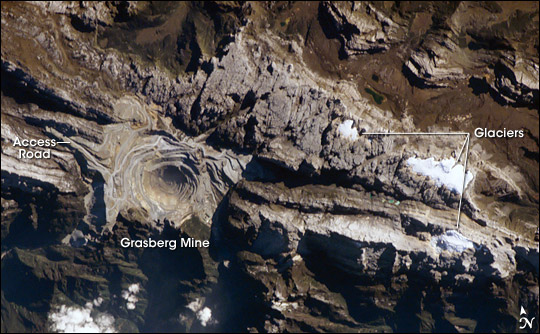
The primary uniqueness of Grasberg is not just about its altitude numbers or the scale of its industrial mining. This operational site is located only about 4 kilometers away from the iconic Carstensz Pyramid.
The giant crater area resulting from the excavation also directly borders the outer boundary of the Lorentz National Park.
This characteristic places a heavy industrial zone side-by-side with a globally recognized protected landscape.
Such geography creates an operational view running right alongside a rare tropical glacier. The existence of an ice glacier near the equator is a phenomenon seldom found on planet earth.
However, the condition of the perpetual ice sheets around the mountains continues to shrink from year to year. Global climate change and rising average atmospheric temperatures are the main factors eroding the thickness of the ice layer.
The warming air temperature causes the snow cover area around the mountain peak to continuously diminish.
The vulnerable surface conditions have also influenced the sustainability of the open-pit excavation method on the mountain.
Shift to the Underground Network
Material excavation activities in the open-pit crater have been completely wrapped up since 2019. The majority of daily operational focus has been relocated into the underground tunnels located right beneath the bottom of the crater.
These dark corridors below the ground surface replace the role of the outer area that once sat directly beneath the open sky. This migration step simultaneously minimizes the direct impact of industrial activities on the sensitive surface ecosystem above.
Workers control the massive heavy machinery from a distance using an integrated digital control center. An automated driverless train system operates constantly inside the earth to transport the crushed mineral rocks.
The deep underground network targets the remaining ore reserves estimated to last until 2041. This technical transition maintains a large production capacity targeting up to 240,000 tons of ore processing per day.
The processed mineral concentrate flows down through a 115-kilometer pipeline directly to the port of Amamapare for the global market.