In June 2022, electricity generated by a hydropower dam in Laos crossed four countries before powering homes and businesses in Singapore.
It didn't travel by ship, truck, or batteries. It flowed through thousands of kilometres of transmission lines stretching across Thailand and Malaysia.
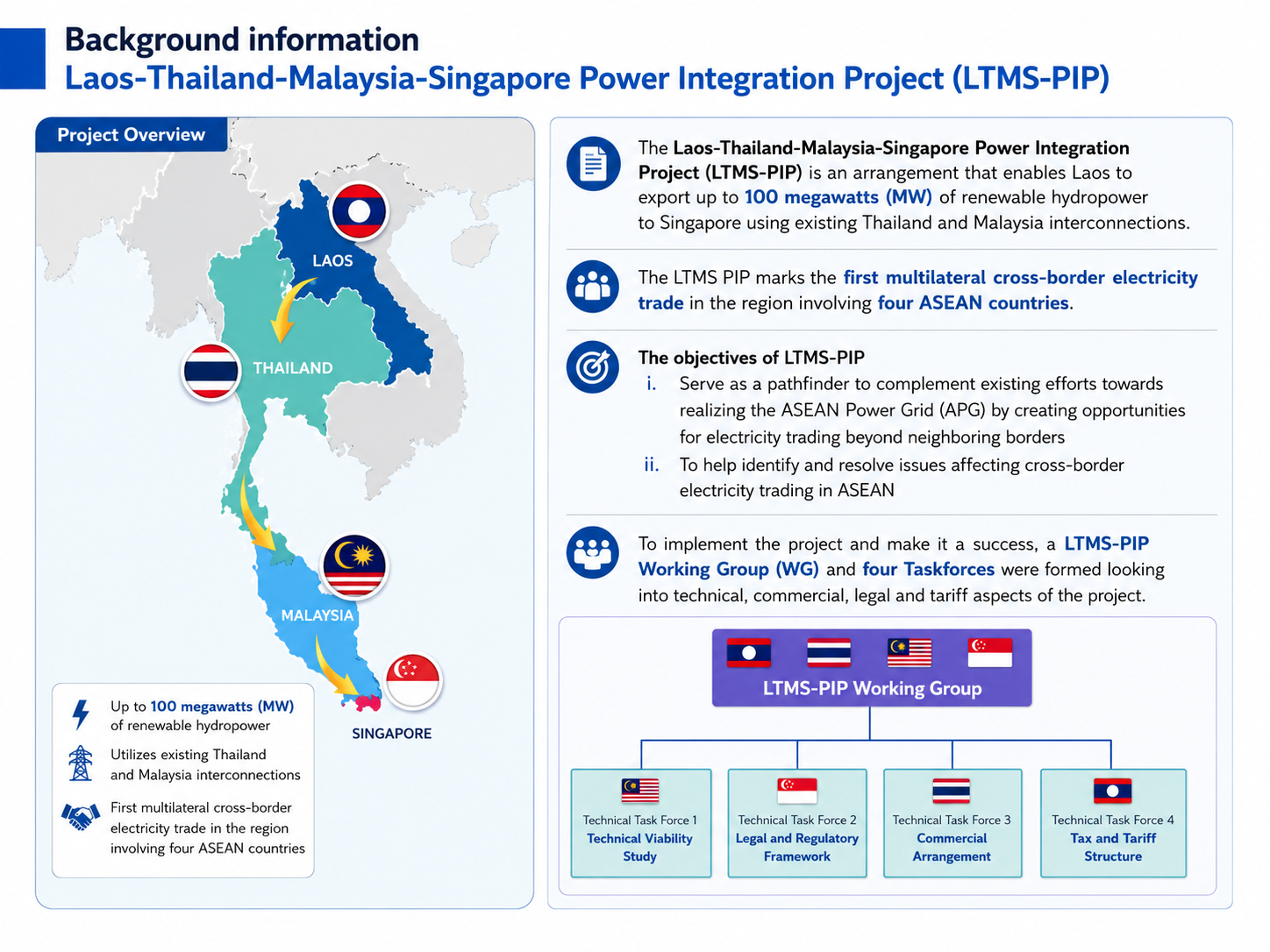
That moment marked the launch of the Laos-Thailand-Malaysia-Singapore Power Integration Project (LTMS-PIP), the first multilateral electricity trading initiative in Southeast Asia.
More importantly, it proved that one of Southeast Asia's most ambitious infrastructure visions, the ASEAN Power Grid (APG) was no longer just a blueprint.
A Vision Nearly Three Decades Old
ASEAN leaders first endorsed the APG in 1997 under the ASEAN Vision 2020, adopted at the Second ASEAN Informal Summit in Kuala Lumpur.
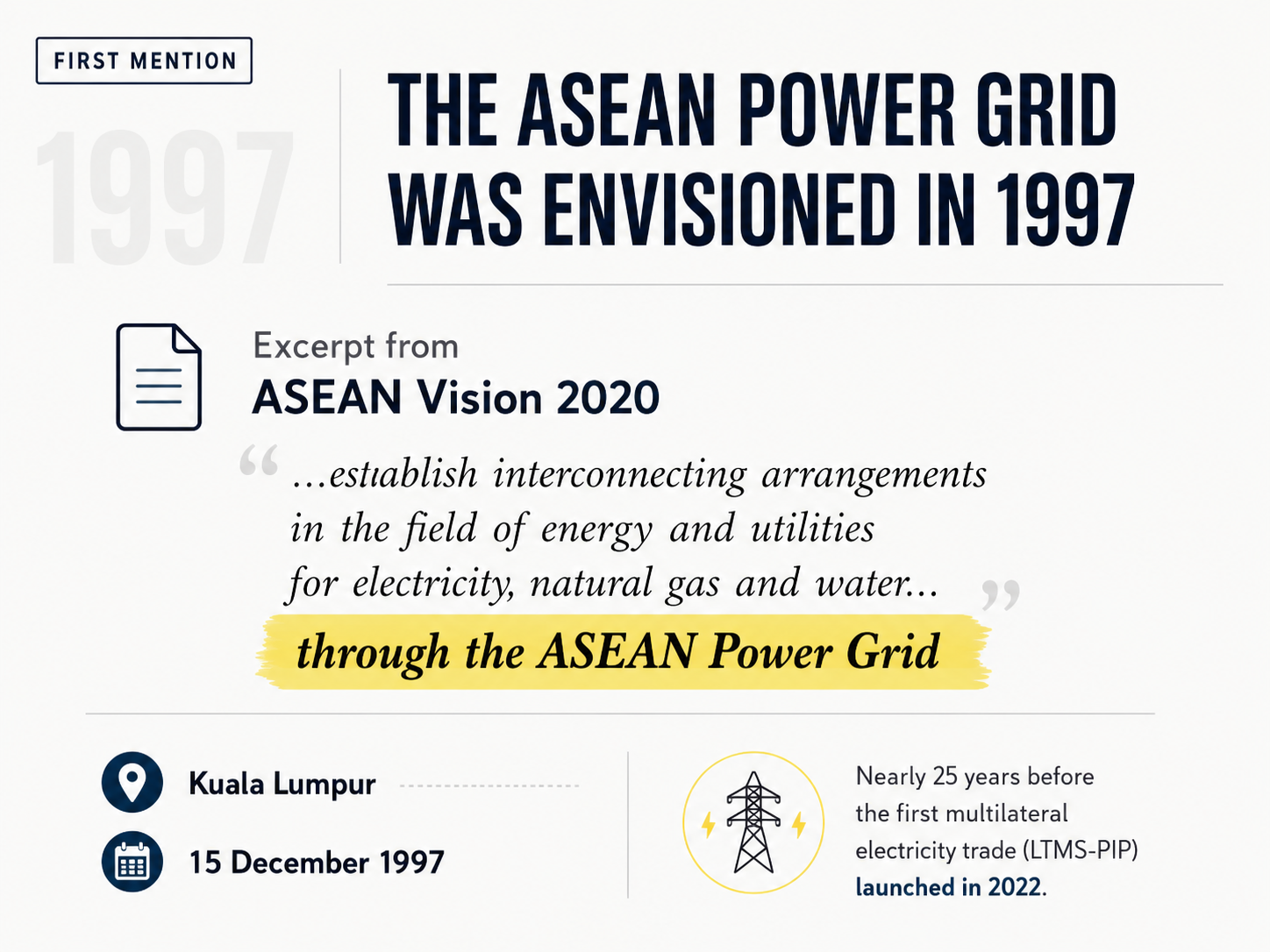
The goal was to eventually connect all ten member states' national grids to strengthen energy security and enable cross border electricity trade. Today, the APG remains a flagship initiative under the ASEAN Plan of Action for Energy Cooperation (APAEC) 2021-2025.
According to the ASEAN Centre for Energy, the regional master plan identifies 18 priority cross border interconnection projects stretching across Southeast Asia. As of December 2024, nine of those are fully operational, with a combined capacity of about 7.7 gigawatts (GW).
Most of these existing links, however, are bilateral rather than multilateral which is exactly why LTMS-PIP stands out.
Electricity Can Cross Borders Too
Most people assume electricity must be generated inside the country where it's used.
The APG works differently, whenever one country has surplus generation, it can trade that power to a neighbor that needs it, using existing transmission lines rather than building an entirely new network from scratch.
Since June 2022, LTMS-PIP has allowed up to 100 megawatts (MW) of hydropower from Laos to reach Singapore via Thailand and Malaysia, which act as "wheeling" countries that transmit the power through their own grids.
In September 2024, the project entered Phase 2, doubling capacity to 200 MW and introducing multidirectional trade, meaning Singapore can now also import directly from Malaysia, not just Laos.
To support this expansion, Singapore's Energy Market Authority (EMA) extended Keppel Electric's electricity importer licence for another two years, through 2026.
Different Countries, Different Advantage
The APG exists because Southeast Asia's energy resources are unevenly distributed.
Laos has rivers, Singapore doesn't. Laos has invested heavily in hydropower and produces more electricity than it consumes domestically, while Singapore has limited land area, leaving little room for large scale renewable projects like hydropower or utility scale solar.
Rather than trying to generate every kilowatt hour domestically, Singapore has chosen to diversify its electricity supply through imports. Its original target was 4 GW of low carbon electricity by 2035.
Strong interest from prospective suppliers led EMA to raise that target to around 6 GW, enough to meet roughly a third of the country's projected electricity demand.
Conditional approvals have already been issued for projects sourcing power from Australia, Cambodia, Indonesia, Sarawak (Malaysia), and Viet Nam.
Building a Regional Grid Isn't Easy
Connecting national electricity systems requires aligning technical standards, regulations, pricing, and energy policies, while investing billions of dollars in infrastructure and years of cross border coordination.
That complexity explains why most of today's nine operational interconnections remain concentrated in the Greater Mekong Subregion, where existing hydropower surpluses and adjoining grids make integration comparatively easier.
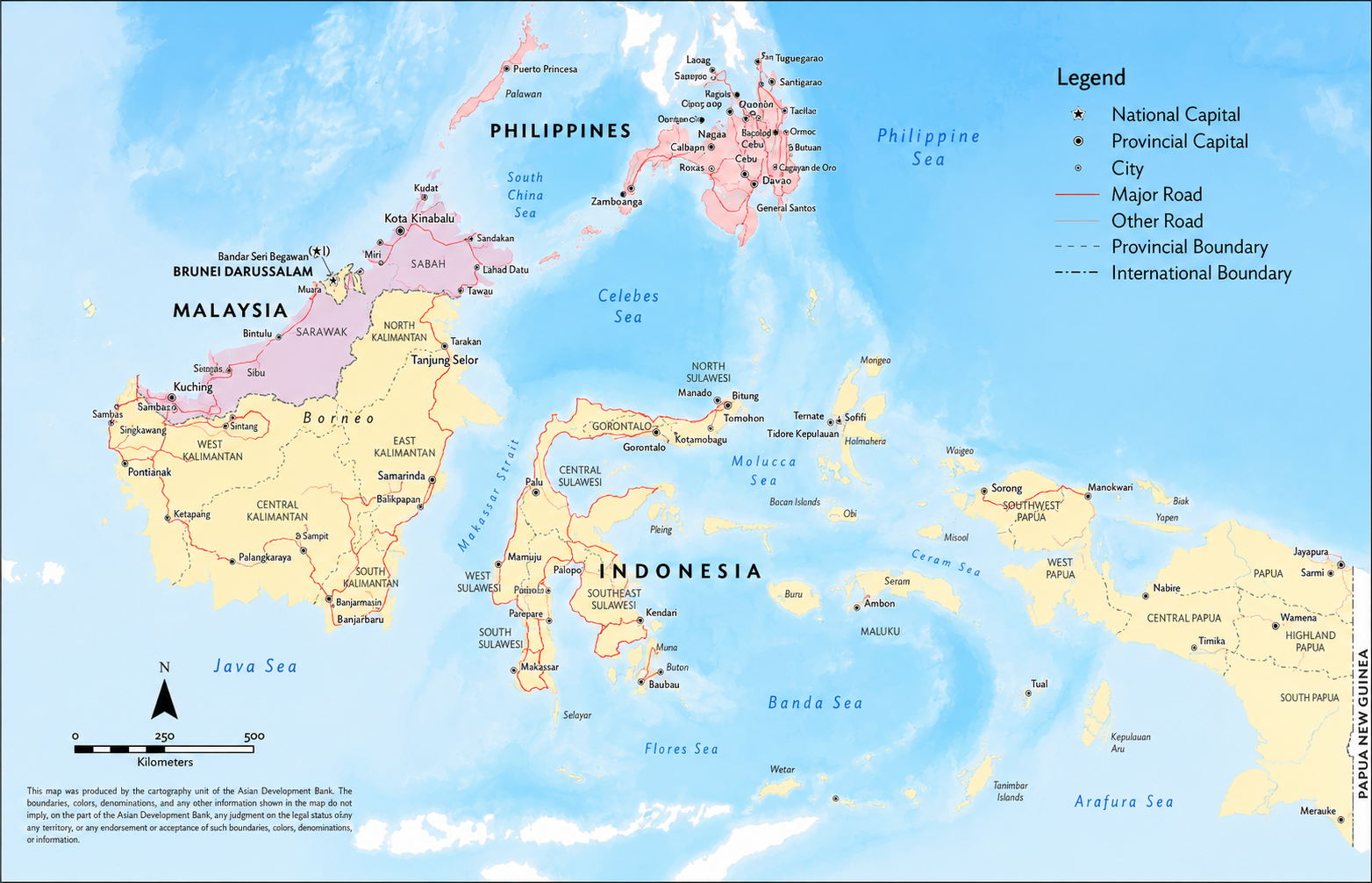
Elsewhere, momentum is building. The Brunei-Indonesia-Malaysia-Philippines Power Integration Project (BIMP-PIP) began taking shape from 2023 as a separate pilot studying multilateral trade among those four countries.
In October 2025, the World Bank and Asian Development Bank launched the ASEAN Power Grid Financing Initiative to help fund feasibility studies and project preparation for future interconnections.
ASEAN now targets full completion of its priority interconnection projects sometime around 2040-2045.
Connecting Southeast Asia
The APG isn't one giant power plant, nor a single transmission line between two neighbors. Its ambition is to link all ten Southeast Asia grids into one integrated network capable of moving electricity across borders wherever it's needed.
Nearly three decades after it was first proposed, that vision is no longer just summit talk. Cross border trade is already expanding as shown by LTMS-PIP's jump from a 100 MW pilot to a 200 MW multidirectional arrangement and additional interconnections continue to be developed.
One transmission line at a time, one of Southeast Asia's most ambitious infrastructure projects is gradually taking shape.