Singapore has never introduced a national minimum wage covering all workers.
The government has stated that a single nationwide wage floor may reduce employment opportunities for lower skilled workers by increasing labor costs across all industries. Instead, Singapore uses multiple policies to support wage growth while allowing wages to differ between industries and occupations.
This makes Singapore one of the few developed economies without a national minimum wage.
The Progressive Wage Model
Rather than applying one wage to every occupation, Singapore introduced the Progressive Wage Model (PWM) in 2012.
The model was first implemented in the cleaning sector before expanding to security, landscaping, lift and escalator maintenance, retail, food services, waste management, and occupational categories such as administrators and drivers.
Unlike a traditional minimum wage, the PWM links wages to skills, training, productivity, and career progression. Each covered sector has a wage ladder negotiated by the government, employers, and labor unions under the National Wages Council. Workers receive scheduled wage increases as they complete training requirements and move into higher skilled roles.
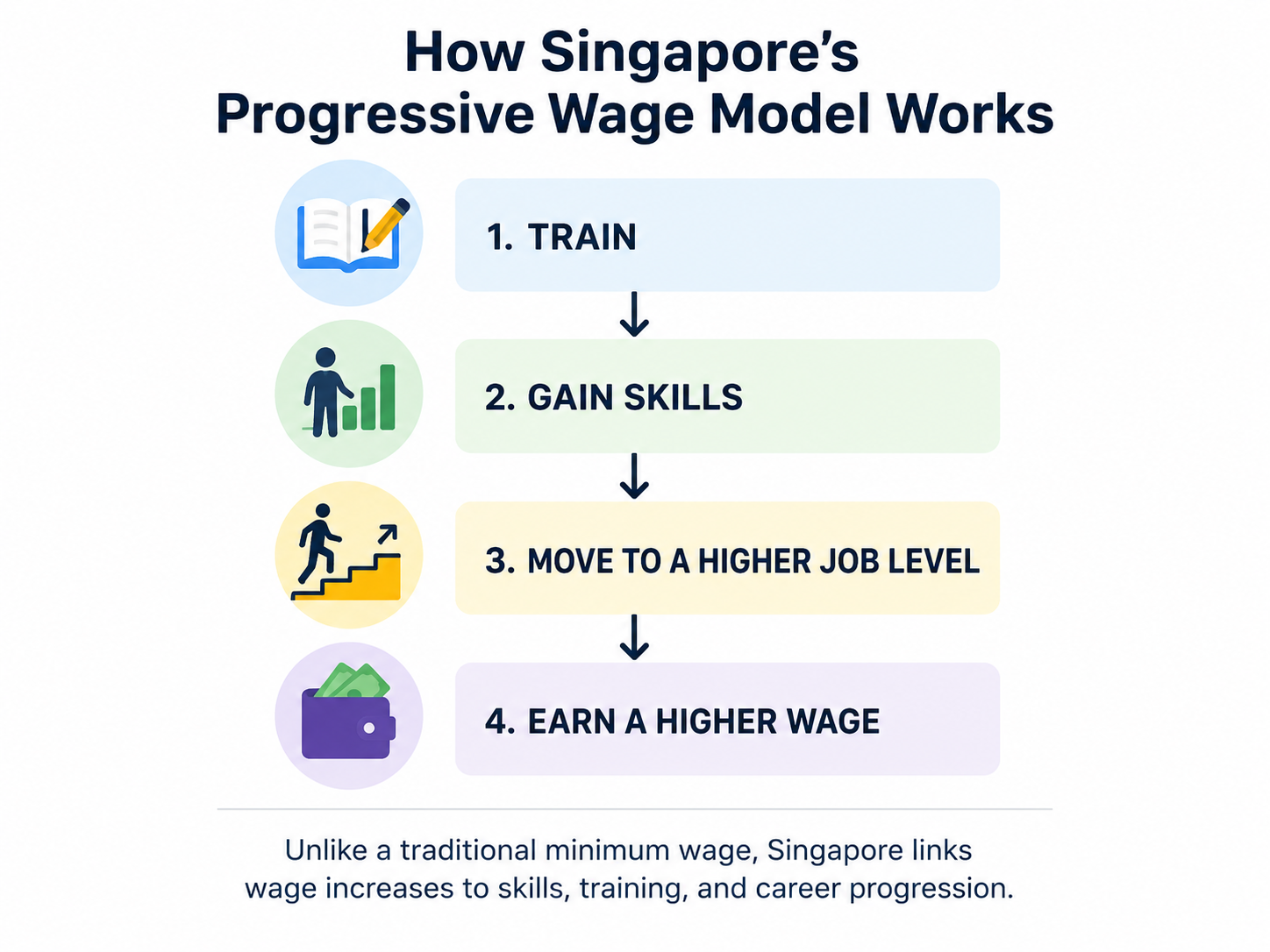
As of 2025, the PWM covers more than 155,000 full time lower wage workers across nine sectors and occupations, according to a Ministry of Manpower press release.
The scale of these wage increases varies by sector. In the security sector, basic wages rose from S$1,100 in 2016 to S$2,870 in 2025, with further increases planned to reach S$3,530 by 2028, according to the National Trades Union Congress (NTUC).
In the cleaning sector, basic wage requirements for general cleaners are set to rise 85 percent over six years, from S$1,312 in 2022 to S$2,420 in 2028, according to the Ministry of Manpower.
Another Wage Requirement Exists
Singapore also applies the Local Qualifying Salary (LQS).
The LQS is not a national minimum wage. Instead, it is the minimum monthly salary employers must pay local workers if they wish to count those employees toward hiring foreign workers under Singapore's work permit system.
The LQS has been raised several times, from S$1,000 to S$1,100 in 2017, to S$1,200 in 2018, to S$1,300 in 2019, and to S$1,400 from July 2020, according to the Ministry of Manpower.
From July 2024, it was raised to S$1,600 per month for full time local employees, or S$10.50 per hour for part-time workers. Following the Budget 2026 announcement, the LQS is rise again to S$1,800 per month, effective July 1, 2026.
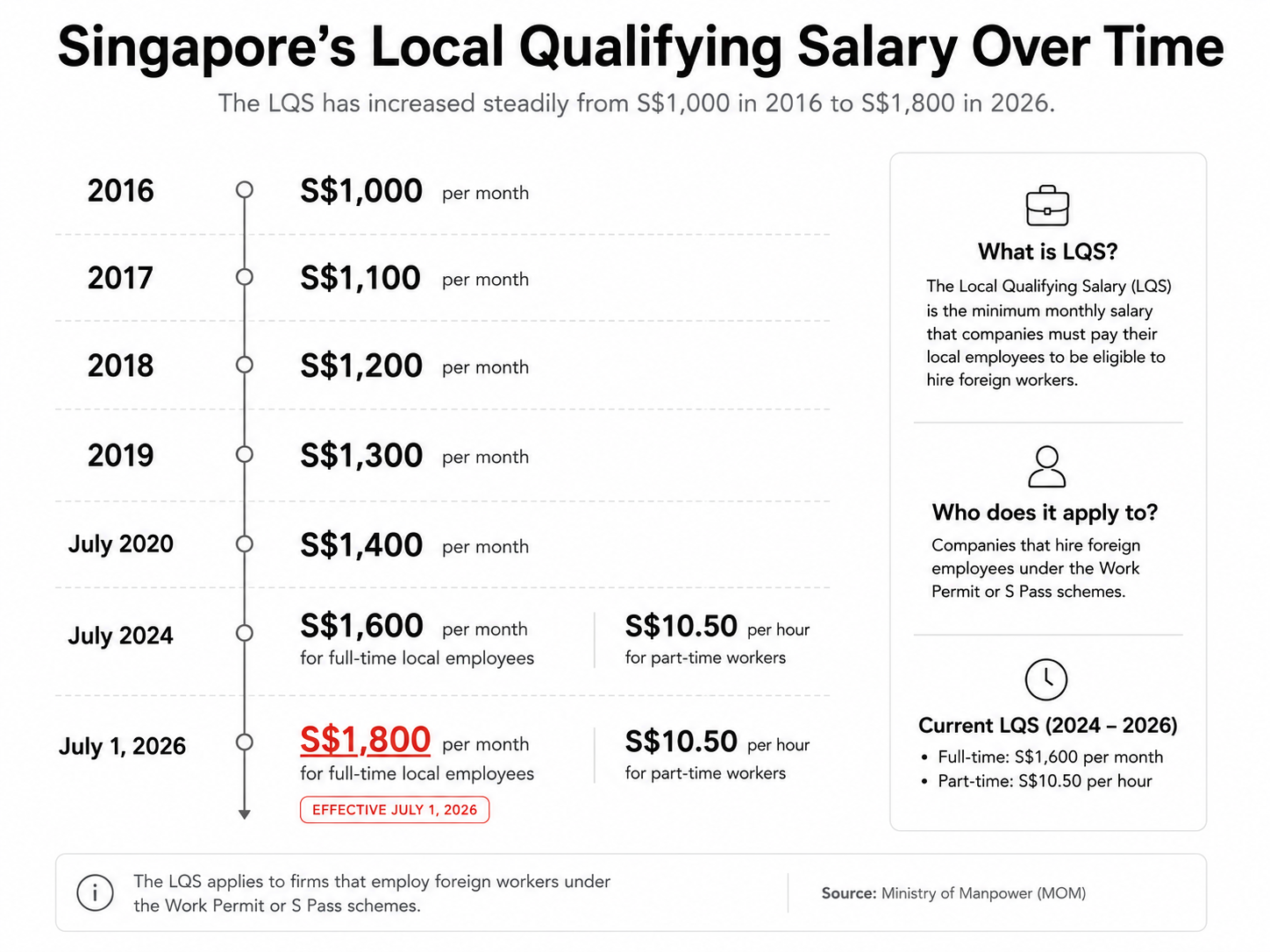
Although it does not apply to every employment relationship in the same way as a national minimum wage, the LQS influences wage practices across businesses that employ both local and foreign workers.
The Workfare Income Supplement
The government has also expanded the Workfare Income Supplement (WIS), a scheme providing cash payments and CPF contributions to eligible lower income workers.
From Work Year 2025, the enhanced Workfare scheme raises the maximum annual payout for employees from S$4,200 to S$4,900, depending on age, with the full amount available to employees aged 60 and above or persons with disabilities.
The monthly income eligibility ceiling was raised from S$2,500 to S$3,000, and the property annual value limit was raised from S$13,000 to S$21,000.
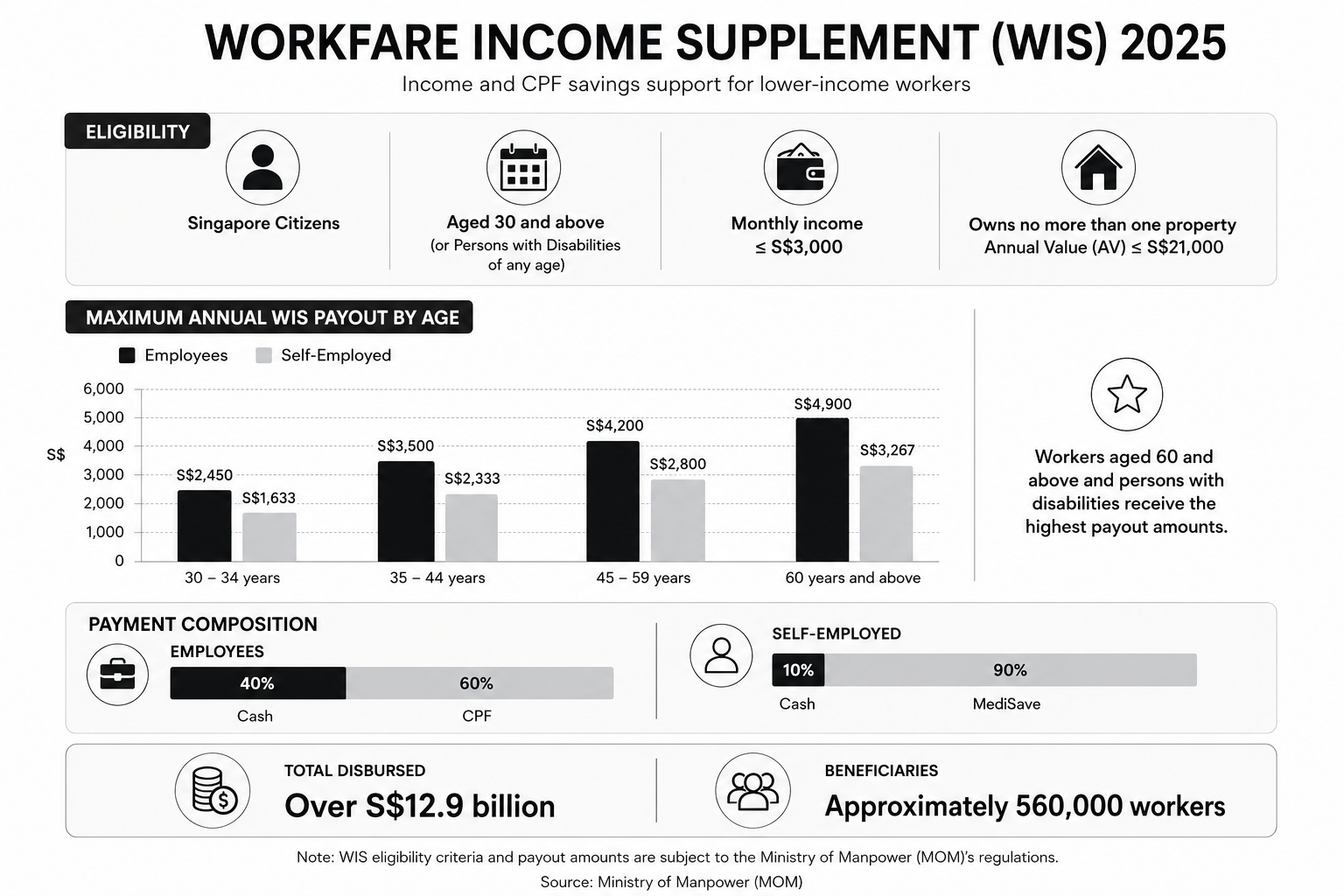
Self-employed persons and platform workers are eligible for a separate maximum annual payout of S$3,267 under the same enhanced scheme.
A Different Wage System
Singapore's wage policy does not rely on a single nationwide minimum wage.
Instead, it combines several mechanisms, including the Progressive Wage Model, the Local Qualifying Salary, the Workfare Income Supplement, and wage recommendations issued by the National Wages Council.
Together, these policies form Singapore's approach to wage regulation. Rather than applying one statutory minimum wage across every occupation, wage requirements vary according to industry, occupation, skills, and eligibility under individual government programmes.