


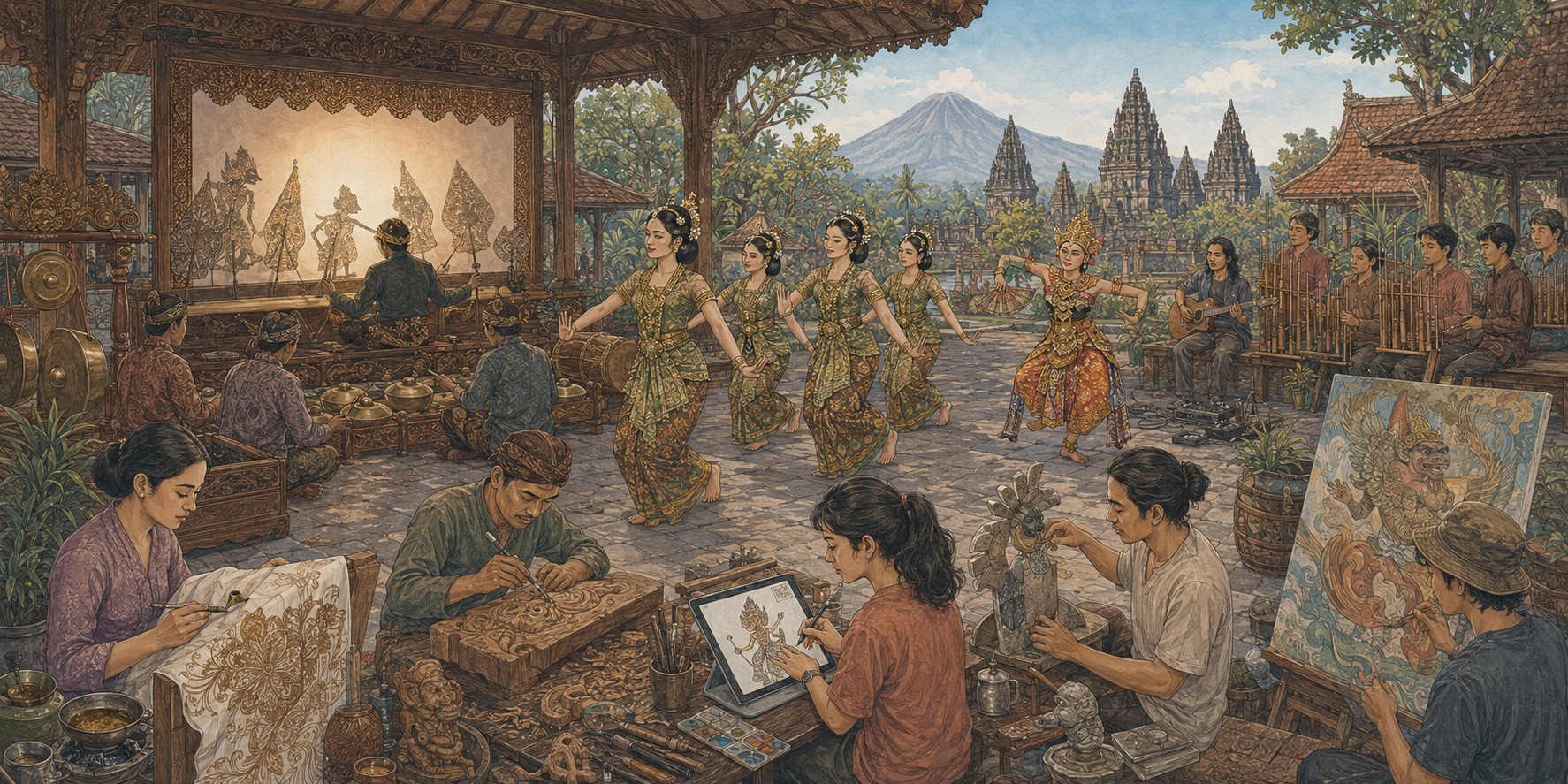
At dusk in Solo, a dalang brings leather figures to life against an illuminated screen. In Yogyakarta, young artists paint murals, build installations and turn neighbourhood studios into informal galleries. Farther east, Balinese dancers prepare for performances shaped by rituals older than the republic itself. Across Indonesia, heritage and experimentation are not competing forces; they are creating the country’s next cultural chapter together.
Traditions That Refuse to Stand Still
Indonesia’s traditional arts remain embedded in ceremonies, family histories and communal life. Wayang kulit combines storytelling, philosophy, humour and political commentary as a dalang manipulates intricately carved puppets to the sound of gamelan. The stories may originate in the Mahabharata and Ramayana, yet performers continually localise them through Javanese characters, contemporary jokes and observations about society.
Batik carries a similarly layered visual language. Motifs such as parang, kawung and mega mendung communicate regional identity, philosophy and social meaning rather than serving as decoration alone. Dance completes this living vocabulary, from the refined Bedhaya traditions of the Javanese courts and the precise expressions of Balinese Legong to the communal intensity of Kecak.
Wayang, batik and gamelan are recognised by UNESCO, but their strength comes from continued practice. As Solo gamelan master Ki Blacius Subono once said, “Gamelan is my soul.”
Yogyakarta Sets the Contemporary Tempo
Yogyakarta remains the beating heart of Indonesia’s contemporary art ecosystem. Affordable working spaces, the Indonesian Institute of the Arts and a strong culture of gotong royong allow established artists, students, curators and independent collectives to work within the same creative network.
Artists including Eko Nugroho, FX Harsono, Christine Ay Tjoe and Nyoman Masriadi have helped carry Indonesian perspectives into international museums, biennales and auction rooms. Their works draw from comic books, street imagery, family memory, political history and traditional symbolism without being confined by expectations of what “Indonesian art” should look like.
ARTJOG reinforces the city’s international position. Running at the Jogja National Museum from June 19 to August 30, ARTJOG 2026 presents ARS LONGA: GENERATIO, opening an intergenerational conversation about art’s changing social role.
Public Spaces Find a Creative Voice
Indonesia’s art movement does not end at gallery doors. Murals across Jakarta, Bandung and Yogyakarta transform walls into public conversations about corruption, inequality, environmental damage, urban pressure and local identity. Their messages often combine folklore and regional patterns with graffiti, illustration and popular culture.
Yogyakarta collective Taring Padi has taken this community-centred approach from neighbourhood workshops to international exhibitions through large woodblock prints, banners and cardboard puppets. Performance artist Arahmaiani follows a similarly participatory philosophy. “My art must do its part to encourage and empower communities,” she has said.
Such practices reflect a distinctly Indonesian understanding of creativity: art is not simply an individual product but a process of gathering, questioning and working together.
Traditional Sounds Enter the Digital Era
A younger generation is carrying local sound into global digital spaces. Creators such as Alffy Rev combine electronic music, cinematic imagery, regional languages and instruments including gamelan and angklung. Rather than treating tradition as something fragile, they present it as material for bold experimentation.
Indie musicians and ethnic-jazz ensembles are also mixing regional scales with rock, jazz and electronic production. Festivals, streaming platforms and short-form video now allow music rooted in Java, Bali, Sumatra or eastern Indonesia to reach listeners far beyond its place of origin.
A Creative Economy Gains New Scale
Indonesia’s wider creative economy—not fine art alone—contributed Rp1,611.2 trillion, or 7.28 percent of national GDP, in 2024. In 2025, the sector grew by 6.86 percent, generated US$31.94 billion in exports and supported more than 27 million workers. These figures show the expanding infrastructure around artists, musicians, designers, craftspeople and digital creators.
Travellers can experience that ecosystem in Ubud’s museums and workshops, Yogyakarta’s studios, Bandung’s Selasar Sunaryo Art Space and Jakarta’s revitalised Taman Ismail Marzuki. Each destination offers a different window into a national scene connected by experimentation and cultural confidence.
Indonesia’s creative strength lies in its ability to move forward without cutting itself off from the past. From wax-drawn batik lines to digital animation, its artists continue turning extraordinary diversity into a shared and constantly evolving cultural language.


