


On August 24, the International Day of National Parks draws attention to Southeast Asia’s most valuable natural strongholds. From ancient rainforests and volcanic islands to peat swamps, mangroves and coral reefs, these protected landscapes support extraordinary wildlife while providing water, food, climate protection and livelihoods for millions of people.
A Regional Network Grows Stronger
Although ASEAN occupies just over three percent of the world’s land area, it contains more than a quarter of the planet’s known plant and animal species. National parks and protected areas form the backbone of efforts to keep this biological richness intact.
The ASEAN Heritage Parks Programme connects the region’s most ecologically important protected areas through shared standards, training and scientific cooperation. Following the addition of six parks from Malaysia and Viet Nam in 2025, the network now comprises 69 sites covering approximately 11.87 million hectares of legally protected terrestrial, wetland and marine ecosystems.
The latest additions include Malaysia’s Bako and Lambir Hills national parks and Viet Nam’s Pu Mat and Xuan Thuy national parks. Their inclusion reflects a conservation system broad enough to protect everything from dipterocarp rainforests and limestone habitats to migratory-bird wetlands.
ASEAN Centre for Biodiversity Executive Director Dr Jerome Montemayor describes these sites as “actual on-the-ground laboratories for ecological restoration, climate resilience and sustainable livelihoods.”
Rainforests, Dragons and Living Reefs
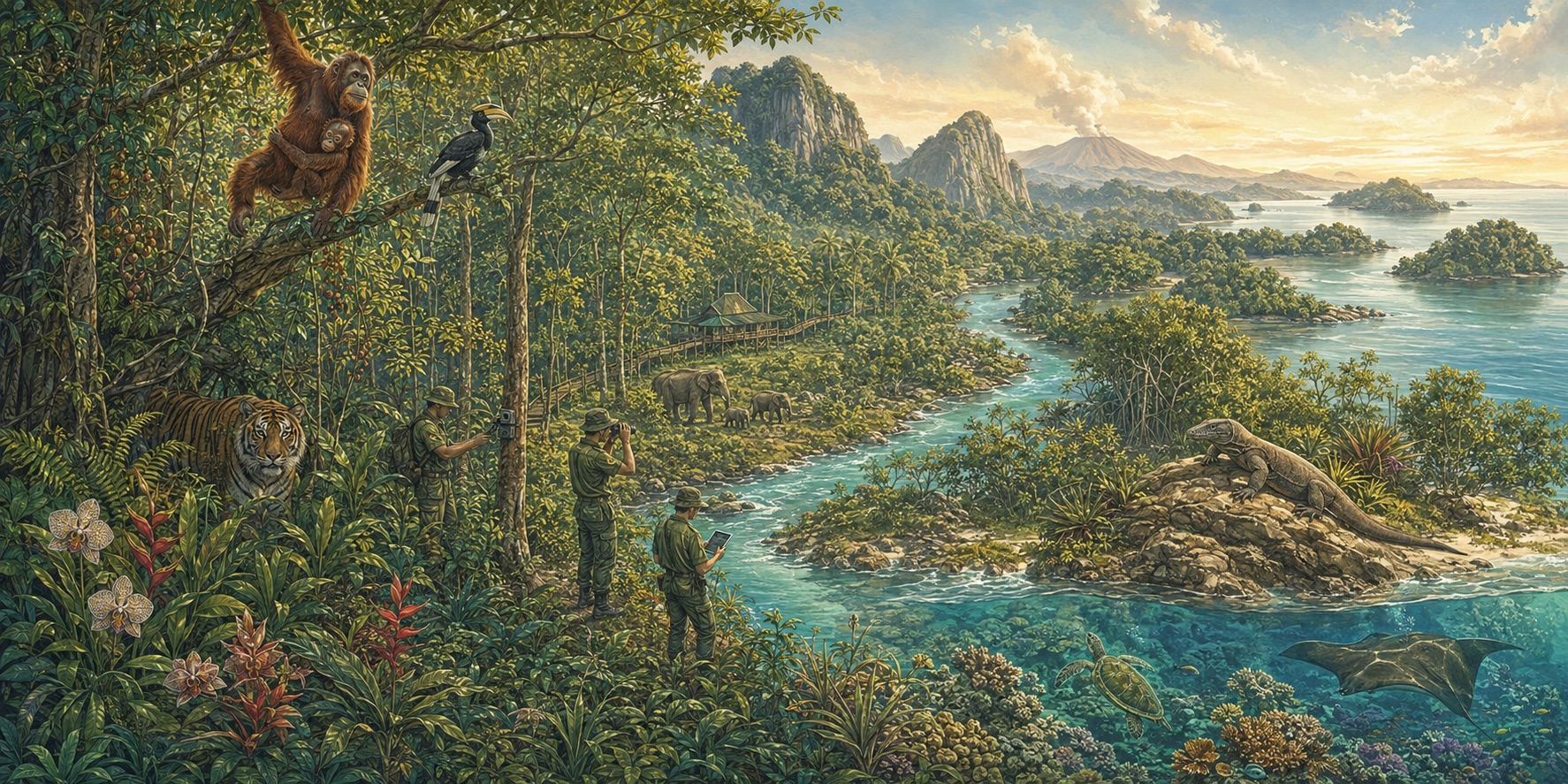
Gunung Leuser National Park in Indonesia remains one of ASEAN’s most important wildlife refuges. Forming part of the Tropical Rainforest Heritage of Sumatra, its wider landscape is the last place where Sumatran orangutans, tigers, elephants and rhinoceroses still coexist.
In Peninsular Malaysia, Taman Negara protects a rainforest estimated to be approximately 130 million years old. Its river systems, caves and suspended canopy walkway offer visitors access to an ecosystem that has survived dramatic geological and climatic changes.
Farther east, Komodo National Park combines rugged volcanic islands with seagrass beds, coral reefs and open ocean. While the Komodo dragon is its best-known resident, the park’s waters also support manta rays, sea turtles and diverse reef species.
National parks therefore operate as interconnected life-support systems. Forests store carbon and regulate watersheds, mangroves reduce coastal erosion, while marine parks protect breeding grounds essential to regional fisheries.
Protection Must Extend Beyond the Map
Legal designation alone cannot guarantee ecological security. Some protected areas continue to face illegal logging, mining, wildlife trafficking and agricultural encroachment because budgets, ranger numbers and monitoring capacity remain inadequate.
Infrastructure built near park boundaries can divide migration routes and push elephants, tigers and other animals toward settlements. Tourism adds another challenge when unmanaged crowds, plastic waste, trail erosion and irresponsible wildlife encounters overwhelm sensitive locations.
The region also continues to lose forests. Official ASEAN figures show that forest covered roughly 47 percent of its land area in 2020, but around 8,000 square kilometres disappeared annually between 2000 and 2020.
Former ASEAN Centre for Biodiversity Executive Director Dr Theresa Mundita Lim emphasized that “more than the quantity, we give value to the quality of the ASEAN Heritage Parks.” Her warning addresses the difference between declaring protected areas and managing them effectively.
Communities and Technology Build Stronger Parks
A new generation of park management increasingly recognizes Indigenous Peoples and neighbouring communities as conservation partners. Local residents are being employed as rangers, wildlife monitors, trekking guides and restoration workers, turning traditional knowledge into a practical component of park protection.
Community-led tourism around Gunung Leuser, Thailand’s protected forests and Philippine marine parks can provide alternatives to logging, poaching and destructive fishing. However, revenue must reach local households fairly if conservation is expected to retain public support.
Technology is also expanding the reach of understaffed ranger teams. Satellite imagery can detect forest clearing, drones can survey inaccessible terrain, camera traps document rare wildlife and acoustic sensors identify chainsaws or gunshots. Digital reporting systems help field teams share evidence with enforcement agencies more quickly.
Visitors have responsibilities too. Choosing licensed guides, remaining on marked trails, refusing wildlife contact, avoiding single-use plastics and carrying waste out of parks reduce tourism’s ecological footprint.
Southeast Asia’s national parks are not scenery preserved behind entrance gates. They are active climate infrastructure, wildlife refuges and living cultural landscapes. Their future will depend on strong enforcement, reliable financing and communities empowered to become long-term guardians of the region’s natural heritage.


