


In Bagan, a lacquer bowl may pass through an artisan’s hands for six months before it is complete. Near Mandalay, marble carvers slowly reveal serene Buddha images from white stone. In Yangon, artists continue transforming memory, uncertainty and everyday life into paintings, photographs and performances. Across Myanmar, creativity remains both an inheritance and a way of enduring change.
The Ten Flowers Continue to Bloom
Myanmar’s traditional crafts are collectively associated with the Pan Ten Myo, or Ten Flowers, a historic classification encompassing painting, sculpture, masonry, woodturning, metalwork and lacquerware.
Bagan remains the centre of pan yun, the art of building lacquer objects from bamboo, wood or finely woven horsehair. Artisans repeatedly coat each form with thit-si tree sap before polishing, engraving and colouring images inspired by Buddhist Jataka stories, palace life and the Burmese zodiac.
Around Mandalay’s Kyauk Sit Tan, commonly called Marble Street, sculptors carve Buddha images from blocks of white marble. Other neighbourhood workshops produce bronze figures, embroidered kalaga tapestries and sheets of gold leaf beaten by hand for devotees to apply at pagodas.
These crafts are not simply decorative industries. They sustain family workshops, religious practices and knowledge transmitted through apprenticeships.
Puppets Keep Royal Stories Moving
Yoke Thé marionette theatre was once a celebrated form of royal-court entertainment. A traditional repertoire draws upon 28 character types, including kings, ministers, animals, alchemists and nat spirits. Puppeteers manipulate their strings while singers and musicians provide dialogue, percussion and melodies.
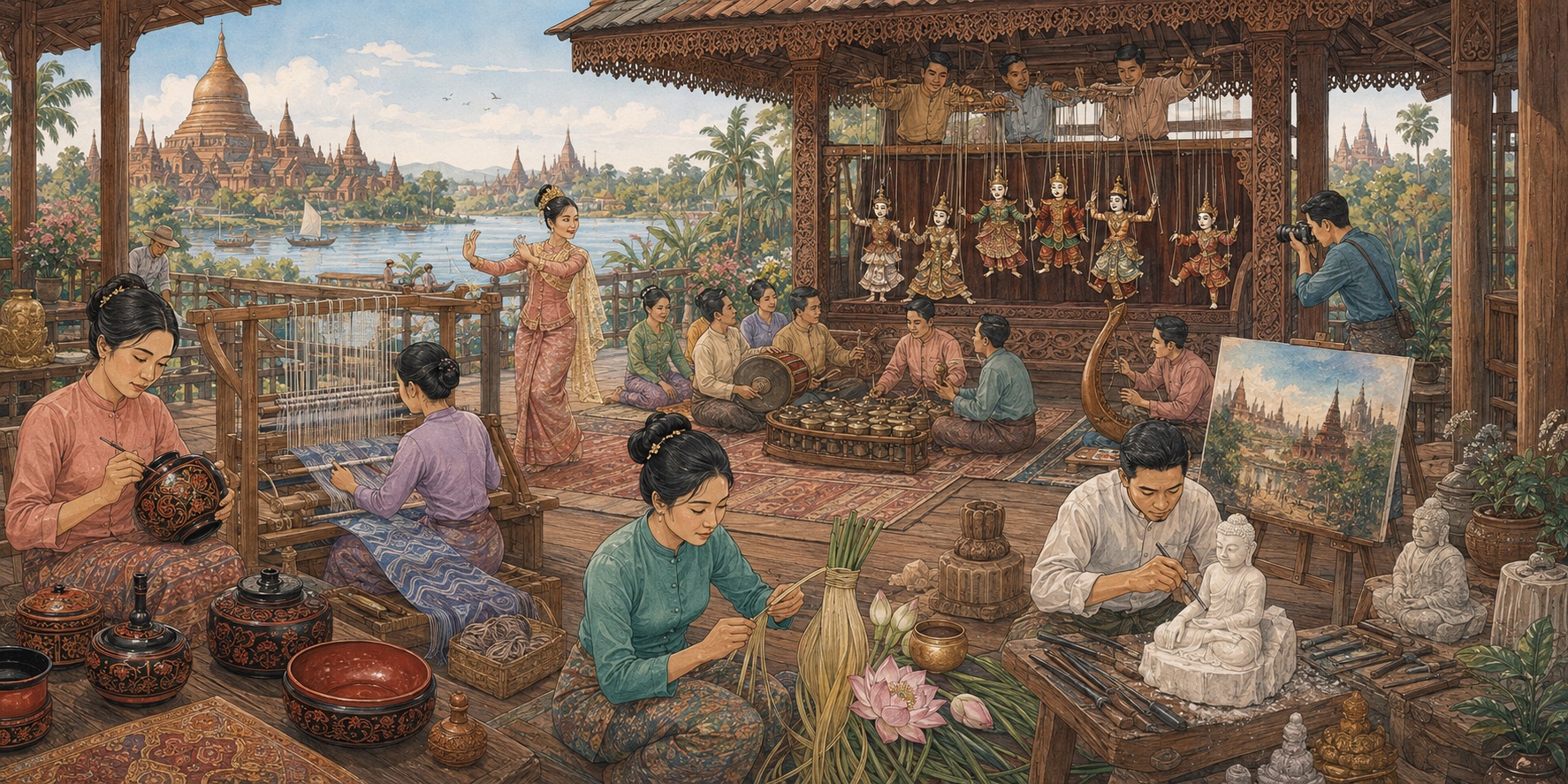
The performances retell Buddhist legends and court stories while creating space for humour and social commentary. Anyeint offers a livelier counterpart, combining a lead female dancer with music and comedians known as lu shwin daw. Their playful exchanges turn daily frustrations and familiar personalities into accessible public theatre.
Royal Textiles Find New Generations
In Amarapura, luntaya acheik weaving produces the flowing wave patterns historically worn by members of the royal court. The name is commonly translated as “a hundred shuttles,” reflecting a demanding process in which several artisans may work together on one loom.
On Inle Lake, lotus-fibre weaving begins by gently pulling delicate filaments from freshly cut stems. The fibres are rolled into thread before being woven into lightweight cloth traditionally used for sacred robes. Cotton and silk are often added to make contemporary scarves and garments more affordable.
These textiles connect artistic beauty with local landscapes. Acheik reflects palace heritage, while lotus cloth carries the physical character of the wetlands from which it emerges.
Yangon’s Artists Reframe the Present
Myanmar painting developed from temple murals and manuscript illustration before colonial art schools introduced realism, watercolour and Western perspective. Contemporary artists have since combined these influences with abstraction, installation, performance and photography.
Pansodan Gallery, founded in Yangon in 2008, became an important meeting point for artists, writers and researchers while building an archive of paintings, photographs, magazines and printed materials. Artists including Aung Myint, Po Po, Nge Lay and Moe Satt have helped position Myanmar within wider conversations about Southeast Asian contemporary art.
Since the 2021 military takeover, artists have faced intensified censorship, detention, displacement and financial hardship. Their creative networks increasingly operate through small gatherings, international exhibitions and digital platforms.
Painter and performance artist Htein Lin produced around 1,000 paintings and drawings while imprisoned from 1998 to 2004, using uniforms as canvases and improvised objects as tools. About 230 works survive. Recalling that experience, he said, “Making art made me feel completely free.”
Cultural Preservation Finds New Pathways
Craft organisations are helping traditional workshops reach contemporary markets. Turquoise Mountain, active in Myanmar since 2014, reports supporting approximately 2,000 artisans across textiles, jewellery, goldsmithing and lacquerware. Its recent work has included reconnecting Bagan lacquer workshops with designers and international buyers as tourism and domestic instability affect livelihoods.
A younger generation is also documenting heritage through accessible technology. Photographer Aung Chan Thar has organised conservation-photography activities for Myanmar youth while recording weaving and daily life around Inle Lake. He explained, “I wanted to show that Myanmar people strive to be productive even in the most difficult times.”
For culturally minded travellers and researchers, Bagan, Mandalay, Amarapura and Inle Lake reveal how art remains embedded in community life. Supporting reputable workshops and buying directly from documented artisans can help sustain skills whose production requires extraordinary time and patience.
Myanmar’s arts scene cannot be separated from the country’s present challenges, but neither can it be reduced to them. Through lacquer, marble, silk, puppetry and contemporary art, its creators continue turning inherited knowledge into expressions of dignity, imagination and hope.


