


In Singapore, art rarely stays inside a gallery. It illuminates civic monuments, appears between MRT announcements, fills former military barracks and gives new energy to historic neighborhoods. Supported by major cultural institutions yet shaped by independent voices, the city-state has built one of Southeast Asia’s most connected creative ecosystems.
A Regional Art Market with Global Reach
At the center of Singapore’s visual arts landscape stands the National Gallery Singapore. Occupying the restored former City Hall and Supreme Court, the institution holds the world’s largest public collection of modern Southeast Asian art. Its exhibitions place Singaporean artists within wider regional histories of colonialism, independence, migration and social change.
Every January, that institutional strength expands across the city during Singapore Art Week. Museums, galleries, independent spaces and public venues present exhibitions, installations, performances and discussions, while ART SG connects Southeast Asian artists with international collectors.
The fourth ART SG in January 2026 welcomed more than 43,000 visitors and brought together over 100 exhibitors from more than 30 countries and territories. Its expanding programme included film, performance, large-scale installations and a new prize for emerging artists, reinforcing Singapore’s role as a meeting point for regional and global art networks.
Technology Turns the City into a Canvas
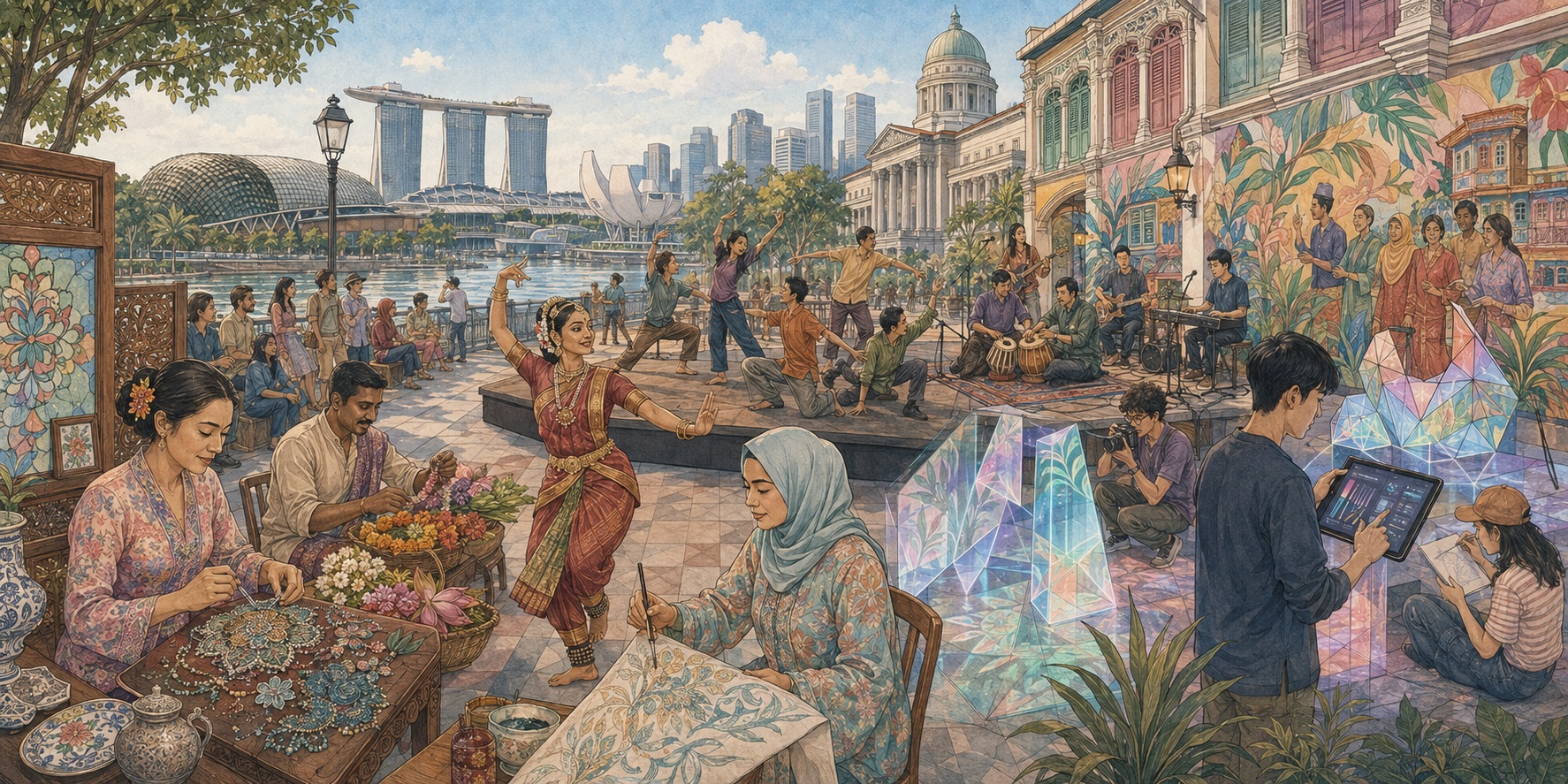
Singapore’s futuristic architecture provides an ideal stage for digital creativity. At Marina Bay, the lotus-shaped ArtScience Museum brings art, science and technology together through interactive exhibitions. Its long-running Future World experience allows projected flowers, cities and aquatic creatures to respond to visitors’ movement and touch.
Across the Civic District, the Light to Night festival transforms historic facades into animated canvases. Projection mapping, sound and participatory installations allow familiar landmarks to be reinterpreted after dark, making contemporary art accessible beyond conventional exhibition spaces.
This approach appears to be building audiences. The National Arts Council’s 2023 survey found that 79 percent of respondents had attended the arts physically or digitally. Physical attendance reached 59 percent, digital consumption stood at 66 percent and participation increased to 28 percent.
Heritage Finds New Life in the Neighborhoods
Singapore’s creativity is equally visible at street level. In Katong and Joo Chiat, pastel Peranakan shophouses provide a living setting for Nyonya beadwork, porcelain, embroidery and sarong kebaya craftsmanship. Kampong Gelam’s murals combine Malay heritage with contemporary graffiti, while Little India remains animated by textile shops, temple sculpture, garland-making and classical performance traditions.
Tiong Bahru has developed a quieter literary personality through independent bookstores, design studios and community events. Singaporean poetry has also entered everyday spaces through Poems on the MRT, which places writing in English, Chinese, Malay and Tamil across several train lines.
Poet and former Singapore Writers Festival director Pooja Nansi captures the importance of grounding creativity in lived experience: “I’ve always believed that the most profound art comes from the deeply personal.”
Diverse Stages Build a Shared Cultural Voice
At Esplanade – Theatres on the Bay, international productions share the calendar with Singaporean and regional voices. Festivals such as Pesta Raya and Kalaa Utsavam provide prominent platforms for Malay and Indian performing arts, while Chinese-language theater, contemporary dance, orchestral music and experimental performance broaden the programme.
Independent companies including Wild Rice and Pangdemonium explore family, identity, inequality, technology and the pressures of urban life. Their productions demonstrate that Singaporean theater can be polished without losing its capacity to question.
Demand for live performance has risen strongly. Singapore recorded more than 3.23 million ticket sales for performing arts and entertainment events in 2024, with gross takings reaching S$565.4 million. Non-ticketed in-person attendance at arts and heritage events approached 8.91 million.
Theater director and 2025 Cultural Medallion recipient Goh Boon Teck offers a fitting reflection on sustaining creative work: “These mistakes build the foundation. So perseverance is the most important thing.”
Independent Energy Keeps the Scene Moving
Gillman Barracks, Aliwal Arts Centre and the Bras Basah.Bugis district extend discovery beyond Singapore’s headline institutions. Galleries occupy former military buildings, street dancers rehearse beside heritage streets and students at LASALLE experiment with performance, film and digital media.
Space and operating costs remain challenges in a compact city, making sustained support for independent artists essential. Yet Singapore’s creative strength lies precisely in this combination of infrastructure and experimentation—where heritage is protected, technology remains playful and artists continue finding new ways to speak to the city and the world.


