


Along the Kinabatangan River in Sabah, across Sumatra’s plantation edges and beside farms bordering Thailand’s forests, elephants regularly cross boundaries they cannot see. Their journeys reveal the central challenge behind World Elephant Day on August 12: Southeast Asia must conserve more than individual animals. It must protect connected landscapes where elephants and people can live safely together.
Sacred Giants Facing a Modern Squeeze
Elephants have shaped Southeast Asia’s identity for centuries. Laos remembers the kingdom of Lane Xang, the “Land of a Million Elephants,” while rare white elephants remain symbols of sovereignty and good fortune in Thailand and Myanmar. At Angkor, Borobudur and other sacred sites, carved elephants connect royal history with Buddhist and Hindu traditions.
Cultural reverence, however, has not guaranteed survival. Fewer than 50,000 Asian elephants remain in the wild across 13 countries. WWF estimates that only about 8,000 to 11,000 survive across Southeast Asia and China, occupying a fraction of their former range. Vietnam’s wild population has fallen to little more than 100, while the Sumatran elephant is classified as Critically Endangered.
Forests Follow Their Footsteps
Elephants are not simply residents of tropical forests; they help build them. A herd consumes vegetation, opens pathways, carries nutrients and disperses seeds over long distances. Those movements create habitat for smaller animals and support the regeneration of large forest trees. Protecting elephants consequently safeguards water, carbon storage and biodiversity far beyond the species itself.
The difficulty is that about 70 percent of Asia’s remaining elephants live outside protected areas. Roads, railways, mines, settlements and plantations increasingly divide their routes. When animals enter farms in search of food, families may lose crops or property overnight, while elephants face poisoning, electrocution, vehicle collisions or retaliatory killing.
Indonesia’s Elephant Conservation Forum chairman Donny Gunaryadi captures the planning problem clearly: “The elephant knows no concession boundaries.” Corridors must therefore continue through production forests, plantations and community land rather than ending at park borders.
Coexistence Moves to the Frontline
In Sumatra, conservation response units combine community reports, patrols and trained elephants to guide wild herds away from villages. In South Sumatra’s Padang Sugihan landscape, government agencies, researchers and companies have mapped movement routes through acacia concessions and explored crossings that allow elephants to move without colliding with vehicles or industrial activity.
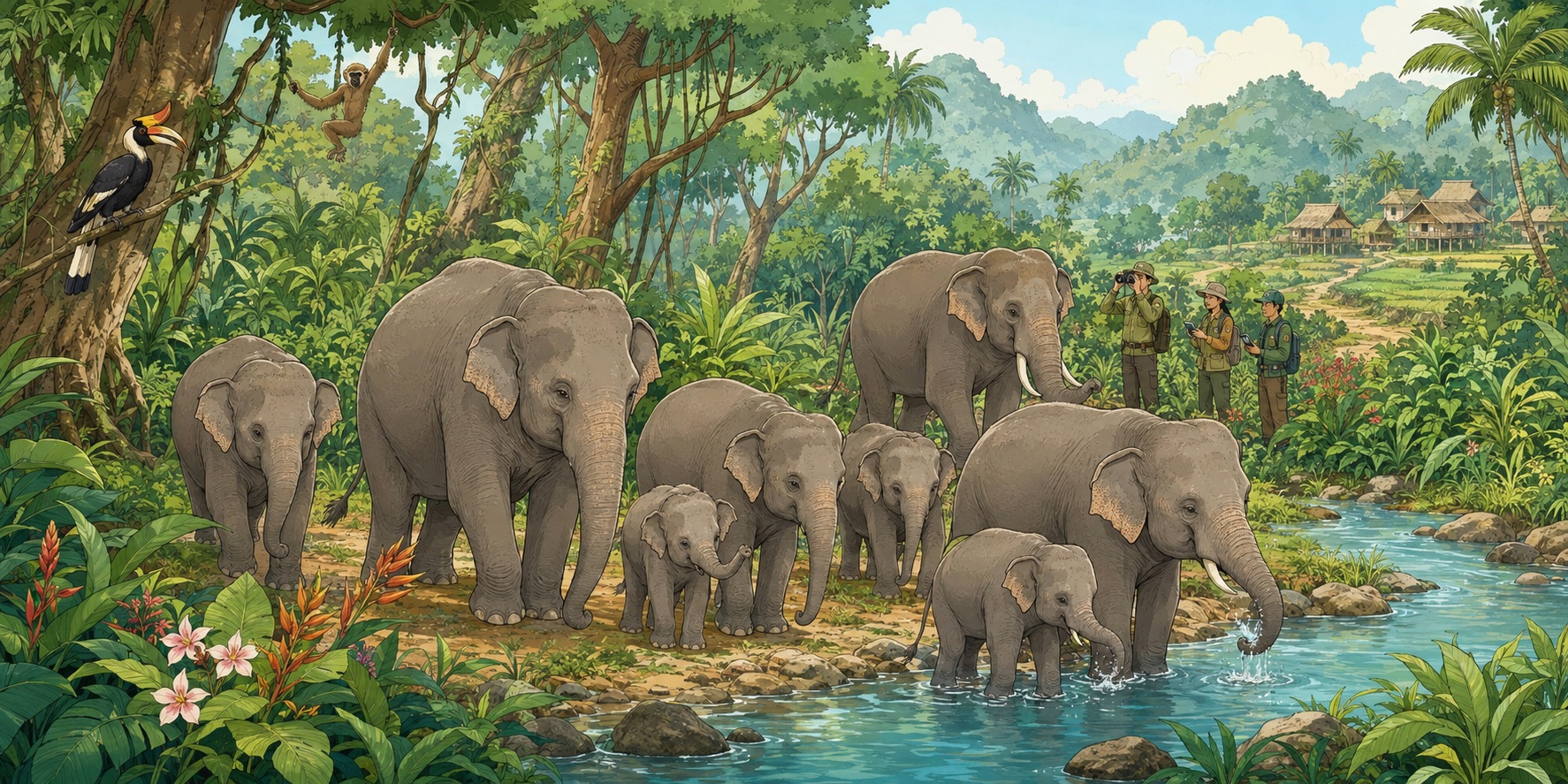
Sabah presents another urgent test. The IUCN’s first assessment of the Bornean elephant as a distinct subspecies estimated only about 1,000 animals remain in the wild. Habitat loss, agrochemicals and the Pan Borneo Highway add pressure to already fragmented herds. Yet local groups are using GPS collars, community wardens and dialogue with plantations to identify corridors and reduce conflict.
Augustine Tuuga, director of the Sabah Wildlife Department and an Asian Elephant Specialist Group member, said, “The last two decades have seen extensive efforts both to understand and to conserve Bornean elephants.” Turning that knowledge into land-use decisions is now the priority.
Tourism Learns to Step Back
Captive-elephant tourism remains the region’s most visible ethical debate. A 2026 assessment covering 2,849 elephants at 236 tourism venues in Thailand found nearly two-thirds living in poor conditions. Although the proportion used for rides fell from 92 percent in 2010 to 43 percent in 2024, washing, feeding and close-contact activities have expanded.
For travelers, “sanctuary” is not proof of good welfare. Responsible venues prioritize observation from a respectful distance, natural foraging, social contact between elephants, qualified veterinary care and humane working conditions for mahouts. Tourism can still support local livelihoods, but the animals—not visitor photographs—must determine the experience.
A Future Shared Across the Landscape
Southeast Asia does not need to choose between elephants and development. It needs better development: connected forests, wildlife-sensitive infrastructure, rapid-response teams, fair assistance for affected farmers and tourism that rewards protection rather than performance.
World Elephant Day offers a simple measure of progress. If elephants still have room to move, communities have the tools to coexist with them and travelers are willing to watch without touching, the region’s sacred giants can remain part of Southeast Asia’s living future—not only its ancient memory.


