You can manufacture a smartphone in Vietnam, assemble a laptop in China, build a car in Germany, or produce a server in the United States. But somewhere deep inside many of those products, the most important component may have been manufactured in Taiwan.
That component is the semiconductor.
A smartphone needs processors and memory. A modern car can contain dozens of chips. Servers require powerful processors and accelerators. The same supply chain runs through products made across different continents, and Taiwan sits at one of its most important semiconductor manufacturing.
Taiwan Semiconductor Industry is Unique
Taiwan is not the world's only semiconductor producer. South Korea dominates memory chips, the US leads much of chip design, Japan supplies critical materials and equipment, and China has a growing manufacturing industry.
Taiwan's semiconductor industry is different because of its position in contract manufacturing. Companies around the world can design their own chips and send those designs to Taiwanese foundries for mass production.
It is home to Taiwan Semiconductor Manufacturing Company (TSMC), the world's largest contract chipmaker. In the fourth quarter of 2025, TSMC accounted for 70.4% of global foundry revenue, compared with 7.1% for Samsung Foundry, according to TrendForce.
A foundry manufactures chips designed by other companies. This means a processor can be designed in the US while its physical chip is manufactured in Taiwan. TSMC's customers include giants like Apple, NVIDIA, AMD, Qualcomm, and MediaTek.
The Chips Behind Modern Electronics
Almost every modern electronic device from smartphones and laptops to cars, gaming consoles, servers and AI systems depends on semiconductors, although not all use the most advanced chips.
Since 2022, 5nm class, 4nm and 3nm chips have increasingly become the technology behind flagship smartphones, high-end laptops and AI processors. Apple's chips, high-end Qualcomm Snapdragon and MediaTek Dimensity processors, and NVIDIA's latest AI accelerators are examples of products built using advanced process technologies.
Terms such as 3nm and 5nm refer to generations of semiconductor manufacturing technology. In simple terms, newer processes allow manufacturers to fit more transistors the tiny switches that perform calculations inside a chip into a similar area, while improving performance and energy efficiency.
TSMC's 3nm technology entered volume production in 2022. By 2025, 3nm products accounted for 24% of TSMC's wafer revenue, while 5nm accounted for another 36%, according to TSMC's 2025 annual report. Together, they represented 60% of the company's wafer revenue.
TSMC also began high-volume production of its 2nm technology in the fourth quarter of 2025. These advanced processes are used for processors powering smartphones, computers, AI accelerators and data centers.
One Factory, Many Global Products
TSMC manufactured 12,682 different products for 534 customers in 2025, according to its annual report. Its chips served high-performance computing, smartphones, automotive electronics, Internet of Things devices and consumer electronics.
The company operates manufacturing facilities outside Taiwan, including in the United States, Japan and China. But Taiwan remains the center of its advanced manufacturing network. At the end of 2025, TSMC operated four 12 inch GIGAFAB facilities in Taiwan, alongside four 8 inch and one 6 inch fab.
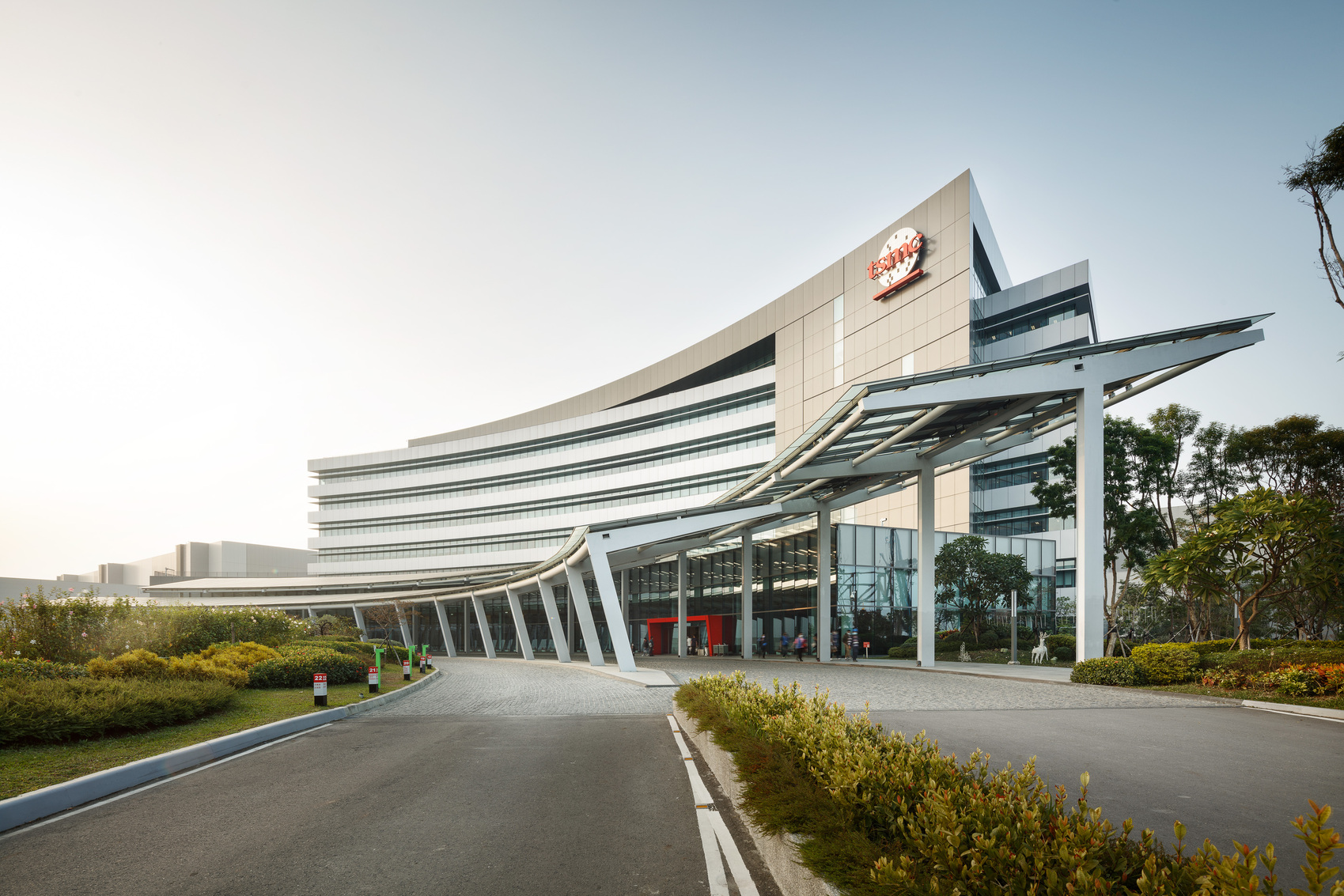
This concentration developed over decades. TSMC was founded in Taiwan in 1987 with a business model focused on manufacturing chips designed by other companies, allowing customers to avoid building their own semiconductor factories.
This Is Why Taiwan Became a Geopolitical Hotspot
Taiwan's semiconductor industry matters geopolitically because so much advanced chip production is concentrated on an island whose sovereignty is disputed by China and whose security is closely tied to the United States.
TrendForce estimated that Taiwan accounted for 68% of global capacity for advanced processes of 16/14nm and below in 2023. For 7nm and below, Taiwan's share was close to 80%.
That concentration has made Taiwan's chip industry strategically important to the world's largest economies. China claims Taiwan as part of its territory, while the United States maintains unofficial relations with Taipei and provides Taiwan with military equipment under U.S. law.
The semiconductor industry has become part of the wider US-China technology competition. The U.S. has imposed export controls limiting China’s access to advanced chips and equipment, while China is investing heavily in building its own semiconductor capabilities.
At the same time, the U.S. is trying to reduce reliance on Asian manufacturing. TSMC's planned investment in the U.S. has grown to US$265 billion as of mid 2026, up from an initial US$65 billion commitment, and now covers plans for up to ten fabrication plants in Arizona alongside advanced packaging facilities.
However, shifting production is not immediate. TSMC still concentrates most of its most advanced manufacturing in Taiwan, which remains central to global leading edge chip supply. As a result, Taiwan’s semiconductor industry sits at the intersection of global supply chains, US-China competition, and cross strait security tensions.