On the slopes of Mount Kinabalu grows one of the rarest orchid species in the world. This plant is commonly known as Rothschild's slipper orchid or by its scientific name, Paphiopedilum rothschildianum.
Rothschild's slipper orchid features large flowers with side petals spreading up to 30 centimeters from tip to tip. Its flower stalk grows upright to a height of 30 to 50 centimeters and can support up to six blooms blooming simultaneously.
The two side petals extend almost horizontally with bold dark stripes over a pale base color. The lower part of the flower forms a deep pouch structure that functions to trap and direct pollinating insects.
Floral Adaptation Mechanism

The pattern of spots and lines on the petal surface resembles a colony of aphids, designed to lure syrphid flies to lay their eggs. Flies that land will slip into the slippery pouch and are forced to crawl upward through a single narrow gap at the back of the flower.
As the fly crawls out, its body brushes against the reproductive structures, transferring pollen. This natural process has proven highly effective in the wild, where nearly all blooming flowers successfully set fruit.
Unlike other orchid species, Rothschild's slipper orchid lacks pseudobulbs for storing water reserves. All water and nutrients are absorbed directly by the root system and its thick, solid green leaves without any pattern.
The thick leaves of Rothschild's slipper orchid can grow up to 60 centimeters in length. The presence of these thick leaves serves to reduce water evaporation, keeping the plant tissues hydrated despite lacking dedicated water-storage organs.
Cool air temperatures and ambient humidity around the slopes of Mount Kinabalu further support a steady natural water supply essential for its survival.
Serpentinite Ecosystem Dynamics
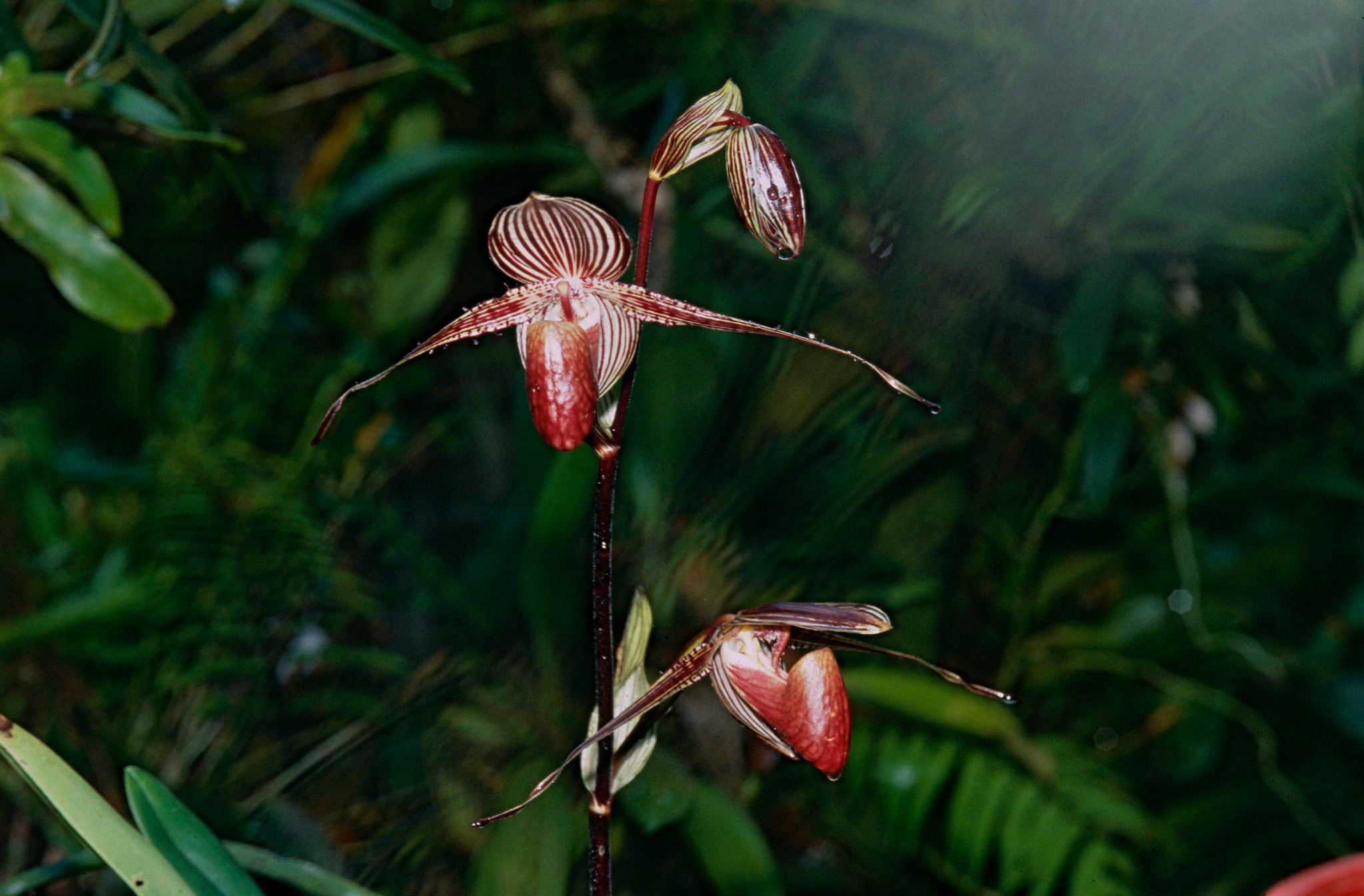
Wild populations of Paphiopedilum rothschildianum are recorded within the protected area of Kinabalu Park, Sabah. The plant grows anchored to rocky cliffs or steep slopes along mountain riverbeds at elevations ranging between 500 and 1,800 meters above sea level.
Its natural growing environment is not under dense forest canopy, but rather in open landslide areas that receive abundant direct sunlight.
The substrate to which it attaches is dominated by serpentinite rock, which is rich in magnesium and iron but extremely deficient in essential nutrients like nitrogen and phosphorus.
Species Extinction Threats
The development of Rothschild's slipper orchid in the wild begins from a microscopic seed that lacks its own food reserves.
The lack of internal nutrients prevents the seed from growing independently, making it entirely reliant on mycorrhizal fungi in the soil to supply the initial nutrients required for germination. Without these specific fungi in its growing substrate, the orchid seed cannot successfully grow into a seedling.
The journey from the seedling stage to a flowering-ready plant takes an exceptionally long time. This orchid requires approximately 8 to 15 years just to reach maturity and produce its very first flower spike.
Natural reproduction on the mountain slopes progresses very slowly due to the many years required for a single flowering event. This slow growth rate leaves the population of Rothschild's slipper orchids extremely vulnerable.
The main threat to the survival of Rothschild's slipper orchid is driven by heavy exploitation for the illegal trade. Its existence in the wild is further threatened by habitat degradation and the impacts of climate change.
Therefore, the International Union for Conservation of Nature (IUCN) Red List, categorizes the Rothschild's slipper orchid as a Critically Endangered species.
References:
- Rankou, H. (2015). Paphiopedilum rothschildianum. The IUCN Red List of Threatened Species 2015, e.T43322055A43327969. http://dx.doi.org/10.2305/IUCN.UK.2015-2.RLTS.T43322055A43327969.en
- van der Ent, A., van Vugt, R., & Wellinga, S. (2015). Ecology of Paphiopedilum rothschildianum at the type locality in Kinabalu Park (Sabah, Malaysia). Biodiversity and Conservation, 24(7), 1641–1656. https://doi.org/10.1007/s10531-015-0881-0