


In 1688, the walls of a French fortress in Bangkok stood under the guns of a much larger Siamese force. For five months, the soldiers inside held their position as food, fresh water, and ammunition dwindled.
Only three years earlier, Ayutthaya had been moving in the opposite direction. The kingdom was at the height of its engagement with the West, sending diplomatic envoys to the court of Versailles and drawing closer to France. Between these two moments, a political upheaval would transform Siam’s relations with Western Europe for more than 150 years.
The Greek Who Rose Through the Royal Court
At the center of Ayutthaya’s Western turn was Constantine Phaulkon, a Greek adventurer who had first worked for the English East India Company. He later entered the service of King Narai and built a close relationship with the monarch.
Phaulkon spoke Thai and several European languages, helping him rise rapidly through the court. By 1685, he had become Siam’s de facto prime minister and the principal force behind King Narai’s foreign policy.
With French Catholic missionaries, particularly the Jesuit Gui Tachard, Phaulkon pushed Siam toward France. The alliance was intended to counter the Dutch, whose economic influence in Ayutthaya was already strong.
In December 1685, King Narai ratified an agreement granting France preferential trading rights and permission to station troops in Singora, now Songkhla, and Bangkok.
The arrival of foreign troops in two important cities, however, deepened unease among nobles and officials who believed French influence had gone too far.
The King Falls Sick and the Palace Splits
The crisis came in March 1688, when King Narai fell gravely ill. With the succession suddenly uncertain, the presence of potential heirs sympathetic to Christianity intensified fears within the palace that foreign interests had gained too much influence.
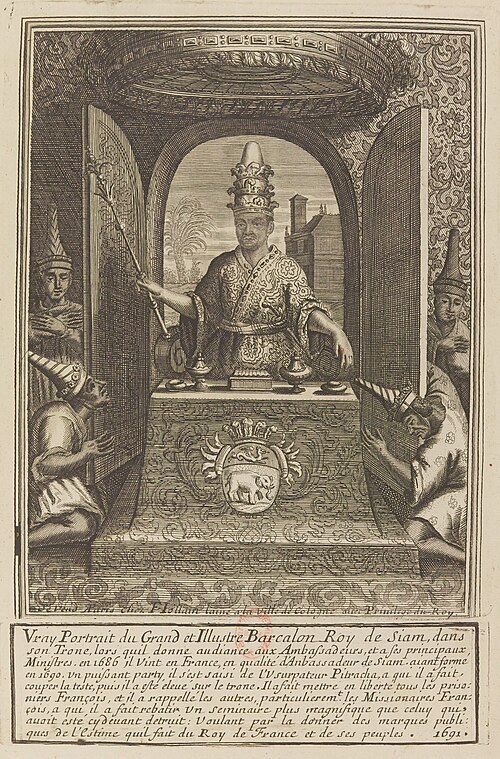
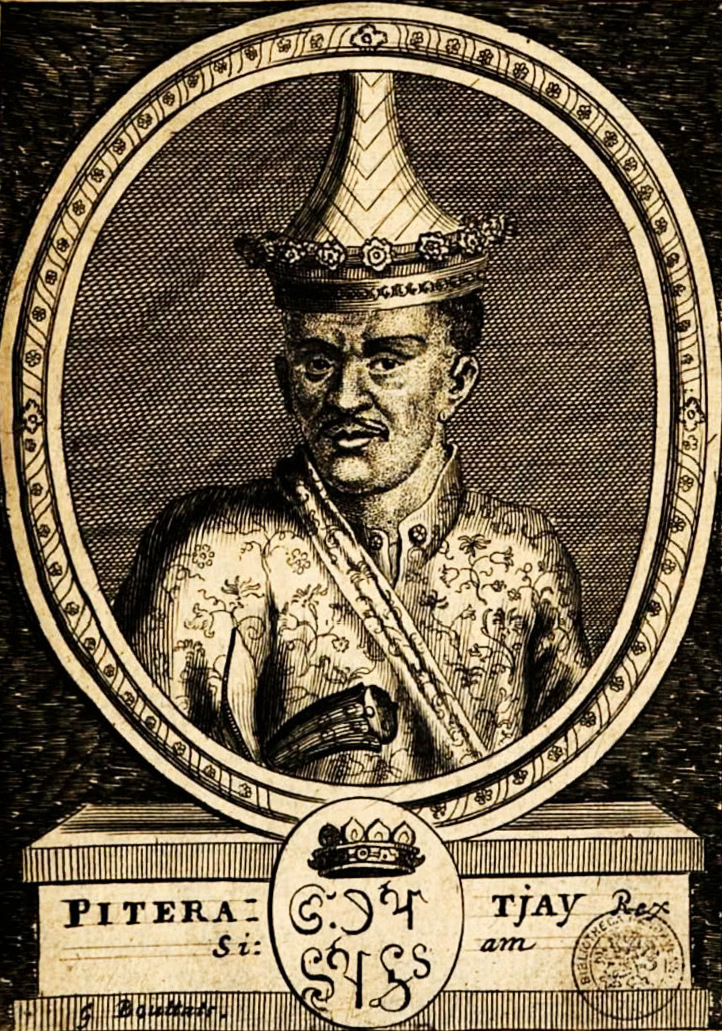
Phetracha emerged as the leader of the anti-French faction. His mother, Phra Nom Prem, had been King Narai’s wet nurse, and the two men had been raised together. Phetracha later became head of the Royal Elephant Department and a leading general.
On May 18, he entered the Lopburi palace with his forces and arrested Phaulkon. French officer Sieur de Beauchamp, who witnessed the events, recorded that Phaulkon was tortured for more than three weeks before being executed in early June. He was beheaded and his body cut in two, following a Siamese method of execution of the period.
The purge extended to the royal family. Mon Pit, King Narai’s adopted son and a prospective heir, was killed two days after Phaulkon’s arrest.
Two of Narai’s brothers were placed inside velvet sacks and beaten to death with sandalwood clubs, a royal execution method designed to prevent blood from being spilled.
King Narai died about a month later, in mid-July 1688.
Phaulkon’s wife, Maria Guyomar de Pinha, was also caught in the upheaval. She was detained by Phetracha’s son, Sorosak, before escaping to the French fortress in Bangkok.
The French eventually surrendered her to Siamese authorities as part of the agreement that allowed their troops to withdraw.
Five Months Behind the Walls of Bangkok
Phetracha then turned against the roughly 200 French soldiers commanded by General Desfarges in the Bangkok fortress.
Siamese forces surrounded the stronghold and built eight or nine artillery positions around it, within musket range. Yet the fortress resisted. As supplies ran low, the siege became a prolonged test of endurance.
According to Beauchamp, the French held out for “five months four days.”
The deadlock began to break in late September, after the French warship Oriflamme arrived in Siamese waters. An agreement allowed the French to withdraw aboard Oriflamme alongside two Siamese vessels, Siam and Louvo.
Bishop Laneau and French trading official Véret were to remain behind as guarantees until the borrowed ships were returned. Véret eventually escaped with the French, while Laneau remained in Siam and was imprisoned for years.
On November 2, 1688, the French troops finally left Bangkok.
When Siam Opened Its Doors Again
The upheaval transformed Siam’s relationship with Western Europe. For generations, successive rulers remained wary of foreign involvement in the royal court and military and largely limited Western commercial and diplomatic contact.
That changed under King Mongkut, or Rama IV, who ruled from 1851 to 1868. After witnessing Britain’s victories over Burma in the First and Second Anglo-Burmese Wars, Mongkut concluded that Siam needed a new strategy.
He reopened diplomatic and commercial relations with the West, culminating in the 1855 Bowring Treaty with Britain. It removed many trade restrictions, established a 3 percent import duty, and allowed British subjects to trade at all Thai ports, own land around Bangkok, and travel freely throughout the country.
The treaty reduced part of Siam’s legal and fiscal sovereignty, but it also became one factor in the kingdom’s ability to avoid direct colonial conquest.
More than 150 years after Siamese guns surrounded the French fortress in Bangkok, the kingdom had opened its doors to the West again—this time as European colonial power was reshaping the map of Southeast Asia.


