


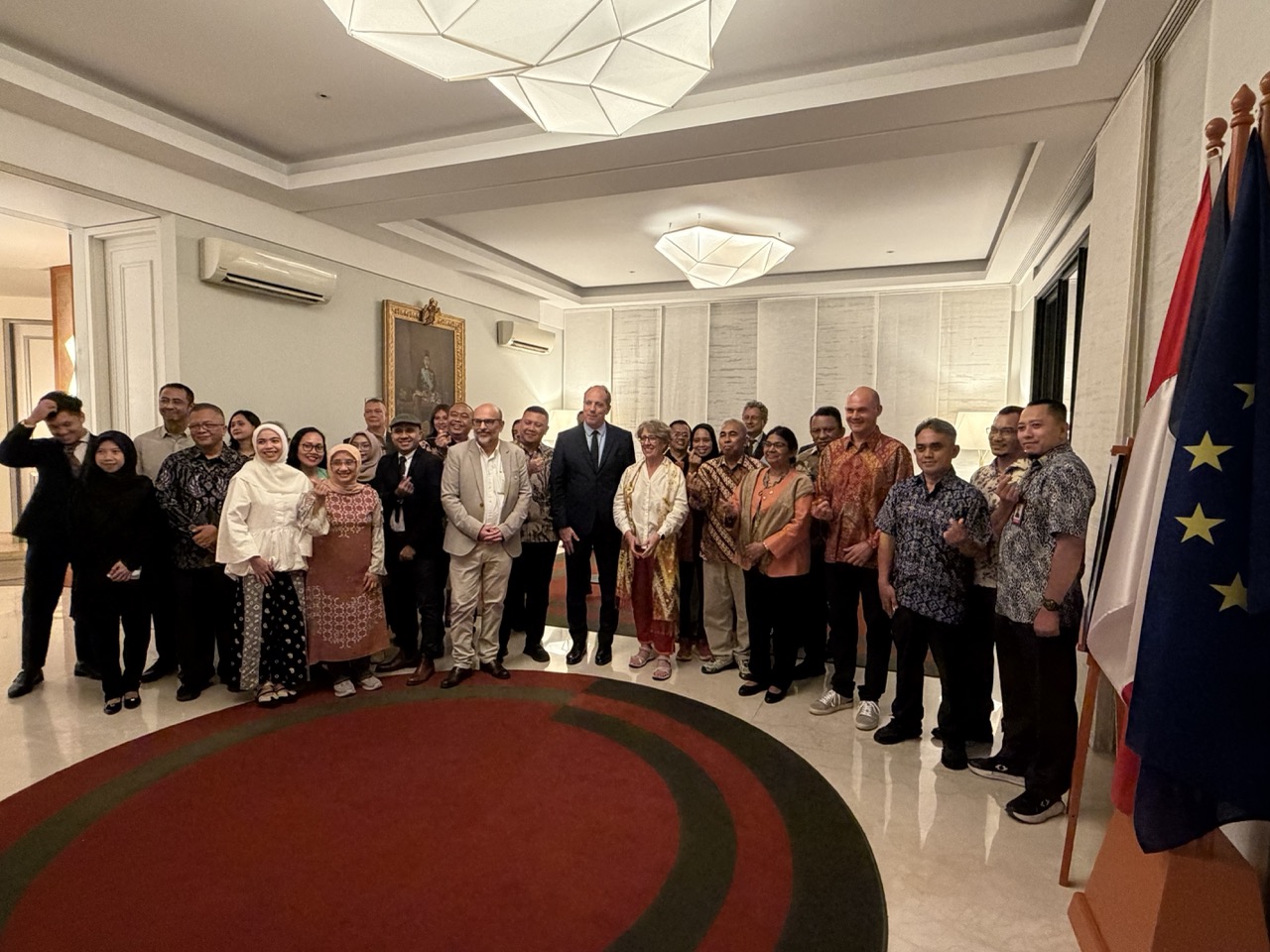
Indonesia’s marine biodiversity brought French and Indonesian scientists together at Ambassador Fabien Penone’s residence in Jakarta on October 29. The press conference and dinner reception highlighted how their shared research could help protect coastal ecosystems—and what would be needed to sustain that work.
Organised by the French Embassy and Institut français d’Indonésie, the gathering accompanied an international evaluation of SELAMAT, the joint laboratory connecting scientific expertise across the Indonesian archipelago.
Five Years of Research, a Growing Partnership
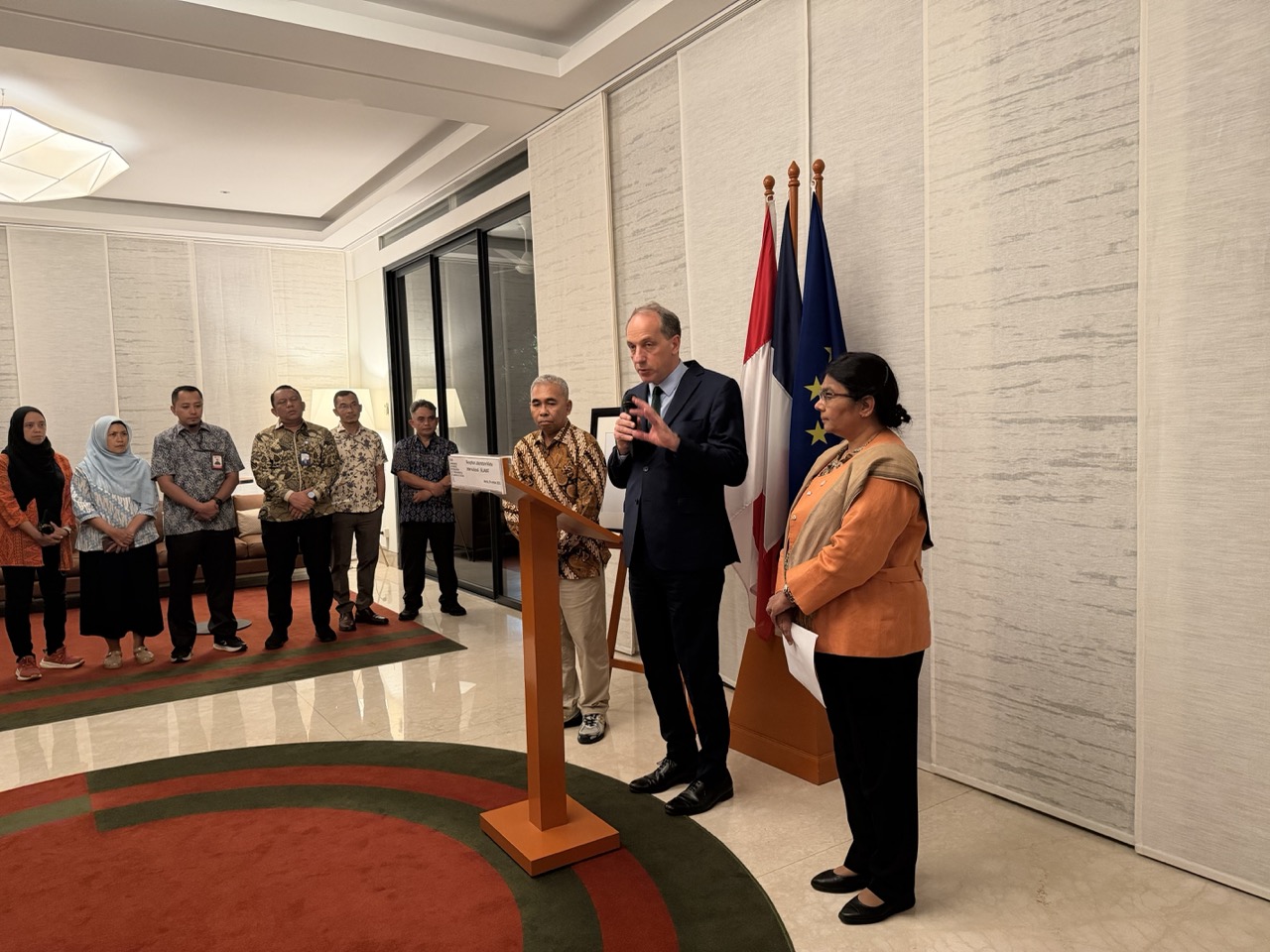
Launched in 2021, SELAMAT—the Sentinel Laboratory of the Indonesian Marine Biodiversity—is jointly led by Indonesia’s National Research and Innovation Agency, BRIN, and the French National Research Institute for Sustainable Development, IRD.
According to Prof. Dr. Julien Bourgeois, Attaché for Science and Technology of the French Embassy in Jakarta, its network now brings together approximately 80 scientists. At its launch, it involved around 28 Indonesian and 23 French scientists, supported by six Indonesian marine stations in Ambon, Ancol, Bali, Lampung, Manokwari and Sorong.
That geographical reach allows researchers to examine different coastal environments while developing shared methods for observing change.
The October 26–30 evaluation involved Sandrine Ruitton of Aix-Marseille Université, Pierre Morand of IRD and Wudianto of BRIN. Their assessment was intended to help shape a proposed second phase for 2027–2030, including continued research, training and stronger institutional support.
The reception therefore marked a moment of review and preparation. The next phase remained a proposal under evaluation, with the laboratory’s longer-term sustainability among its central objectives.
Reading the Ocean’s Early Signals
SELAMAT focuses on three interconnected ecosystems: coral reefs, mangroves and seagrass meadows. Its approach uses selected species and habitats as ecological “sentinels”—indicators that help researchers identify changes in the wider environment.
Indonesia hosts nearly 20% of the world’s coral reefs, according to IRD. Monitoring selected organisms and locations offers a practical way to study an ecosystem too extensive to survey comprehensively. These observations can help researchers understand pressures affecting biodiversity, fisheries and coastal livelihoods.
The laboratory combines field observations, molecular biology, online training and work involving local communities. Its research includes commercially important sea urchins and toxic dinoflagellates, demonstrating how biodiversity studies can connect with resource management and seafood safety.
Environmental DNA, or eDNA, is another tool in that work. By analysing genetic traces collected from water, scientists can detect organisms that conventional surveys may overlook.
“Even there, conventional methods underestimate reality,” Régis Hocdé said in an earlier IRD feature discussing discoveries in supposedly well-studied waters. His observation illustrated why researchers combine different methods to build a fuller picture of marine life.
From Raja Ampat to Jakarta’s Island Neighbours
During the Jakarta discussion, Hocdé highlighted Raja Ampat in the western Papua region as an example of Indonesia’s exceptionally rich and comparatively well-preserved marine environments.
Indonesian researcher Indra Bayu Vimono drew attention to a more troubled setting closer to the reception venue: the Seribu Islands north of Jakarta. He identified the island group as an area of particular concern for marine biodiversity.
Together, their observations illustrated the range of conditions confronting researchers. Indonesia’s marine conservation priorities include both safeguarding relatively intact habitats and understanding environmental deterioration near major population centres.
Indra also said French and Indonesian scientists planned to travel to Sabang, Aceh, the following week to investigate marine biodiversity and collect specimens for further research. The planned fieldwork would carry the cooperation discussed in Jakarta into another part of the archipelago.
These examples gave the evening’s scientific discussion a clear local relevance: marine biodiversity was a concern extending from distant reef landscapes to waters neighbouring the capital.
Opening Marine Science to More People
Hocdé also challenged the assumption that marine research required every scientist to be a certified diver. Some researchers worked in laboratories or above water, contributing expertise essential to understanding what field teams observed.
That distinction broadened the picture of scientific participation. Protecting marine ecosystems required people who could collect samples, identify organisms, analyse genetic information and interpret findings, as well as those conducting underwater surveys.
During the reception, it was stated that SELAMAT teams had conducted laboratory and field training in Papua, North Sulawesi, South Lampung and the Seribu Islands, including training in eDNA sampling.
Community participation also formed part of the research approach. In the earlier IRD feature, Indonesian biologist Hagi Yulia Sugeha emphasised: “Involving local scientists and indigenous communities in this work is essential.” She connected their involvement with understanding environments and passing knowledge and technologies to younger generations.
Her remarks reinforced the importance of building research capacity alongside collecting scientific data.
Building Continuity Beyond the Reception
The proposed 2027–2030 phase would seek to strengthen research, train future scientists and expand SELAMAT’s regional impact. Its evaluation offered an opportunity to examine how the partnership could maintain observations over time and make its findings more useful for marine management.
The October 29 gathering placed those ambitions within a relationship sustained through institutions, fieldwork and individual researchers. From the Seribu Islands to Raja Ampat and the planned expedition to Sabang, its purpose remained concrete: understanding Indonesia’s marine ecosystems well enough to help protect them.


