


Indonesia’s carbon market is still in its early stages, but its development is beginning to create new opportunities for young people, from carbon trading and climate finance to sustainability consulting and nature-based solutions.
However, interest in climate issues alone is not enough. To participate in this growing sector, young people also need to understand how carbon markets, policies, and projects work.
This need is at the heart of Carbon Youth Week 2026 (CYW 2026), organised by Indonesia Carbon Trading Association (IDCTA) Youth. The programme officially began on September 7 with Carbon Dialogues & Capacity Building at the Indonesia Stock Exchange (IDX).
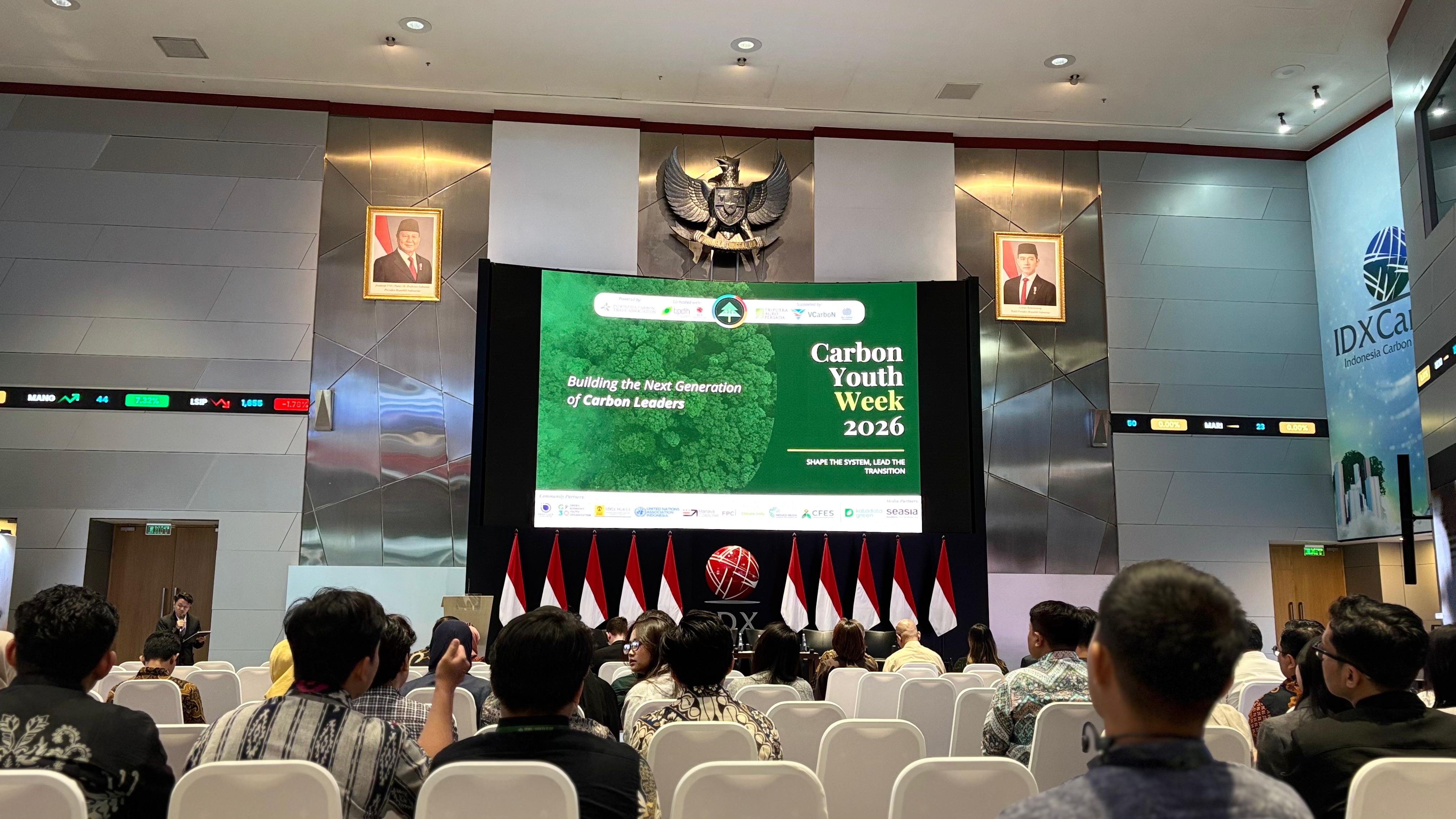
The opening event brought young people together with carbon sector practitioners and stakeholders to discuss the development of Indonesia’s carbon market and the wider ASEAN region. Participants gained an understanding of carbon market architecture, trading mechanisms, and developments shaping the carbon ecosystem.
The Growing Demand for Carbon Market Talent
The development of carbon markets, climate finance, and nature-based solutions is also increasing the need for human resources who understand both climate change issues and the mechanisms operating within the carbon ecosystem.
Edwin Hartanto, Head of Carbon Development at IDXCarbon, said Indonesia’s carbon trading sector is still moving toward maturity and requires more human resources with expertise in the field.
“Indonesia still needs a lot of human resources, and that is what is currently lacking. Events like this can serve as a catalyst to increase awareness and participation.”
IDCTA Chairman Dr. Riza Suarga also emphasised the importance of creating learning opportunities for young people to understand their role in climate change mitigation and adaptation.
CYW 2026 builds on several previous IDCTA Youth initiatives, including Carbon Guide and Carbon Youth Challenge, which have provided young people with opportunities to learn about decarbonisation and carbon markets.
This year, the programme expands its scope to include learning about carbon markets, policy discussions, field experience, and an introduction to various career paths in the low-carbon economy.
Preparing Youth for a Changing Carbon Market
Building the capacity of young people is also linked to the broader challenge of developing a credible carbon ecosystem.
Haryo Pambudi, S.Hut., M.Sc., Acting Director of Carbon Economic Value Governance at the Ministry of Environment/Environmental Control Agency (KLH/BPLH), said young people need to be able to connect data, technology, and knowledge with climate action.
“Going forward, Indonesia needs young people who understand the carbon ecosystem and can connect data, technology, and knowledge into meaningful climate action.”
He said Indonesia’s increasing integration with global carbon markets also needs to be accompanied by governance principles that safeguard environmental integrity and long-term sustainability.
Where Carbon Policy Meets the Field
Following the opening at IDX, CYW 2026 will continue with three programmes.
On September 9, the Youth-Policy Roundtable: Carbon Governance Lab – Article 6 Simulation Framework at BPDLH will explore the implementation of Article 6 of the Paris Agreement through negotiation simulations and policy discussions. Participants will also prepare Individual Position Papers, which will be consolidated into a Policy Brief.
The online Career Clinic: Navigating Careers in the Green & Carbon Economy on September 11 will introduce various career paths in carbon markets, sustainability consulting, climate finance, renewable energy, ESG, and other areas of the green economy.
The programme will conclude on September 12 with the Carbon Project Excursion in Muara Angke, Jakarta. Through field immersion in the mangrove area and a carbon market simulation, participants will explore the relationship between environmental and social conditions on the ground, nature-based project development, and carbon market mechanisms.
By bringing young people together with market players, policymakers, project developers, financial institutions, academics, and sustainability professionals, CYW 2026 provides a space for the next generation to understand the carbon sector from different perspectives.


