


Thailand often introduces itself through small moments: the scent of grilled pork drifting across a morning market, the sound of a temple bell behind Bangkok traffic or a ferry pulling away from an island pier under a changing sky. Yet the country cannot be understood through beaches and temples alone. Bangkok, the northern mountains, the Isan plateau and the southern coasts each move to a different rhythm.
Thailand welcomed 32.97 million international visitors in 2025, alongside approximately 202 million domestic trips. Combined tourism activity generated about 2.7 trillion baht. The Tourism Authority of Thailand is pursuing up to three trillion baht in total tourism revenue in 2026 while placing greater emphasis on quality and sustainability. TAT Governor Thapanee Kiatphaibool described the direction clearly: “Thailand Tourism Next marks a clear shift from recovery to transformation.”
1. Entry requirements and immigration procedures: Arrive with the right documents
Entry rules depend on nationality, travel purpose and the date of arrival. Many nationalities qualify for visa-exempt entry, while others require a visa on arrival or an advance visa. Thailand approved revisions to its visa-exemption arrangements in May 2026, making it especially important to confirm the permitted stay through an official Thai embassy, consulate or e-visa service immediately before traveling.
A passport should generally remain valid for at least six months. Immigration officers may request an onward ticket, accommodation address and evidence of sufficient funds. The number of days granted is determined at the border, so check the entry stamp or electronic record before leaving the immigration area. Overstaying can result in daily fines, detention or restrictions on future entry.
All non-Thai nationals entering by air, land or sea must normally submit the free Thailand Digital Arrival Card within three days before arrival, including the arrival date. The TDAC is not a visa and a new submission is required for each entry. Save the confirmation and QR code offline. Travelers remaining in international transit without clearing immigration generally do not need to complete it.
2. Best time to visit and seasonal conditions: Choose your region before your season
November to February usually brings cooler and drier weather to Bangkok, northern Thailand and much of the central region. March to May can be extremely hot, with April temperatures frequently approaching or exceeding 40 degrees Celsius. The rainy season affects much of the country from approximately May to October, but rainfall often arrives in intense bursts rather than continuing all day.
Thailand’s two southern coastlines follow different patterns. Phuket, Krabi, Khao Lak and the Andaman islands experience their wetter period mainly between May and October. Koh Samui, Koh Phangan and Koh Tao in the Gulf of Thailand often receive their heaviest rain later, particularly from October through December. Rough seas can cancel ferries and close marine parks even when conditions look calm from the beach.
Northern destinations such as Chiang Mai, Chiang Rai, Mae Hong Son and Pai can experience seasonal haze from agricultural and forest burning, commonly between February and April. Travelers with respiratory conditions should monitor air-quality readings and remain flexible.
Songkran in April offers extraordinary cultural energy, but it also brings heat, crowds, water-soaked streets and busy transportation. Loy Krathong and Yi Peng attract large numbers to northern cities later in the year. Booking early is essential around national holidays and major festivals.
3. Currency, payments, and typical travel costs: Carry baht beyond the big cities
Thailand uses the Thai baht. Credit cards are widely accepted in large hotels, malls, restaurants and supermarkets, but cash remains important at markets, street-food stalls, small guesthouses, local buses and rural businesses. PromptPay QR payments are common, although many foreign visitors cannot access every feature without a participating bank or payment service.
ATMs accepting international cards are widespread but commonly charge a local withdrawal fee in addition to fees imposed by the traveler’s bank. Withdrawing larger amounts less frequently can reduce repeated charges, provided the cash can be stored securely. Choose to be charged in baht when an ATM or card terminal offers currency conversion, as the machine’s conversion rate may be less favourable.
A street-food meal commonly costs approximately 50 to 120 baht, while a casual restaurant meal may range from 150 to 500 baht. Basic rooms can start around 500 to 1,200 baht, with many comfortable midrange properties costing 1,500 to 4,000 baht. Islands and resort areas are generally more expensive because food, water and fuel must be transported farther.
A budget traveler might plan on 1,200 to 2,500 baht per day, while a comfortable midrange trip may require 3,000 to 6,500 baht, excluding domestic flights, diving and private tours. Tipping is appreciated but not compulsory. Small amounts for drivers, guides, massage therapists and hotel staff are customary when service has been good.
4. Transportation and geographical challenges: Connect the regions patiently
Thailand has an extensive transportation network, but no single system covers every journey. Bangkok offers the BTS Skytrain, MRT, Airport Rail Link, public buses, canal boats, river ferries, taxis and motorcycle taxis. Payment systems are not completely integrated, so a card working on one rail line may not work on another.
Metered taxis are affordable when drivers use the meter. Confirm this before departure and use a ride-hailing service if a driver refuses. Tuk-tuks can be enjoyable for short trips, but fares must be agreed upon first. A surprisingly cheap sightseeing offer may include unwanted stops at tailor shops, gem stores or travel agencies.
Intercity trains connect Bangkok with Chiang Mai, Nong Khai, Ubon Ratchathani, Hat Yai and southern gateways. Overnight trains are popular, but lower berths and private compartments sell quickly. Long-distance buses and minivans reach places beyond the railway, while domestic flights save time between distant regions.
Island travel requires additional planning. A journey to Koh Lanta, Koh Tao or Koh Lipe may combine a flight, van and ferry. Check whether the advertised ticket includes every transfer and leave room for weather delays. Avoid scheduling an island ferry and an international departure on the same day.
Motorcycles provide freedom but are a major source of serious injuries. Riders need the correct licence, an appropriate international driving permit, a helmet and insurance that covers motorcycle use. Never assume that a rental company’s willingness to hand over a scooter proves that the rider is legally insured.
5. Internet access, SIM cards, and essential apps: Stay connected from city to island
AIS and True-dtac operate Thailand’s largest mobile networks, with tourist SIM cards and eSIM packages available at airports, official shops and convenience outlets. Registration normally requires a passport. Coverage is strong in cities and established resorts but may weaken in mountain areas, national parks and between islands.
Grab and Bolt are useful for private transportation, while ViaBus can help with Bangkok bus routes. The State Railway of Thailand’s D-Ticket service is useful for train reservations. LINE is widely used by hotels, guides, dive operators and local businesses, sometimes more frequently than email.
Google Maps works well in cities but may show outdated ferry times or questionable rural routes. Confirm boat schedules directly with the operator, especially during monsoon periods. Save the Thai-language version of the accommodation address because some taxi drivers may not recognize an English place name.
Air4Thai provides air-quality information, while the Thailand Tourist Police application offers assistance and multilingual communication. The Tourist Police hotline is 1155 and operates around the clock. Download essential documents and maps before traveling into areas with uncertain coverage.
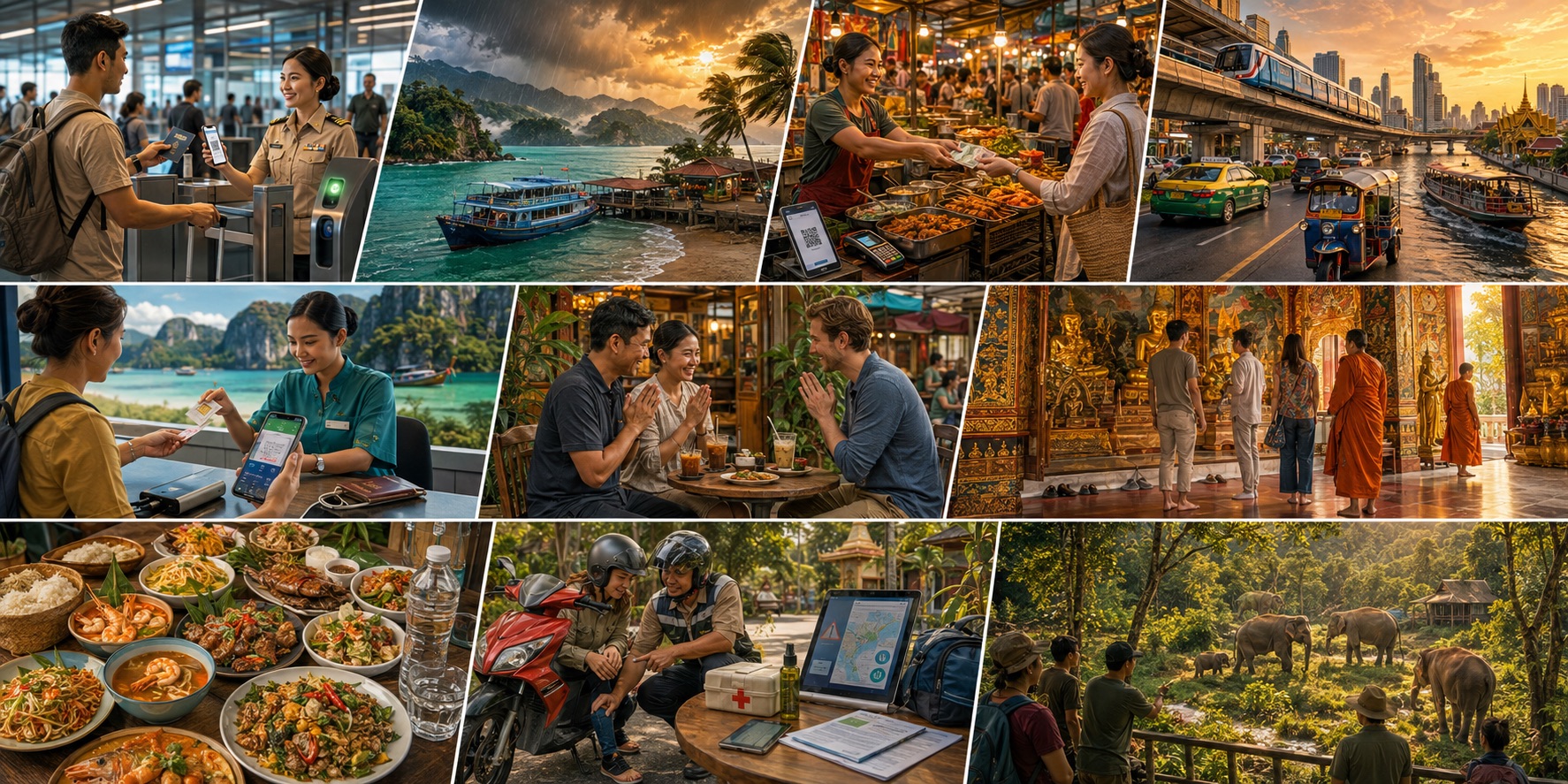
6. Languages and useful local expressions: Let politeness guide the conversation
Thai is the national language, but regional speech varies considerably. Northern communities have Lanna linguistic traditions, while the Isan language is closely related to Lao. Malay is spoken in parts of the far south. English is common in major tourism areas but may be limited in provincial markets, bus stations and rural communities.
Sawasdee khrap or sawasdee kha means hello, while khop khun khrap or khop khun kha means thank you. Male speakers generally use khrap as a polite ending, while female speakers commonly use kha. Tao rai asks how much, hong nam yu thi nai asks where the toilet is, and mai phet requests that food not be spicy. Travelers with allergies should show the ingredient written in Thai rather than depending entirely on pronunciation.
The wai, made by placing the palms together, expresses greeting or respect. Visitors can return a wai offered by an adult, although service staff and children do not always expect one in return. A smile and slight nod are sufficient when uncertain.
The idea of jai yen, or keeping a cool heart, helps explain the value placed on patience and emotional control. Raising one’s voice, publicly blaming someone or showing visible anger can make a disagreement harder to resolve. Calm, specific questions usually produce better results.
7. Religion, customs, dress codes, and etiquette: Show respect from temple to street
Most Thais identify as Buddhist, while significant Muslim communities live throughout the country, particularly in the south. Christian, Hindu, Sikh and Chinese religious traditions are also visible. Travelers should avoid assuming that every community follows the same customs.
At Buddhist temples, cover shoulders and knees, remove shoes where indicated and speak quietly. Do not climb on Buddha images or temple structures for photographs. Feet should not be pointed toward a Buddha image, monk or another person. Women should avoid touching monks or handing objects directly to them, while everyone should ask before photographing a religious ceremony.
The head is traditionally regarded as the highest part of the body and should not be touched casually. Feet are considered lower and should not be used to move objects, point at people or stop rolling money. Thai banknotes and coins carry royal images, so stepping on them is particularly disrespectful.
Thailand’s monarchy is protected by strict laws. Avoid insulting comments, mocking images or confrontational discussions about the royal family. Stand respectfully when requested during royal ceremonies, cinema presentations or public observances.
Public composure is valued. Travelers who encounter a misunderstanding should lower their voice, allow everyone to save face and seek help from a neutral person when necessary. Respectful communication is more effective than insisting on winning an argument.
8. Local food, drinking water, and dietary considerations: Taste Thailand through its regions
Thai food changes substantially across the country. Bangkok and central Thailand are associated with dishes such as pad krapao, tom yum and boat noodles. Chiang Mai and the north offer khao soi, sai ua sausage and nam prik dipping dishes. Isan cuisine brings som tam, larb, grilled chicken and sticky rice, while southern cooking uses turmeric, coconut milk, seafood and powerful chilli pastes.
Street food is part of daily life rather than a separate attraction. Choose busy stalls where ingredients turn over quickly and dishes are cooked in front of customers. Be more cautious with seafood that has been sitting in the heat, pre-cut fruit exposed for long periods and unsealed alcoholic drinks.
Fish sauce, oyster sauce, shrimp paste, peanuts and coconut appear frequently. A dish that looks vegetarian may still contain fish sauce, dried shrimp or meat stock. The word jay describes a stricter plant-based tradition that excludes animal products and certain pungent vegetables, while mangsawirat usually refers more broadly to vegetarian food.
Visitors generally avoid drinking untreated tap water. Choose sealed water or a reputable filtered-water refill station. Commercial ice is widely used and normally produced from treated water, but hygiene still depends on handling and storage. Hydration becomes especially important during the hottest months.
Thai dishes ordered at full local heat can be substantially hotter than visitors expect. Asking for mai phet may still produce some chilli because spice is integral to many recipes. Travelers with low tolerance can request mai sai phrik, meaning no chilli, although sauces and curry pastes may already contain it.
9. Safety, health, laws, and common tourist mistakes: Stay informed without losing confidence
Thailand is generally welcoming and accessible, but road accidents, scams and alcohol-related incidents affect travelers more frequently than serious violent crime. Protect drinks, use licensed transportation and avoid walking alone on poorly lit beaches or roads late at night.
Common scams include claims that a major temple is closed, heavily discounted gem investments, unexplained tuk-tuk shopping stops and demands for payment over alleged jet-ski or motorcycle damage. Photograph rental equipment before using it and avoid leaving a passport as security. Book tours through identifiable businesses and request receipts.
Cannabis regulations have changed significantly and, as of 2026, recreational use is illegal while medical use requires a Thai-issued prescription. Never carry cannabis across an international border. Vaporisers, e-cigarettes, pods and related liquids are also illegal to possess or use, including for tourists.
Drug penalties are severe. Police may ask for identification, so carry a passport copy and keep the original securely accessible. Travelers should also monitor official advisories for Thailand’s far southern provinces and areas near the Cambodian border, where security conditions and border access can change.
Dengue is present throughout the country, and rabies remains a risk from dogs, cats and monkeys. Use mosquito repellent and seek urgent medical advice after any animal bite or scratch. Malaria risk is more localized and should be discussed with a travel-health professional when visiting remote border or forest areas.
Follow beach flags and local warnings about currents, storms and jellyfish. Travel insurance should cover medical care, evacuation, motorcycles and planned adventure activities. Call 191 for police emergencies, 1669 for emergency medical assistance and 1155 for the Tourist Police.
10. Responsible travel and ways to support local communities: Choose experiences that protect Thailand
Elephant tourism requires particular care. A business calling itself a sanctuary does not automatically guarantee good welfare. Avoid elephant riding, performances, forced bathing, painting and close-contact photography. Look for observation-led facilities where elephants can move freely, form social groups and choose whether to approach people.
Thai conservationist Saengduean Lek Chailert has explained the importance of elephant relationships: “No one can heal them as quickly as they can heal each other.” A responsible facility places the herd’s behaviour ahead of a visitor’s photograph and explains how tourism income supports elephants, mahouts, veterinary care and habitat.
On islands, never stand on coral, feed fish or remove shells from protected areas. Respect seasonal marine-park closures, which allow ecosystems to recover and protect visitors during rough weather. Choose boat operators that use mooring buoys, provide life jackets and limit waste.
Spend with locally owned guesthouses, restaurants, guides, craft producers and community tourism projects. Provinces such as Nan, Loei, Phatthalung, Trang and Nakhon Si Thammarat offer meaningful alternatives to overcrowded routes. Buy directly from artisans and avoid visits to schools, orphanages or villages that turn vulnerable people into attractions.
Thailand becomes more rewarding when travelers slow down enough to recognize its regional identities. A calm conversation, a carefully chosen wildlife experience or an extra night in a provincial town can reveal more than a hurried collection of famous sights. Arrive curious, remain respectful and let the country unfold at its own pace.


