


At sunset, Bandar Seri Begawan seems to slow around the Brunei River. Golden domes catch the fading light, water taxis cross between stilt villages and the rainforest remains close enough to shape the horizon.
This unhurried atmosphere is becoming Brunei’s strongest tourism identity. As the country prepares for Visit Brunei Year 2027, it is inviting travellers to look beyond the familiar stopover and discover a destination where Islamic heritage, community life and protected wilderness remain closely connected.
A New Chapter for the Abode of Peace
Brunei recorded 763,375 tourist arrivals by land, air and sea in 2025, an increase of 12.6 percent from 678,037 the previous year. Land crossings contributed 435,340 arrivals, followed by 286,749 by air and 41,286 by sea.
Growth continued during the first half of 2026, when the country welcomed nearly 400,000 visitors, up 7.8 percent year on year. Tourism receipts reached approximately BND158 million, compared with BND140 million during the same period in 2025.
The momentum is leading into Visit Brunei Year 2027, which will coincide with the Diamond Jubilee of Sultan Haji Hassanal Bolkiah’s accession to the throne. The campaign uses “The Abode of Peace” as its theme, presenting Brunei’s tranquillity, hospitality and Malay Islamic Monarchy traditions as central parts of the visitor experience.
“Our goal is to create more market-ready experiences that encourage visitors to discover Brunei as part of a wider Southeast Asian journey,” said Muhammad Nazmi bin Mahali of the Tourism Development Department.
That regional approach is particularly relevant for travellers from Indonesia, Malaysia and Singapore. Brunei offers familiar elements—Malay language, halal cuisine and a shared Bornean environment—but presents them through its own royal history and distinctly peaceful rhythm.
Golden Domes Shape the Capital
The Sultan Omar Ali Saifuddien Mosque provides Bandar Seri Begawan with its defining image. Completed in 1958, the mosque combines Mughal-influenced architecture with a golden dome, marble surfaces and an artificial lagoon containing a ceremonial royal barge.
The building is most atmospheric in the late afternoon, when its reflection appears on the water and the city begins preparing for evening prayers. Visitors are welcome outside prayer periods, although modest clothing and respectful behaviour are essential.
A short journey away, Jame’ Asr Hassanil Bolkiah Mosque offers an even grander expression of Brunei’s Islamic architecture. The country’s largest mosque is distinguished by 29 golden domes, honouring Hassanal Bolkiah as Brunei’s 29th sultan, as well as landscaped gardens and richly decorated interiors.
Royal history continues at the Royal Regalia Museum, where ceremonial objects, gifts and the chariot used during the sultan’s coronation help explain the monarchy’s place in national life. Istana Nurul Iman, the official royal residence, is generally viewed from outside except during selected festive occasions, but its scale remains an important part of the capital’s landscape.
Kampong Ayer Keeps History Afloat
Across the river lies a different expression of Brunei’s identity. Kampong Ayer is not a reconstructed heritage attraction but a living community where thousands of residents occupy houses built above the water.
Wooden walkways and water taxis connect homes with schools, mosques, shops and emergency services. Modern utilities exist beside traditional building forms, demonstrating how an old river settlement has adapted without losing its distinctive character.
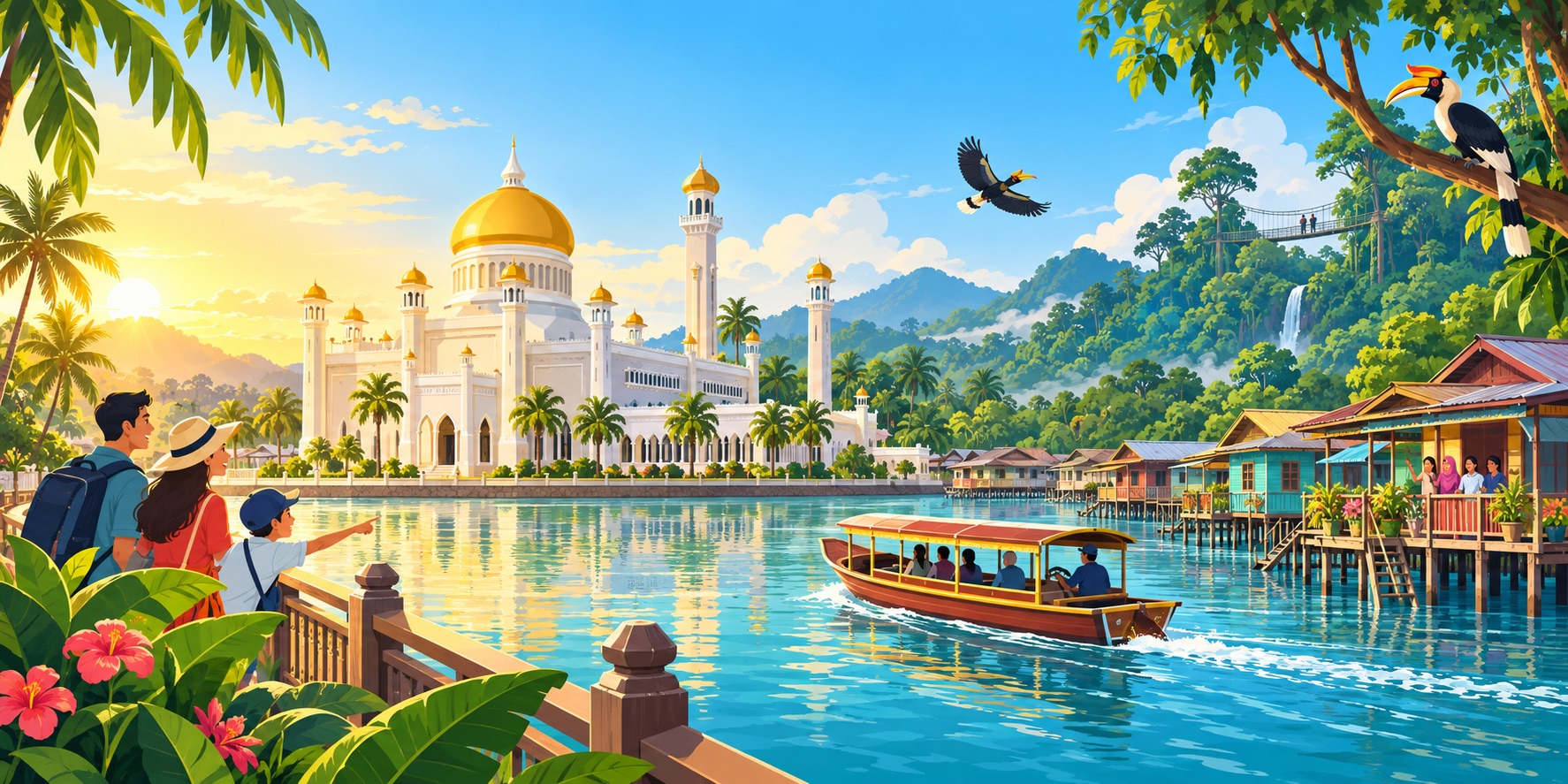
The most rewarding visits go beyond photographing the houses from a boat. The Kampong Ayer Cultural and Tourism Gallery introduces the settlement’s history and crafts, while locally guided walks and home visits allow travellers to meet residents over tea and traditional cakes.
Water taxis can also continue into the mangroves surrounding the capital. Within a relatively short distance of the city centre, travellers may encounter proboscis monkeys, crocodiles, hornbills and fireflies. The transition from royal architecture to village life and wildlife can unfold during a single afternoon.
Local Flavours Bring Brunei Closer
Brunei’s food scene is at its most approachable in its markets. Tamu Kianggeh offers a daytime introduction to local produce and snacks, while Gadong Night Market becomes livelier after sunset as vendors prepare grilled seafood, satay, noodles and rice dishes.
Nasi katok captures the appeal of everyday Bruneian food: rice, fried chicken and sambal served without ceremony and at an accessible price. Ambuyat, a sticky preparation made from sago starch, provides a deeper connection to Borneo’s culinary traditions and is usually eaten communally with sauces and side dishes.
These meals give travellers opportunities to interact with vendors and families rather than experience the country only through monumental attractions. In Brunei, hospitality is often expressed through small conversations, shared tables and invitations to try something unfamiliar.
The Rainforest Begins Beyond the Road
Brunei’s strongest contrast appears in Temburong. The final approach to Ulu Temburong National Park is made by traditional longboat, following narrow rivers into dense rainforest where the sounds of engines gradually give way to insects, birds and flowing water.
The park’s canopy walkway rises approximately 50 metres above the forest floor. Reaching it requires an early start, a river journey and a climb, but the reward is a panoramic view across one of Borneo’s best-preserved rainforest landscapes.
Visitors can also swim near waterfalls, walk forest trails and learn about plants from local guides. Because access is carefully managed, travelling with an authorized operator is essential for both safety and environmental protection.
Beyond Temburong, Tasek Merimbun Heritage Park in Tutong offers another side of Brunei’s natural landscape. Its distinctive blackwater lake, wetlands and surrounding forest earned it recognition as an ASEAN Heritage Park. Along the coast, Muara and Serasa provide quieter seaside escapes, while certified diving operators visit historic wrecks that have developed into artificial reefs.
Tourism Designed for Longer Journeys
Brunei’s challenge is no longer simply attracting visitors. It is encouraging them to remain longer, travel beyond Bandar Seri Begawan and ensure that tourism supports hotels, guides, restaurants, transport operators and community enterprises.
“The primary objective of the ministry is to increase the economic value generated by each visitor,” said Coordinating Minister for Economic Policies and Minister of Economy, Trade and Industry Abdul Manaf Metussin.
That objective can be seen in efforts to connect the country’s four districts through multi-day itineraries. A visitor might begin with the mosques and museums of Brunei-Muara, continue into Temburong’s rainforest, explore Tutong’s wetlands and finish with coastal or diving experiences in Belait.
Travellers should also understand the character of the country they are entering. Alcohol is not sold publicly, mosque visits must be arranged around prayer times and opening hours can be reduced on Fridays or during religious observances. Lightweight modest clothing, rain protection and advance reservations for rainforest and diving excursions make travel considerably easier.
Brunei does not attempt to compete with Southeast Asia’s busiest destinations. Its appeal lies in something increasingly rare: the space to travel slowly. Between golden domes, river communities and an ancient forest canopy, the Abode of Peace is turning tranquillity into an invitation to stay.


