

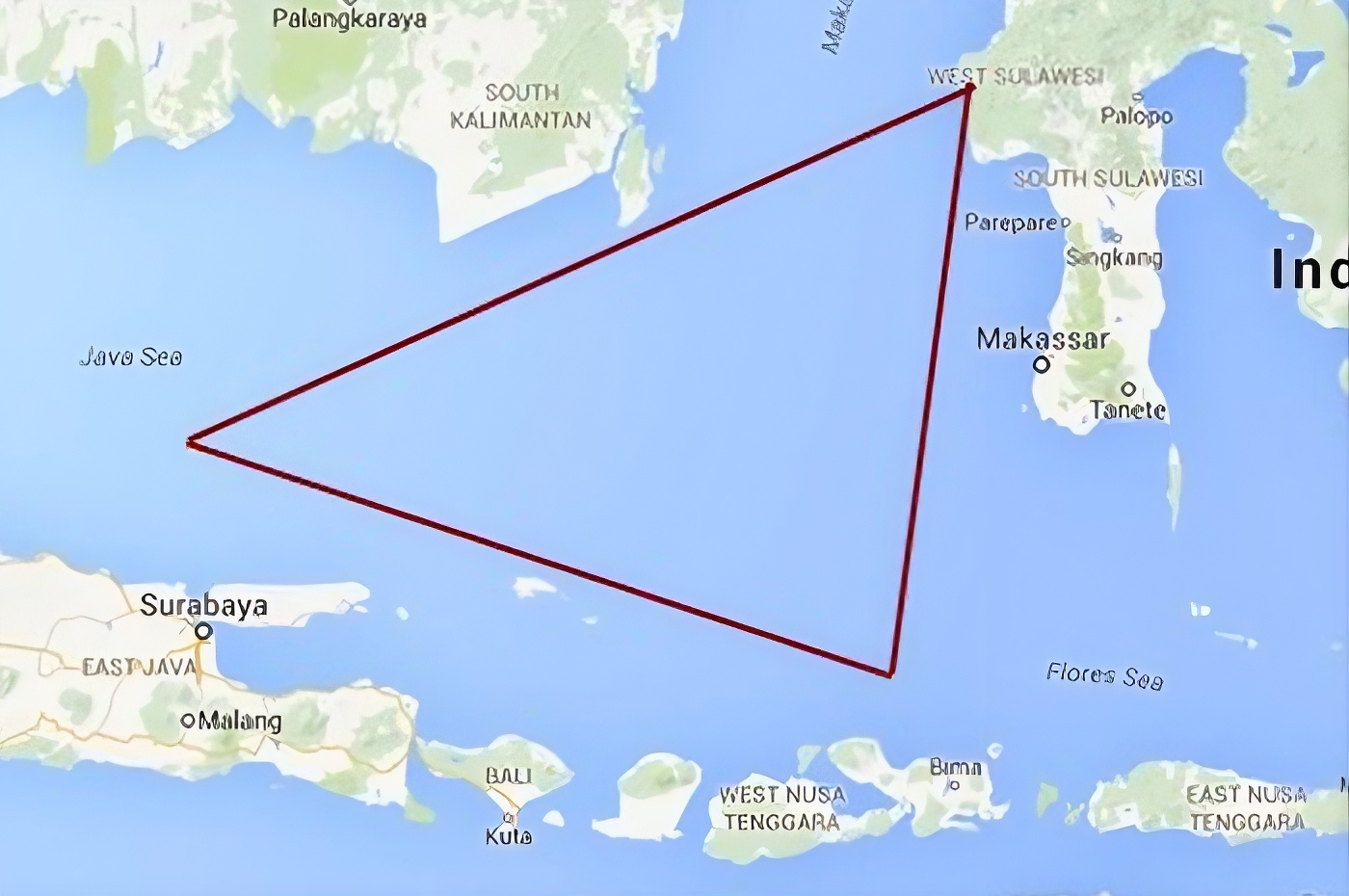
The Masalembo Triangle is a notorious area of water located in the Java Sea around the Masalembu Islands in East Java. This maritime zone forms an imaginary boundary connecting Bawean Island, Majene in Sulawesi, and the Tengah Islands. Local residents and sailors often refer to this dangerous region as the Bermuda Triangle of Indonesia.
The area gained widespread fear due to a long history of severe transport accidents. Numerous passenger ships, cargo vessels, and commercial airplanes have crashed or vanished while crossing these waters. These frequent disasters created a lasting legacy of horror across the Indonesian archipelago.
Local folklore frequently attributes these tragic crashes to supernatural forces and mystical entities. Traditional stories mention the mythical realm of Ratu Malaka claiming human sacrifices from passing vessels. Local fishermen even observe a sacred boundary known as the white line to avoid entering dangerous waters.
Despite these widespread myths, what are the actual reasons for those 'horror' accidents?
Tragic Maritime and Aviation Disasters in Masalembo
One of the earliest recorded major catastrophes occurred on January 27, 1981, when the passenger ferry KMP Tampomas II caught fire and sank. The tragic fire and subsequent sinking resulted in the deaths of over six hundred passengers. Decades later, on December 29, 2006, the passenger ship KM Senopati Nusantara also sank nearby during a severe storm.
Read also: Indonesia Has a Tropical Sea Where Temperatures Can Suddenly Drop to 12°C
On January 1, 2007, Adam Air Flight 574 vanished from radar over the Makassar Strait with one hundred and two people on board. Investigators eventually located the aircraft wreckage in deep waters off Majene in West Sulawesi. More recently, in September 2026, the ferry KMP Virgo Transport 8 capsized in bad weather while carrying over two hundred passengers.
Several other commercial vessels have also sunk in the same region, including KM Mutiara Indah and KM Fajar Mas. The recurring nature of these maritime events continually reinforces the grim reputation of the waters. Every new accident revives historical memories and fuels public fascination with the area.
Oceanographic Factors and Current Collisions
Geographically, the Masalembu Islands lie near the equator at a complex maritime junction. The area sits at the intersection where the horizontal Java Sea meets the vertical Makassar Strait and the Flores Sea. This positioning places the region directly between contrasting marine ecosystems and water channels.
The primary physical danger for vessels comes from the intense collision of major ocean currents. High volumes of Pacific Ocean water carried by the Indonesian Throughflow flow southbound through the Makassar Strait. When this deep water system meets surface currents moving across the Java Sea, it generates dangerous horizontal eddies and vertical water turbulence.
The seabed topography around Masalembo also features a sudden bathymetric drop. Waters on the western side in the Java Sea remain shallow at depths under fifty meters, while eastern waters plunge into deep ocean trenches over five hundred meters deep. This dramatic change in underwater terrain disrupts current stability and severely threatens ship balance.
Read also: The Dugong Legend: Tracing the 'Woman of the Sea' in Southeast Asian Myth
Weather Anomalies and Air Pocket Turbulence
Shallow water absorbs equatorial solar heat much faster than deep ocean water. This rapid thermal heating triggers massive seawater evaporation around the Masalembu Islands. The resulting atmospheric moisture leads to the frequent formation of dense Cumulonimbus storm clouds.
These storm systems create sudden atmospheric air pressure drops and microclimatic instability. Aircraft flying through these weather formations can encounter high-velocity air pockets that cause rapid loss of altitude. Pilots navigating the airspace can experience severe turbulence and spatial disorientation.
Seasonal monsoon transitions also bring abrupt changes in wind speed and direction. High-velocity winds and crosswinds create large, sudden waves across the surface. When strong winds blow perpendicular to powerful ocean currents, ships can be knocked off course or flipped over.



