


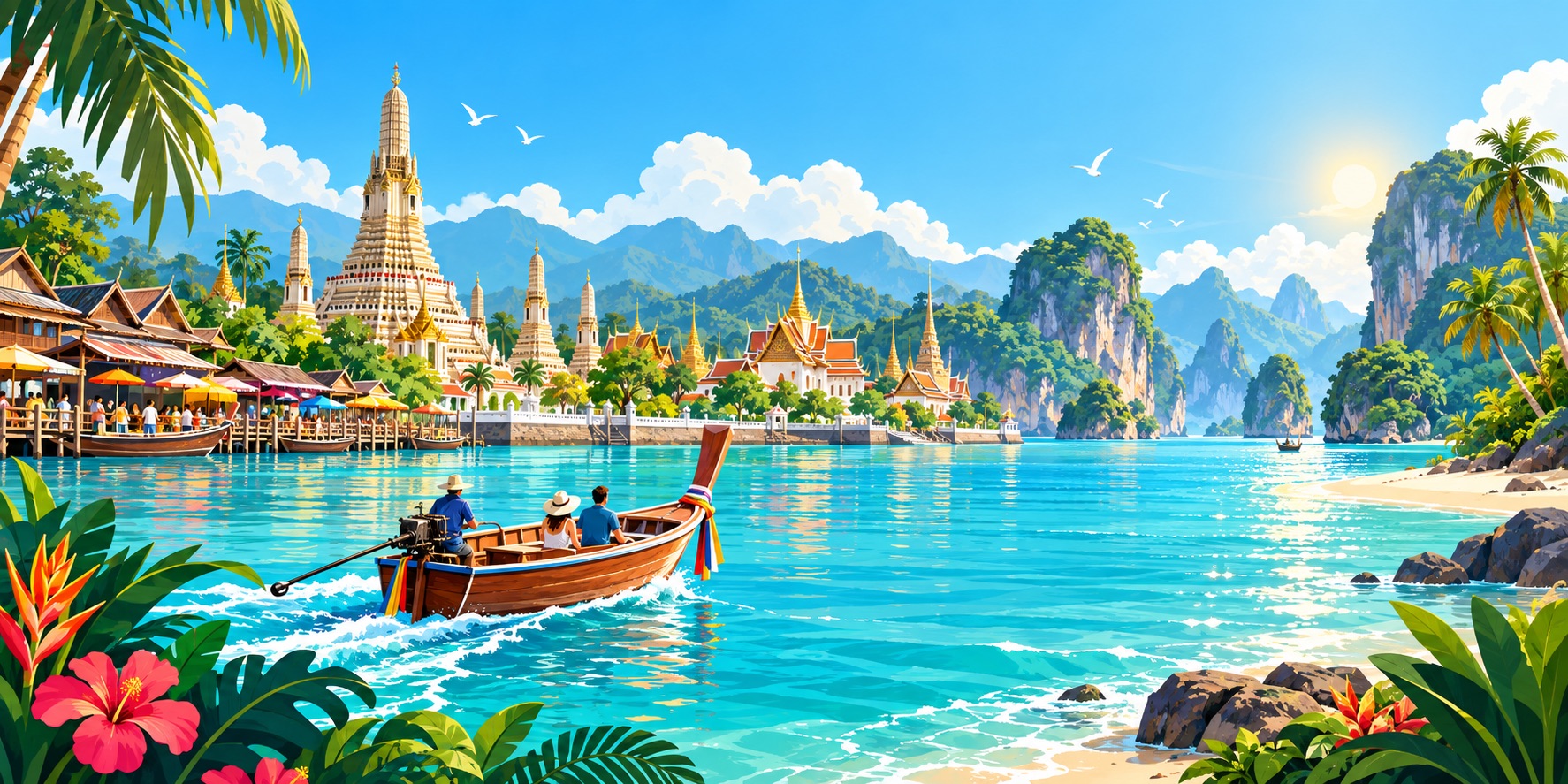
Thailand’s familiar postcard remains irresistible: golden temples glowing at dusk, long-tail boats crossing turquoise bays and fragrant dishes arriving from a sizzling wok. Yet the country’s emerging tourism story reaches beyond sightseeing, inviting visitors to travel more slowly, restore their wellbeing and create deeper connections with local communities.
A Bigger Goal Than Visitor Numbers
Tourism remains one of Thailand’s most important economic engines. The country welcomed 32.97 million international visitors in 2025, while domestic travellers made 202.37 million trips. Together, the two markets generated 2.70 trillion baht in tourism revenue. By September 5, 2026, international arrivals had exceeded 21.28 million, contributing approximately 1.04 trillion baht in visitor spending.
Those figures demonstrate Thailand’s enduring appeal, but they also reveal the challenge facing a mature destination: how to generate stronger benefits without relying solely on ever-increasing arrivals. The response is a transition from inexpensive mass tourism towards longer stays, higher-quality services and experiences rooted in Thailand’s distinctive culture.
When the strategy was introduced, then tourism and sports minister Sorawong Thienthong summarised the shift clearly: “Tourism is no longer just about numbers—it’s about trust, value, and inclusivity.”
Looking ahead, the Tourism Authority of Thailand has designated 2027 as its “Year of Transformation.” The plan targets tourism-revenue growth of at least five per cent and a 60:40 distribution of visitors between major and emerging destinations. TAT Governor Thapanee Kiatphaibool called it “a clear commitment to reshape Thai tourism around quality, value and long-term competitiveness.”
Wellness with a Thai Sense of Place
Thailand’s wellness offering illustrates what higher-value travel can mean. On Koh Samui, beachfront yoga, meditation and healthy Thai cooking can complement traditional herbal therapies. Phuket combines medical expertise and sophisticated retreats with restorative experiences beside the Andaman Sea.
The most memorable treatments, however, are often inseparable from place. In Chiang Mai, visitors can encounter northern traditions such as Nuat Fon, a therapeutic massage inspired by the graceful movements of Lanna fingernail dancing, and Yam Khang, an old fire-based treatment. These experiences connect wellbeing with knowledge passed between generations.
Thailand’s wellness economy was valued at US$42.7 billion in 2024, according to TAT, encompassing traditional therapies, preventive care, medical services and lifestyle wellbeing. Its “Healing is the New Luxury” campaign now presents luxury less as material indulgence and more as time, balance and emotional renewal.
History That Continues to Breathe
Bangkok captures Thailand’s contrasts in a single day. A morning can begin among the gilded roofs of the Grand Palace and the incense-filled halls of Wat Traimit before moving into contemporary galleries, riverside developments and the energetic food streets of Yaowarat.
Beyond the capital, Ayutthaya and Sukhothai transform history into a journey through former royal capitals. At Ayutthaya’s Wat Mahathat, the famous stone Buddha head rests within the roots of a tree, while the riverside towers of Wat Chaiwatthanaram become silhouettes in the evening light. In Sukhothai, cycling between temple ruins provides a quieter encounter with the foundations of Thai civilisation.
Culture remains equally alive in the north. Around Chiang Mai, visits to Doi Suthep can be paired with Lanna craft workshops, community markets and respectful observation of morning merit-making. During Loy Krathong and Yi Peng, candlelit offerings and floating lanterns reveal how spiritual traditions continue to shape contemporary life. Songkran brings a more exuberant atmosphere each April, combining nationwide water celebrations with rituals of renewal and respect for elders.
Nature Beyond the Beach Postcard
The limestone towers of Krabi and Phang Nga Bay remain among Thailand’s most recognisable landscapes, but their appeal is evolving. Kayaking through mangrove channels, climbing limestone cliffs with local instructors and choosing small-group island excursions create more intimate encounters while reducing pressure on sensitive shorelines.
Farther inland, Khao Sok National Park offers rainforest trails, wildlife observation and floating stays on Cheow Lan Lake. At Khao Sam Roi Yot National Park, a demanding walk leads to Phraya Nakhon Cave, where sunlight falls through the cavern roof onto the historic Kuha Karuhas pavilion.
These places also expose tourism’s central tension. Popularity can support guides, boat operators and family-run accommodation, but unmanaged growth can damage reefs, forests and community life. Thailand’s new direction consequently places greater emphasis on certified operators, low-carbon routes and its “Travel with Care” standards. The traveller becomes part of the conservation story through choices such as respecting marine restrictions, carrying reusable items and supporting locally managed experiences.
A Wider Map of Shared Opportunity
Thailand’s transformation will be most visible beyond Bangkok, Chiang Mai, Phuket and the best-known islands. TAT plans to connect international markets with 19 priority areas, expand its UNESCO-related tourism network across 29 locations and develop experiences in more than 55 community tourism destinations.
That wider map includes the royal seaside heritage and markets of Hua Hin, the railway history and forested surroundings of Kanchanaburi, and the orchard-lined waterways of Samut Songkhram. It extends to Ubon Ratchathani’s elaborate Candle Festival, Nakhon Phanom’s illuminated boats on the Mekong and Songkhla’s growing identity as a UNESCO Creative City of Gastronomy.
Food provides perhaps the easiest route into these communities. Bangkok may offer Michelin-starred restaurants beside humble noodle stalls, but regional travel reveals a much broader table: northern khao soi, southern turmeric-rich curries, Isan grilled chicken with green-papaya salad and fresh seafood prepared in Gulf fishing towns. Each meal carries local ingredients, livelihoods and stories.
A Journey Designed to Stay with You
Thailand does not need to leave its celebrated beaches and temples behind. Its opportunity is to connect those icons with the people, knowledge and landscapes surrounding them.
A journey that combines Bangkok’s energy, Chiang Mai’s living heritage, Krabi’s coast and a community-led regional stop delivers more than a collection of photographs. It leaves visitors restored, directs income more widely and gives Thailand’s “Land of Smiles” welcome a deeper, more sustainable future.


