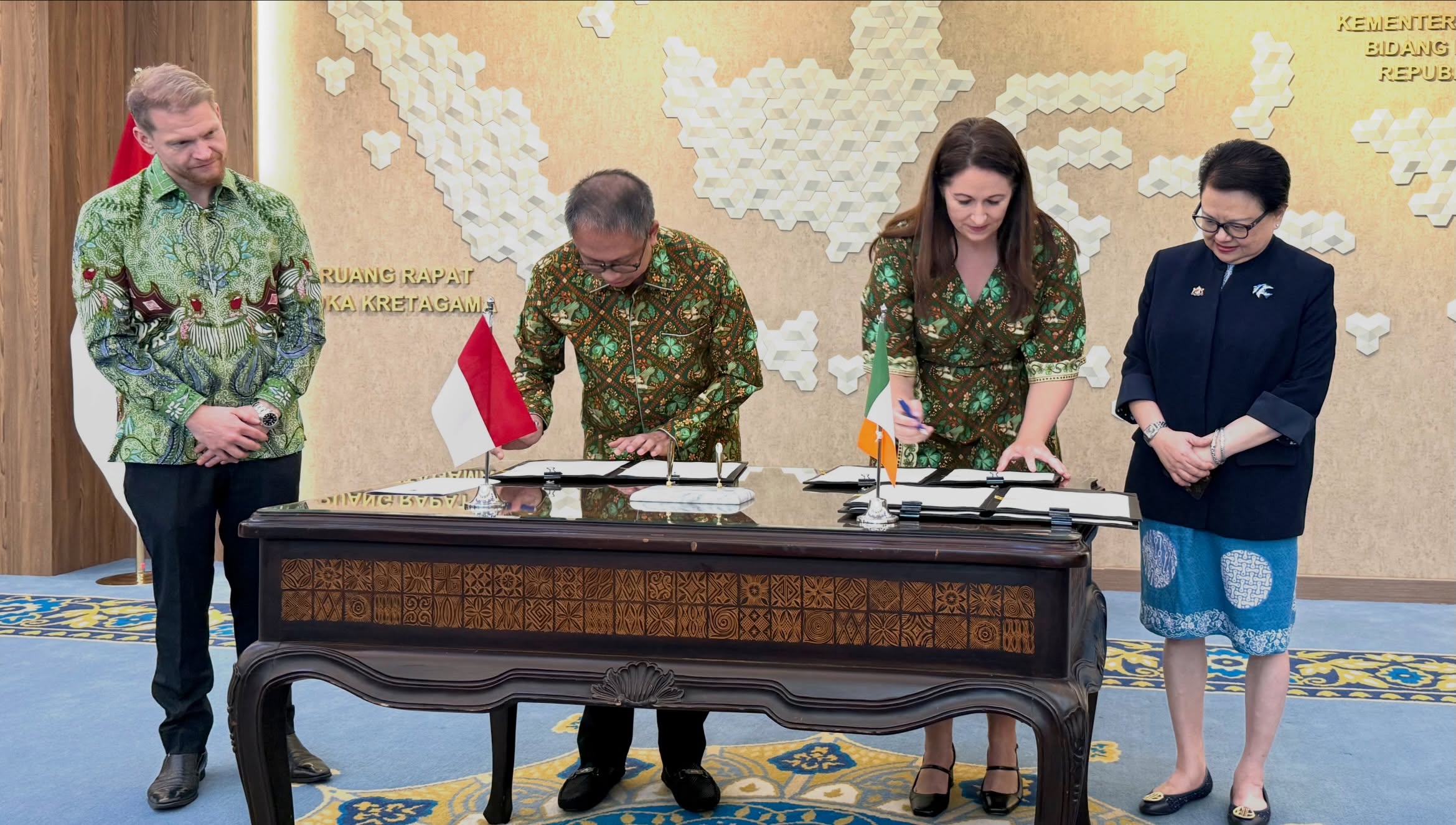
The signing of a Letter of Intent (LoI) between the governments of Indonesia and Ireland on September 4, 2026, marks a new chapter in the two nations' bilateral relationship, which has spanned 42 years. Although nominally not a defence cooperation agreement, this strategic partnership in artificial intelligence (AI) and the aviation industry holds significant security and geopolitical dimensions for Indonesia.
The partnership between Indonesia and Ireland is historically built upon a foundation of strong economic complementarity. It emphasized that the economic structures of both nations complement one another, rendering the partnership mutually beneficial.
Indonesia offers a vast domestic market with a population exceeding 270 million, expanding industrial capacity, and a strategic position as a nation with stable economic growth in Southeast Asia. Meanwhile, Ireland also boasts strengths as a leading digital technology hub in Europe, serving as a regional base for global tech giants such as Google, Meta, and Microsoft, and is recognized as a global epicentre for the biopharmaceutical industry.
Bilateral trade data indicates significant untapped potential. Total trade between Indonesia and Ireland reached US$228.6 million in 2025, while the period from January to July 2026 recorded US$145.5 million, an increase compared to the same period the previous year.
These figures, however, reflect only a fraction of the true potential of the economic relationship. The two sectors that are the main focus of this bilateral cooperation are AI and the aviation industry, which have strategic implications that go beyond mere economic aspects.
Artificial Intelligence as a Matter of Security and Competitiveness
First, Artificial Intelligence (AI) as a Matter of Security and Competitiveness
The development of AI is no longer solely an economic or technological issue; it has also become a matter of national security and geopolitics. AI has the potential to reshape the global balance of power, influencing everything from military capabilities and cybersecurity to a nation's economic dominance.
The Irish government offers extensive expertise and experience in digital technology, which can accelerate AI adoption and development in Indonesia. Irish Ambassador to Indonesia Sharon Lennon stated that Ireland is ready to leverage its long-standing expertise to support Indonesia's innovation and ambitions in this sector.
For the Indonesian government, technology transfer and capacity building in AI serve as crucial tools to reduce reliance on the specific nations that have historically dominated the global technology supply chain.
Aviation and Maritime Security
Secondly, the Aviation Industry and Maritime Security
The aviation sector encompasses security dimensions that cannot be overlooked. Ireland holds a leading position globally in the aircraft leasing business and aviation licensing. For Indonesia, an archipelagic nation renowned for its thousands of islands and strategic sea lanes, strengthening the domestic aviation industry has direct implications for national connectivity and maritime security.
Indonesian aviation companies can leverage Irish expertise in aircraft maintenance and fleet management. Strengthening the domestic aviation ecosystem will enhance Indonesia's capacity to project power and safeguard its sovereignty across its airspace and waters capabilities that are integral to its national defence posture.
From Letter of Intent to Broader Economic Engagement
The signing of the LoI marks an initial step that will subsequently be translated into more concrete cooperation. This LoI serves as a foundation for turning shared priorities into tangible actions involving governments, the business community, and relevant institutions in both countries.
Another key aspect concerns the push to finalize the Double Taxation Agreement between Indonesia and Ireland. Concluding this agreement will streamline trade relations and facilitate business interests in both nations.
Strategic momentum also arises from Ireland’s Presidency of the Council of the European Union, running from July 1 to December 31, 2026. This position offers Indonesia an opportunity to deepen its broader engagement with the European Union, particularly through the upcoming Indonesia-European Union Comprehensive Economic Partnership Agreement (IEU-CEPA).
Once the IEU-CEPA enters into force, 90.4 percent of Indonesian tariff lines will immediately benefit from a zero-percent tariff rate, opening up wider market access for Indonesian products in Europe.
Partnership Diversification and Strategic Autonomy
Cooperation with Ireland reflects a partner diversification strategy consistent with Indonesia’s "free and active" foreign policy. By expanding partnerships in high-tech sectors, Indonesia avoids over-reliance on traditional major powers, such as the United States (US), China, or Russia, and instead opens avenues for collaboration with European nations possessing specific technological strengths.
This approach aligns with Indonesia’s efforts to build national technological independence and capacity, which in turn strengthens the country's bargaining position on the international stage. The collaboration also underscores the growing integration of economic and defence diplomacy, where mastery of strategic technologies such as AI and the aviation industry serves as a prerequisite for comprehensive national power.
The partnership between Indonesia and Ireland in AI and aviation exemplifies how a relationship that is formally economic in nature can yield far-reaching strategic implications. While not a defence collaboration in the strict sense, the partnership bolsters the foundation of Indonesia’s national security by fostering the mastery of strategic technologies and reducing dependency.
Ultimately, by leveraging the countries' complementary strengths, Indonesia’s vast market and Ireland’s technological expertise, this collaboration has the potential to serve as a model for future partnerships between Indonesia and other European nations. The successful implementation of this Letter of Intent (LoI) will hinge on the ability of both nations to translate political commitments into concrete cooperation that delivers tangible benefits to their respective populations.
This article was created by Seasians in accordance with the writing rules on Seasia. The content of this article is entirely the responsibility of the author.