


Before sunrise, Southeast Asia’s highlands are already at work. Farmers tend hillside crops, guides prepare for summit climbs and streams carry water towards towns below. As tourism, energy development and environmental pressures converge, the region’s mountains face a shared challenge: supporting livelihoods while protecting the landscapes that sustain them.
Protecting life across the slopes
Mount Kinabalu in Malaysian Borneo illustrates the extraordinary diversity that elevation creates. Rising to approximately 4,095 metres, the mountain anchors a UNESCO-listed park containing an estimated 5,000–6,000 vascular plant species. Its six vegetation zones extend from lowland rainforest to alpine scrub, bringing dramatically different habitats together within one protected landscape.
UNESCO also identifies development pressures along the park’s boundaries, including agriculture, settlement and logging. Protecting the summit alone is therefore insufficient. The surrounding slopes and forests help maintain the ecological integrity that makes the mountain exceptional.
Across the region, mountain conservation requires attention to these connections: between forests and farms, upland streams and downstream users, and protected areas and neighbouring villages. Development decisions made on one slope can carry consequences well beyond it.
Bringing highland products to wider markets
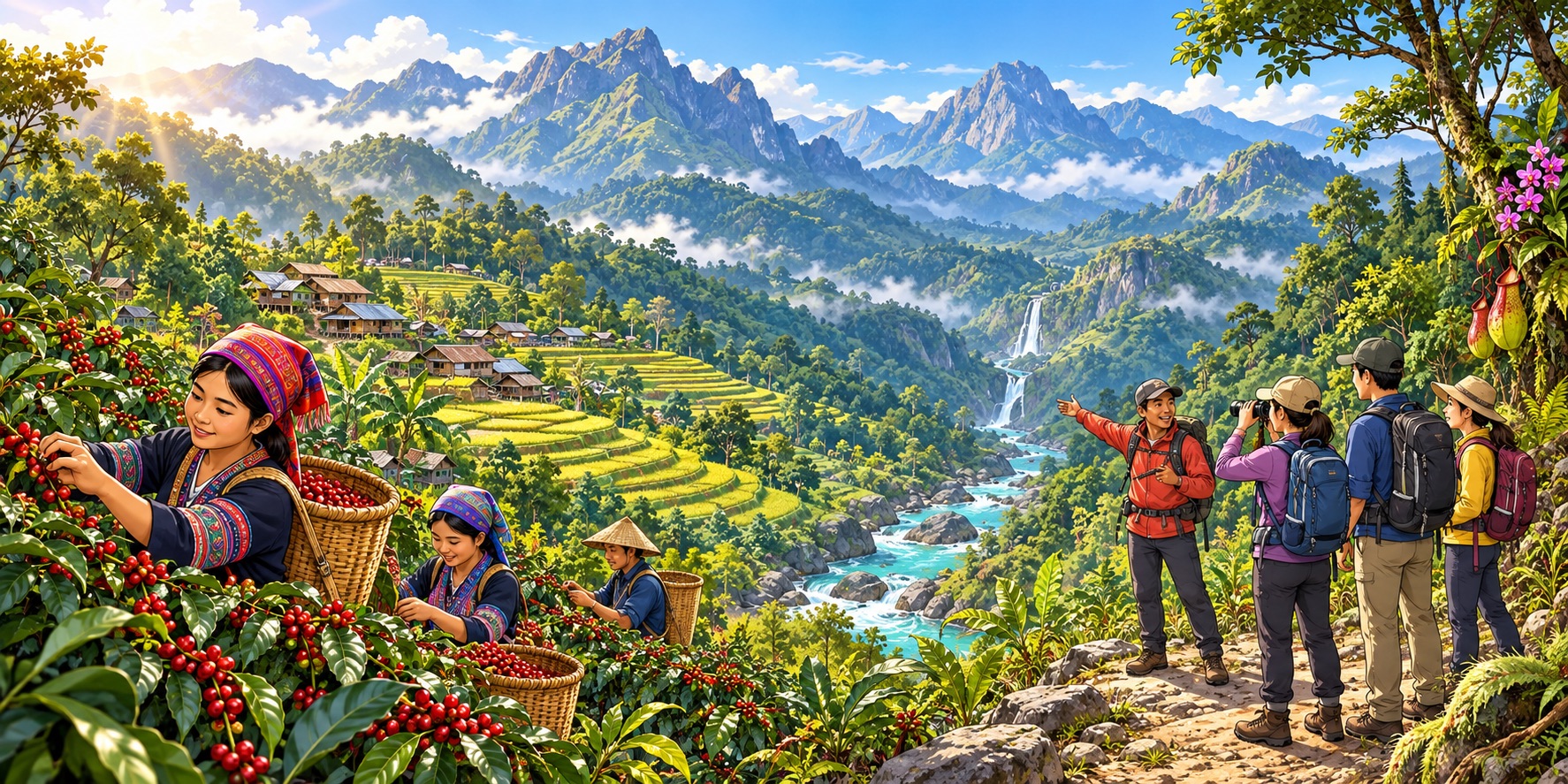
Mountain economies offer opportunities that extend beyond summit tourism. In the Philippine Cordillera, a project involving the Food and Agriculture Organization’s Mountain Partnership, the Philippine Department of Tourism and Slow Food connected small-scale producers with tourism businesses.
Itogon Arabica coffee and Kalinga Ulikan red rice from Pasil received Mountain Partnership Product narrative labels, which communicate the products’ origins and the communities behind them. The approach links food, agricultural heritage and visitor spending, giving travellers a way to engage with mountain life beyond the scenery.
Such initiatives offer a practical direction for highland development. Local processing, reliable buyers and recognition of traditional knowledge can help communities retain more value from their produce. Success should be judged by farmers’ earnings and working conditions, alongside sales and visitor numbers.
Connecting mountain energy responsibly
The economic reach of mountain water extends across national borders. In June 2022, the Laos–Thailand–Malaysia–Singapore Power Integration Project began trading up to 100 megawatts of Lao hydropower through existing connections. It became the first multilateral electricity trade involving four ASEAN countries.
That achievement demonstrates the potential of regional cooperation, but electricity generation must be assessed alongside river health. The Mekong River Commission’s guidance identifies risks involving fish migration, sediment movement and changes in water flows. These affect communities whose food and livelihoods depend on functioning rivers.
For mountain development, the central question is how benefits and costs are shared. Power revenues and greater energy security need to be considered together with downstream impacts and the interests of people living near projects.
Making every climb count
Mountain tourism creates work for guides, porters and local businesses. It also places responsibility on operators and visitors to respect difficult terrain.
In May 2026, Mountain Medicine Society Malaysia president Muhamad Aliff Abdullah warned against underestimating those conditions: “Many people see hiking as a low-risk activity, while the mountain environment can change very quickly and unpredictably.”
Speaking to Bernama, he described how idealised social-media content can encourage inexperienced hikers to attempt demanding routes without sufficient preparation.
The people guiding those climbs are also important custodians of mountain destinations. At a 2024 event supporting Kinabalu’s licensed guides, tourism operations specialist Lesley Hiew said: “The uniforms were designed with safety in mind, featuring elements of red to increase the visibility of guides.”
The modest detail points to a larger priority: professional support for the people responsible for visitors on the trail. Training, suitable equipment and clear communication deserve as much attention as destination promotion.
Southeast Asia’s mountains will remain sources of wonder, income and essential resources. Their future depends on development that respects ecological limits and gives highland communities a meaningful role in deciding what happens on the slopes they call home.


