Conservation efforts for the Sumatran rhinoceros have long centered on protecting its habitat and preventing poaching. Both remain essential, but neither solves a more basic problem. A species can be shielded from outside threats and still decline if too few of its members can reproduce.
Indonesia is now turning to science to close that gap. The approach aims to give the remaining animals more ways to breed and to secure a reserve of genetic material in case the living population keeps shrinking.
A Species Running Out of Chances
The Sumatran rhinoceros (Dicerorhinus sumatrensis) is the smallest living rhino and the only Asian species with two horns, according to the IUCN SSC Asian Rhino Specialist Group. It once ranged widely across Southeast Asia, but hunting and habitat loss have confined it to a few isolated populations in Indonesia.
Estimates of the wild population vary. IPB University put it at roughly 50 in September 2025, and the specialist group reported fewer than 50 in February 2026.
Isolation compounds the decline. Animals separated by distance rarely meet to breed, and limited genetic diversity leaves small populations more vulnerable over time. The IUCN counts both among the major threats to the species.
The animals’ health is also at stake. In a report published on September 7, 2025, IPB University’s assisted reproductive technology expert, Dr. Muhammad Agil, said that more than 70 percent of Sumatran rhinos rescued between 1980 and 1990 had reproductive-organ disorders.
That figure covers only the rescued animals of that period, not the population alive today.
How Technology Could Help
The initiative rests on two tools, assisted reproductive technology (ART) and biobanking, both outlined by the Ministry of Forestry.
ART covers techniques that help animals reproduce when natural breeding is difficult. The ministry lists artificial insemination, in-vitro fertilization (IVF), embryo transfer and the cryopreservation of reproductive cells and embryos, with the choice depending on the species and how far research has progressed.
For the Sumatran rhino, Agil said researchers are collecting sperm, eggs and skin cells to develop stem cells and artificial gametes. If natural reproduction becomes harder, these could become additional options.
Biobanking is the storage side. The ministry describes it as collecting and preserving genetic material such as sperm, eggs, embryos and tissue for future conservation work, and the IUCN Species Survival Commission’s 2025 guidelines set out how such samples can be collected, stored and managed.
At the September 2025 launch of the partnership, IPB University Rector Arif Satria argued that protecting wildlife also means preserving its genes in biobanks.
Material kept this way preserves genetic resources even as living populations shrink. It does not guarantee that cells or tissue will stay viable, or that healthy offspring can later be produced from them.
Where the Work Happens
The centerpiece of the project is a central ART and biobank laboratory at IPB University’s Dramaga campus in Bogor, West Java, where a groundbreaking ceremony was held on September 2, 2025. In its press release, the ministry described the laboratory as a base for protecting endangered wildlife through reproductive technology and genetic preservation.
The partnership also extends to facilities associated with the Sumatran Rhino Sanctuary in Way Kambas National Park, Lampung, and the Kelian Rhino Sanctuary in East Kalimantan. The ministry said the goal is to improve the chances of successful births.
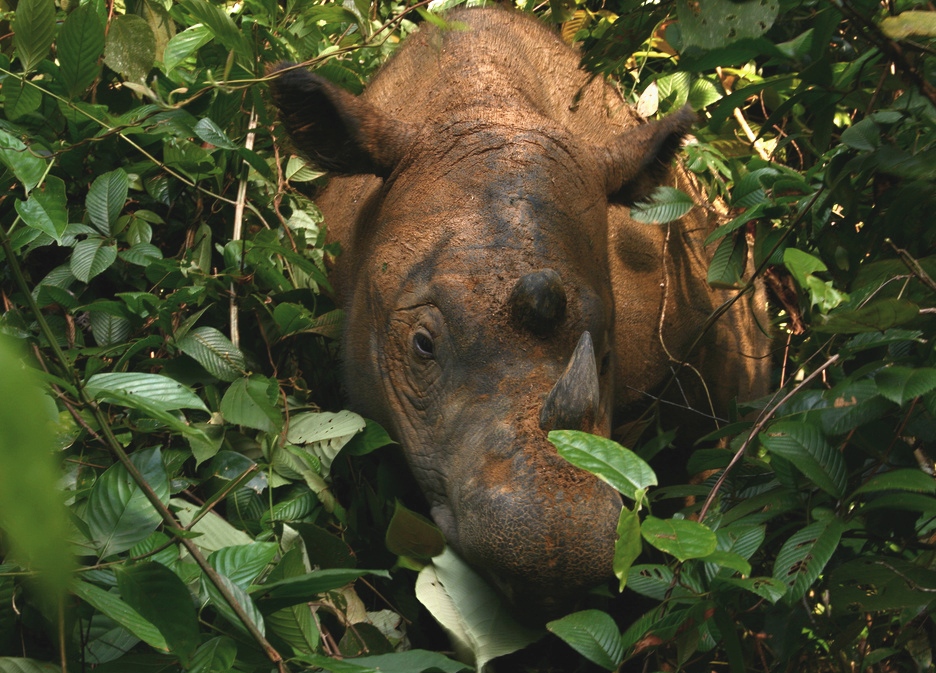
Natural breeding has already produced results at Way Kambas. A male calf named Indra was born there to Delilah and Harapan on November 25, 2023, which the International Rhino Foundation called a significant milestone, since Delilah was the first Sumatran rhino born in captivity to give birth herself.
The laboratory is meant to build on that record, working alongside habitat protection and conventional breeding.
A Promising Approach, Not a Guaranteed Rescue
Each step on the technical path is a separate problem. Developing reproductive cells, producing viable embryos and achieving a pregnancy all require their own research, and success at one does not carry over to the next.
IPB University researchers have reported producing Sumatran rhino embryos in vitro through intracytoplasmic sperm injection (ICSI), in which a single sperm is injected directly into an egg. In a report published on December 18, 2024, researcher Prof. Arief Boediono said the embryos could be frozen for later use or transferred to a suitable recipient.
An embryo in a laboratory is not a pregnancy, and no verified report to date says ART has produced a Sumatran rhino calf.
The pregnancies reported so far came from conventional breeding. In October 2026, the Ministry of Forestry said two females at the Way Kambas sanctuary, Ratu and Delilah, were pregnant after being bred with male rhinos.
Whether the technology earns a place in the species’ recovery will depend on whether it can eventually help produce healthy offspring.