


Days before United Nations Day, António Guterres brought a message of appreciation—and a call for change—to Indonesia. His October 17–19 visit connected presidential diplomacy with the service of Indonesian peacekeepers, highlighting how Southeast Asia can help strengthen an international system under pressure.
“Indonesia is a pillar of multilateralism in our changing world,” the UN Secretary-General said during his joint press encounter with Foreign Minister Arrmanatha Nasir in Jakarta on October 19.
From Hambalang to a Shared Global Agenda
Guterres arrived on Saturday, October 17, welcomed by Nasir at Soekarno-Hatta International Airport. The following day, he met President Prabowo Subianto at Hambalang, West Java, for discussions on reforming the multilateral system and advancing the 2030 Agenda for Sustainable Development.
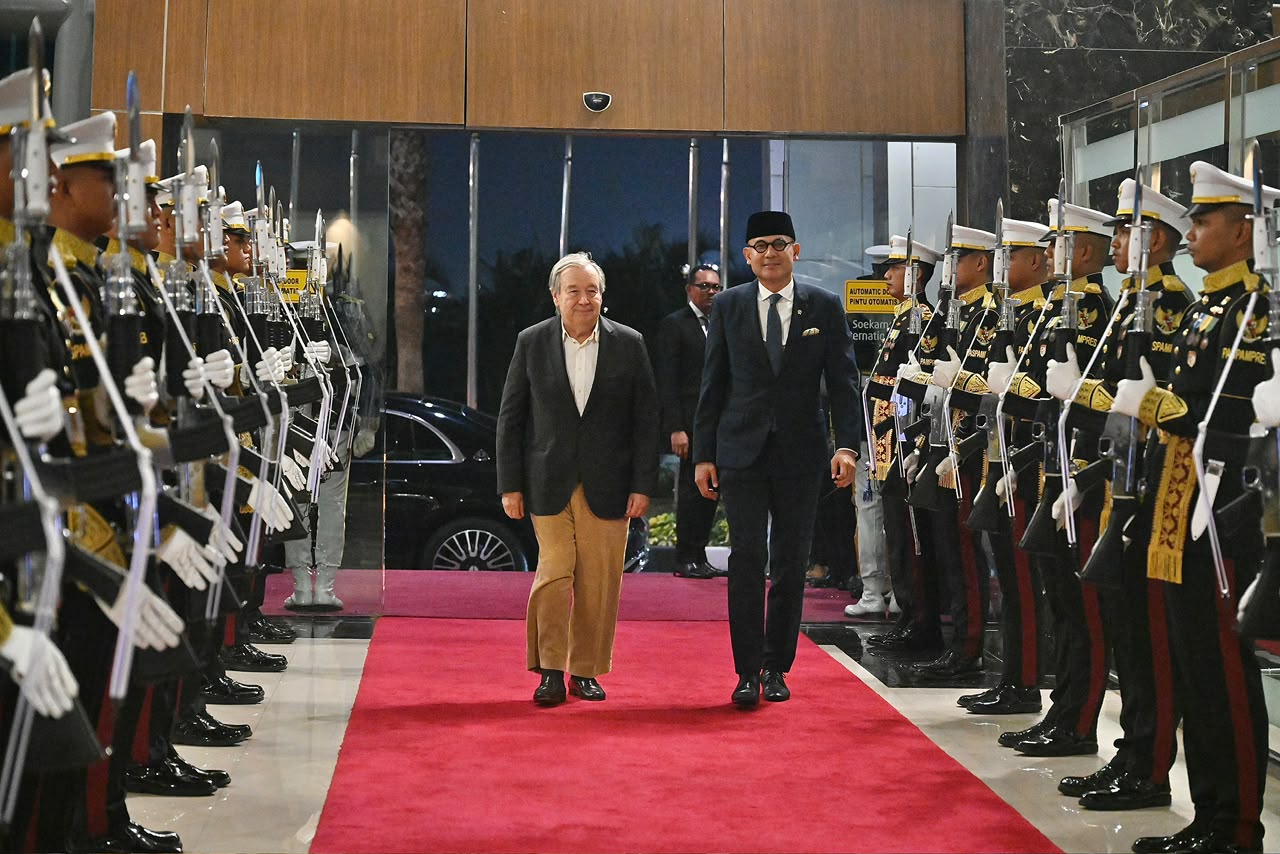
According to the UN’s meeting readout, Guterres thanked Indonesia for supporting the organisation, particularly through peacekeeping. He also recognised its leadership in innovative development financing and climate action. Their discussion covered global and regional issues, including the Occupied Palestinian Territory.
These themes gave the visit a practical focus. International cooperation influences whether developing countries can finance public services, respond to climate risks and help resolve conflicts. Indonesia’s contribution extends from diplomatic proposals to personnel deployed far from home.
Honouring Service, Preparing the Next Mission
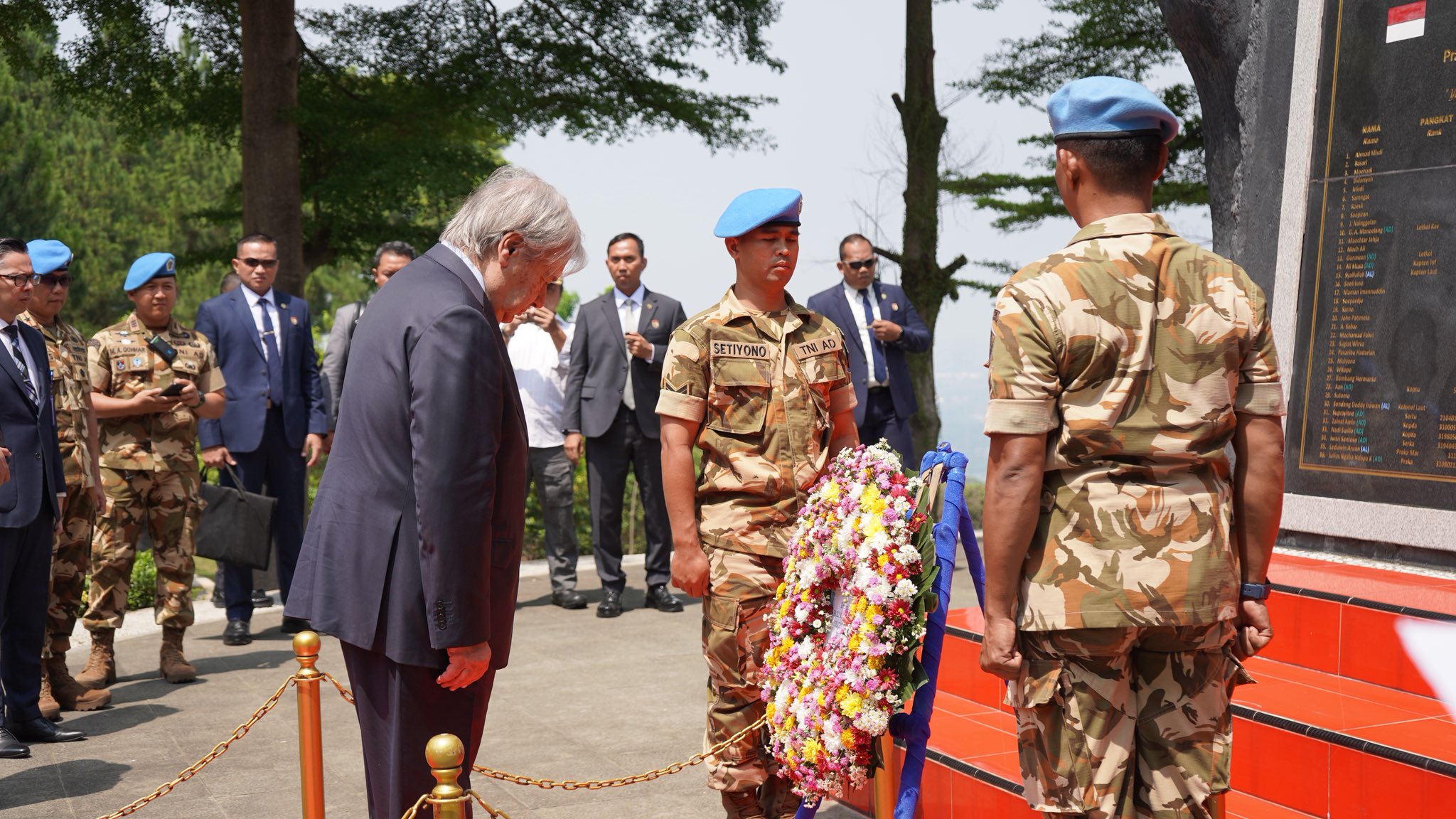
That human dimension came into focus on October 19 at the Indonesian Armed Forces Peacekeeping Centre in Sentul. Guterres laid a wreath in remembrance of Indonesian peacekeepers who had died in service, including four killed in Lebanon this year.
He also addressed personnel preparing to deploy to the Central African Republic under MINUSCA, the UN’s multidimensional stabilisation mission. The encounter brought remembrance and responsibility together: honouring those who had fallen while encouraging those preparing to serve.
UN News reported during the visit that Indonesia was the sixth-largest contributor of uniformed personnel to UN peacekeeping, with nearly 2,000 women and men serving across seven missions. Indonesia is also set to co-host the 2027 UN Peacekeeping Ministerial with the Netherlands.
For Indonesian families, these contributions carry personal significance. For the communities receiving peacekeepers, their value depends on civilian protection, security and the space created for political solutions. The visit recognised both the commitment involved and the need to safeguard personnel carrying out these mandates.
Reforming Institutions to Deliver Results
At the Ministry of Foreign Affairs, the discussion turned to whether global institutions adequately reflect today’s distribution of economic and political influence.
Guterres called for developing countries to have greater participation in international financial institutions, alongside reform of the UN Security Council. He also emphasised investment in sustainable development, climate commitments and broader access to the benefits of artificial intelligence.
Nasir made Indonesia’s position clear during the joint press statement.
“The Security Council must be a place for solutions, not a place for vetoes,” he said, translated from Indonesian, according to ANTARA. He also reaffirmed Indonesia’s commitment to peacekeeping and to shaping the UN’s security, humanitarian and development work.
The distinction is consequential: Indonesia’s criticism of institutional shortcomings accompanies continued engagement. Reform is intended to make cooperation more representative and effective, particularly for countries whose needs are not consistently reflected in global decision-making.
Bringing Southeast Asia’s Concerns to the Table
The visit also connected global reform with urgent regional concerns. Guterres expressed alarm over Myanmar’s deepening crisis and civilian suffering, calling for an end to violence, inclusive dialogue and the release of people arbitrarily detained.
He renewed his appeal to protect those fleeing persecution, including Rohingya refugees across the region. For Southeast Asia, these concerns involve immediate responsibilities surrounding displacement, humanitarian assistance and cooperation between neighbouring countries.
On Gaza, Guterres urged implementation of the peace plan and preservation of the two-state solution. He acknowledged Indonesia’s longstanding support for Palestinian self-determination. Nasir likewise reaffirmed support for Palestinian independence and a just, lasting peace.
Southeast Asia’s contribution to multilateralism also extends beyond Indonesia. Singapore co-founded the Forum of Small States in 1992 with Barbados and Cabo Verde. The informal grouping now brings together 108 countries, demonstrating how smaller states can organise across regions to strengthen their collective voice.
Indonesia’s peacekeeping and Singapore’s coalition-building illustrate different ways the region contributes: through operational service, diplomatic networks and sustained participation in global institutions.
Giving UN Day a Practical Purpose
United Nations Day on October 24 commemorates the entry into force of the UN Charter in 1945. This year marks its 81st anniversary. The organisation has grown from 51 founding members to 193 member states, reflecting a world substantially different from the one in which it was established.
Guterres’s visit offered a timely way to assess that legacy. In Hambalang, the focus was cooperation and development. In Sentul, it was service and sacrifice. In Jakarta, it was the reform needed to make international institutions more responsive.
As UN Day approaches, Indonesia’s role points towards a practical measure of multilateralism: whether cooperation protects people, expands opportunity and delivers results. Recognition of past contributions becomes more meaningful when it strengthens the commitment to what comes next.


