


At low tide, a mangrove forest reveals a busy world beneath its canopy: crabs crossing mud, young fish sheltering among roots and waterways connecting villages to the sea. Across Southeast Asia, these forests support livelihoods while storing carbon and helping protect vulnerable coastlines.
The region holds roughly one-third of the world’s mangroves. Indonesia has the largest national extent, with approximately 3.4 million hectares recorded in its 2021 National Mangrove Map—more than one-fifth of the global total, according to the World Bank. Protecting this coastal inheritance is a regional responsibility with global consequences.
A Climate Asset Beneath the Roots
Much of a mangrove forest’s climate value lies underground. Waterlogged soils accumulate organic material, storing carbon alongside the trees’ trunks, branches and roots. Clearing or disturbing these ecosystems can release carbon that has built up over long periods.
A landmark study published in 2015 estimated that Indonesian mangroves stored approximately 3.14 billion metric tonnes of carbon. That figure describes a carbon stock, rather than the amount absorbed each year.
“We hope that these numbers help policymakers see mangroves as a huge opportunity for climate change mitigation,” said Indonesian scientist Daniel Murdiyarso, the study’s lead author, in CIFOR’s announcement of the research.
The findings strengthen the case for conserving existing forests alongside rehabilitation. Mature ecosystems already provide carbon storage, habitat and coastal protection; newly planted seedlings need time and suitable conditions to develop those functions.
Living Protection for Coastal Communities
Mangrove roots, trunks and branches create resistance to moving water, helping reduce wave energy. They also trap sediment and contribute to shoreline stability.
A global modelling study published in Scientific Reports in 2020 estimated that mangroves prevent more than US$65 billion in flood-related property damage annually. Without them, approximately 15 million more people would experience flooding each year. These are global estimates, illustrating the economic importance of keeping coastal ecosystems intact.
Protection varies with forest width, condition, coastal topography and the nature of the hazard. Mangroves therefore belong within broader coastal planning that includes early warnings, evacuation systems and appropriate infrastructure. Their presence does not make a settlement immune to storms or tsunamis. Research also shows that losing coastal protection can involve changes in forest structure and distribution, beyond the hectares cleared.
For fishing villages and agricultural communities, maintaining a healthy coastal belt can help protect the land, roads and waterways on which daily life depends.
Keeping Fisheries and Forests Together
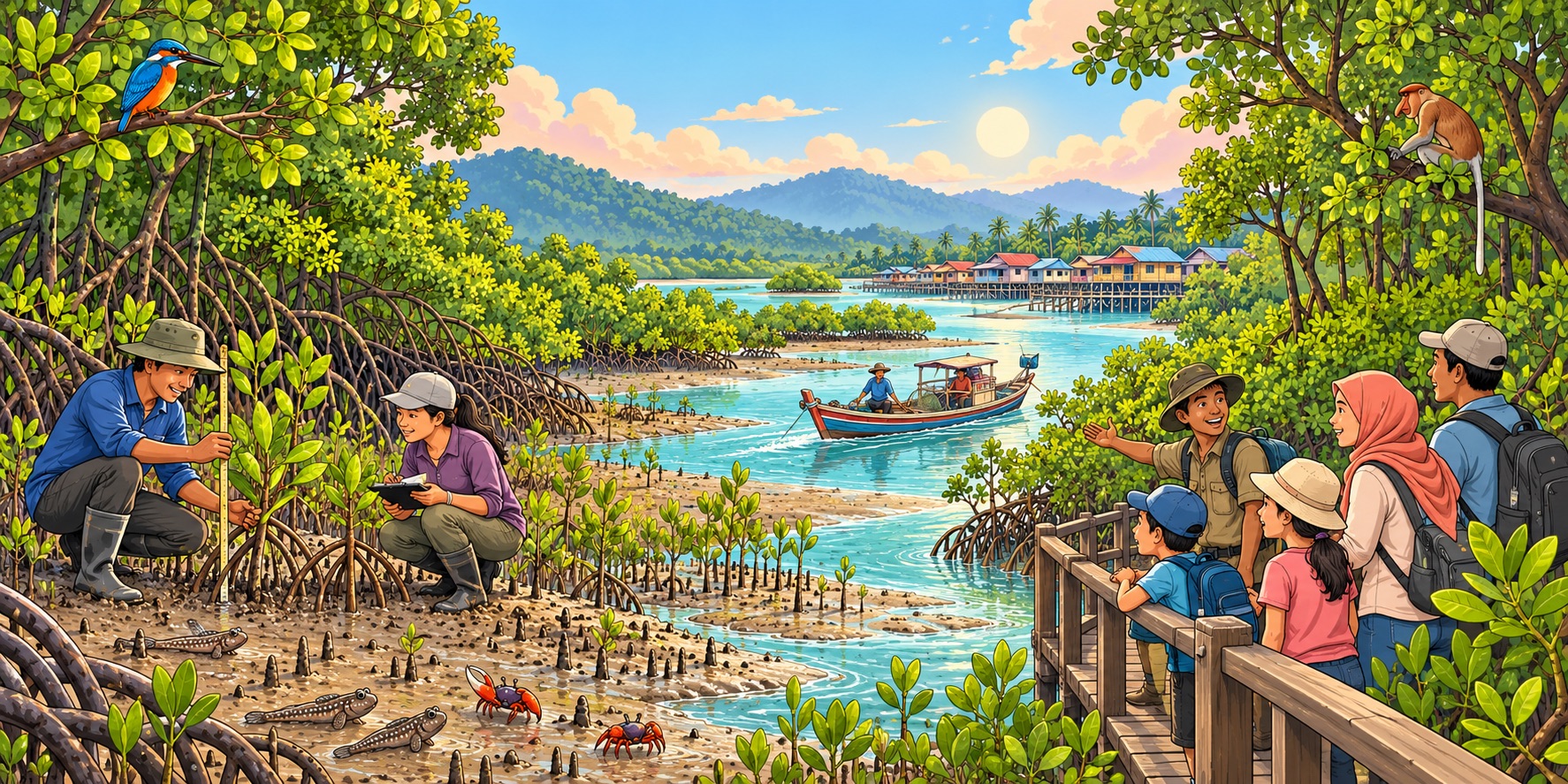
Mangroves provide shelter and feeding grounds for numerous fish and crustaceans. Their value reaches from small fishing boats to markets selling shrimp, crabs and other seafood. In Indonesia, they also support products such as honey and provide habitat for distinctive wildlife, including Borneo’s proboscis monkey.
Yet aquaculture expansion has been a major cause of mangrove conversion. Resolving that tension requires approaches that sustain livelihoods while retaining or restoring forest cover.
Vietnam’s Cà Mau offers a practical example. During the first phase of the Mangroves and Markets project, from 2013 to 2016, around 2,000 shrimp-farming households received training and technical assistance towards organic certification requiring 50% mangrove coverage on participating farms.
More recent IUCN work in Cà Mau combines mangrove rehabilitation with aquaculture training and livelihood support. Such integrated systems offer an alternative on suitable working landscapes, although they should not become a justification for converting intact forests into new ponds.
Restoring Forests That Last
Successful restoration begins with understanding tides, elevation, sediment and the reasons a forest disappeared. Planting the wrong species—or planting where mangroves do not naturally belong—can waste resources and damage other valuable coastal habitats. ZSL’s restoration guidance emphasises protecting existing forests and choosing interventions appropriate to each site.
Filipino mangrove specialist Jurgenne Primavera has urged organisations to measure results beyond planting-day totals.
“Biological success should be defined at the end: What was the percent [of] survival? How many hectares have been created?” she told Climate Tracker in 2022.
That distinction is important when assessing national ambitions. Indonesia’s widely cited 600,000-hectare rehabilitation target was announced with a 2024 deadline. It represents a policy commitment, not evidence that the entire area was successfully restored. Long-term monitoring is essential to establish survival, ecosystem recovery and benefits for communities.
Opening a Window onto Coastal Nature
Mangroves also offer opportunities for education and carefully managed tourism. Vietnam’s Cần Giờ Mangrove Biosphere Reserve, recognised by UNESCO in 2000, encompasses 75,740 hectares southeast of Ho Chi Minh City. Its proximity to a major urban centre demonstrates how coastal nature can remain connected to metropolitan life.
Guided visits and nature interpretation can help visitors understand what lies beyond the trees. The strongest programmes give local communities a meaningful role, minimise disturbance and help finance continued care.
Southeast Asia’s mangrove future depends on protecting existing forests and restoring damaged coastlines with patience and evidence. Success will be visible in surviving trees, functioning habitats and coastal communities able to sustain their livelihoods.


