


A waterfall announces itself before it comes into view. Along a forest trail, the sound grows louder, the air cools and mist gathers above the river. Across Southeast Asia, that encounter draws visitors into landscapes that also sustain villages, support livelihoods and hold cultural meaning.
From East Java’s plunging curtains of water to the limestone cascades of northern Laos, waterfalls reveal how closely tourism depends on healthy rivers—and how much happens upstream of the photograph.
Landscapes Shaped by Water
At Tumpak Sewu in East Java, streams spill over a curved cliff into a deep ravine. Indonesia’s official tourism and local government materials describe a drop of approximately 120 metres. Its scale makes the surrounding landscape as compelling as the falling water itself: forested slopes, steep canyon walls and the volcanic terrain around Semeru.
Kuang Si, near Luang Prabang in Laos, offers a different experience. Water descends through a succession of pools whose appearance changes with the seasons. The official Luang Prabang tourism guide distinguishes designated swimming areas and highlights the adjacent bear rescue centre, connecting a waterfall visit with wildlife education.
Farther northeast, Ban Gioc–Detian straddles the Vietnam–China border. Fed by the Quay Son River, its main cascade falls more than 30 metres over limestone steps. On the Vietnamese side, the surrounding Cao Bang landscape introduces visitors to caves, farming communities and the cultural traditions of Tay and Nung residents.
These differences help explain the region’s appeal. Some waterfalls are dramatic plunges; others spread across terraces or divide into narrow streams. Their character depends on geology, river flow and the seasonal movement of water through the catchment.
Turning Visits into Local Opportunity
A waterfall can bring customers to places that otherwise receive little tourism spending. Guides, drivers, food vendors and accommodation providers may all benefit, particularly when visitors stay beyond a brief photo stop.
Southern Laos illustrates those connections. Tad Fane’s twin cascades and gorge-crossing zipline form part of the Bolaven Plateau’s tourism offering, while nearby coffee-growing areas provide another reason to explore the highlands. Tourism Laos places waterfall attractions and the Bolaven Plateau Coffee Producers Cooperative along the same travel corridor.
The opportunity lies in connecting these experiences thoughtfully. A locally guided waterfall walk followed by a coffee visit can distribute spending among several businesses. Overnight stays can support village accommodation and restaurants.
Yet visitor numbers alone reveal little about who benefits. Local employment, fair arrangements with guides, access for residents and the allocation of entrance revenue all influence whether tourism strengthens the surrounding community. Maintaining paths, toilets and waste collection also requires reliable funding after the crowds leave.
Designing Tourism Around the Forest
Waterfall management begins well beyond the viewing platform. Roads, parking areas and trails can alter drainage, disturb vegetation and concentrate foot traffic. Good design needs to accommodate visitors while protecting the landscape they came to see.
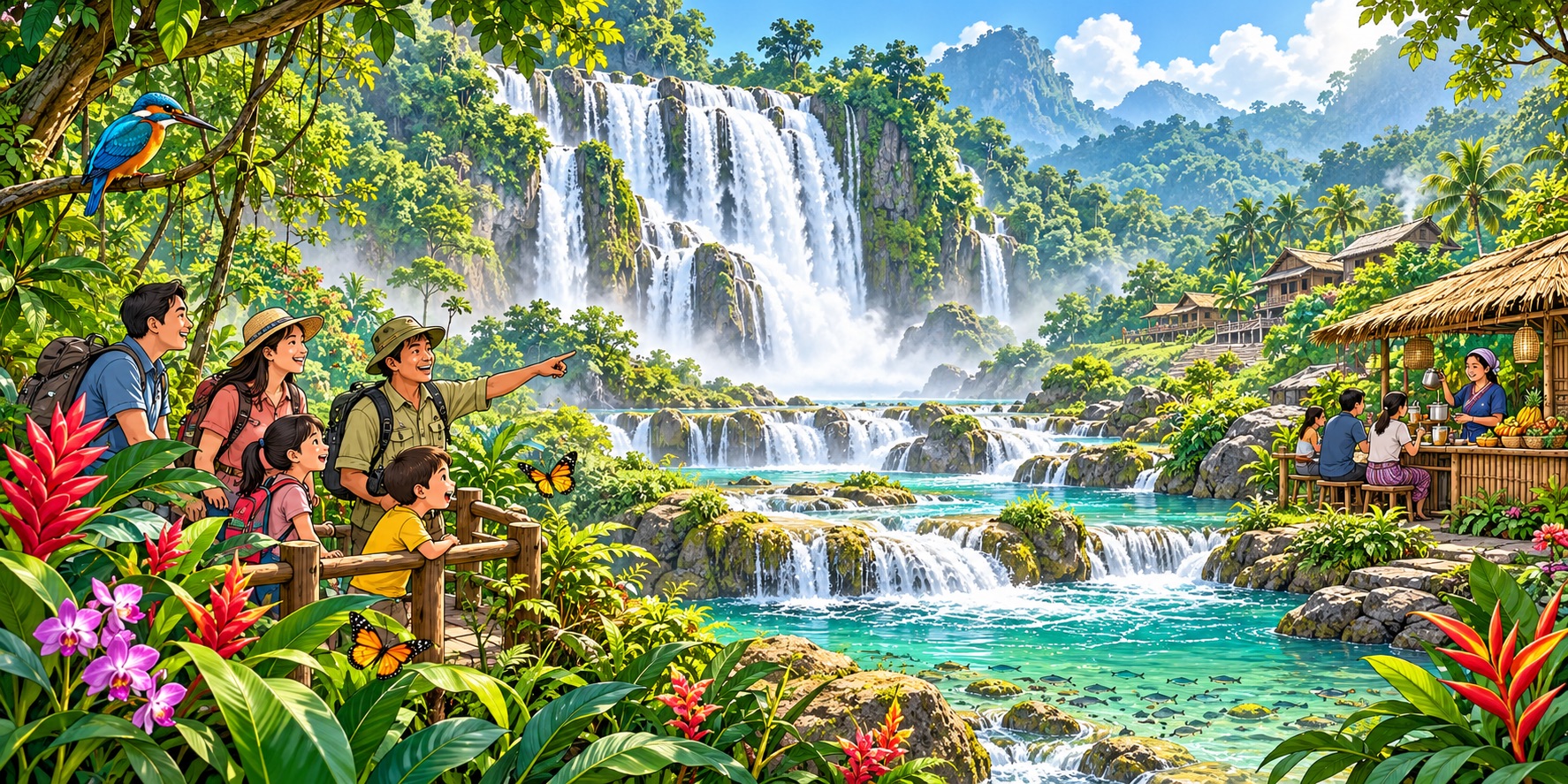
At Phrom Lok Waterfall in Thailand’s Khao Luang National Park, a nature-trail design initiative brought together conservation authorities, the Thai Rak Pa Foundation, EGCO Group and academic partners. The proposed route covered approximately three kilometres, with an estimated walking time of two and a half hours.
In the project announcement, Saengchan Waitook, identified as deputy director-general of Thailand’s Department of National Parks, Wildlife and Plant Conservation, described the waterfall forest as “an area of exceptional ecological importance and rich biodiversity.” The announcement anticipated opening the new trail by December 2026; that remained a planned milestone rather than a completed outcome.
Such projects offer a useful direction: give visitors a way to understand the forest, its water sources and its wildlife. Interpretation can turn a scenic stop into a lesson about the wider catchment.
Understanding the Power of Flowing Water
The elevation changes that create waterfalls also help explain hydropower’s potential. Electricity generation depends on both water volume and the difference in elevation, commonly called hydraulic head. A natural waterfall is not essential: hydropower installations can use dams or diversion channels to direct water through turbines.
This distinction is important in Southeast Asia, where river development must balance energy production with fisheries, farming and tourism. Run-of-river projects may require less storage than large reservoir schemes, but they can still divert flows and affect aquatic habitats. Renewable electricity therefore needs careful environmental assessment and operating rules.
“The Mekong cannot continue to lose sediment, otherwise it will cease to be the Mekong,” Anoulak Kittikhoun warned while serving as chief executive of the Mekong River Commission Secretariat. His remarks concerned the wider basin, where sediment trapping and sand mining were affecting river processes and downstream livelihoods.
For waterfall landscapes, the implication is clear: decisions upstream can change what communities and visitors experience downstream. Assessing energy potential requires attention to the entire river system, including the flows needed to sustain ecosystems and existing livelihoods.
Respecting Water’s Cultural Meaning
Water also carries meanings that tourism cannot reduce to scenery. In Sebatu, Bali, sacred water sites are associated with melukat, a purification practice rooted in Balinese Hindu tradition. Indonesia’s tourism-village directory identifies these places as part of the village’s spiritual heritage.
That context calls for respectful interpretation. Visitors need to understand when a water site is a place of worship, how local customs shape access and why photography or recreational bathing may be inappropriate in particular areas.
Community knowledge can deepen waterfall tourism in other ways, too. Residents’ accounts of seasonal flows, changing paths and local histories help explain a landscape that a viewpoint alone cannot reveal.
Southeast Asia’s waterfalls offer wonder, but their enduring value rests on the rivers, forests and communities around them. Protecting those connections can keep the water flowing while allowing tourism, cultural traditions and rural livelihoods to flourish together.


