


The minerals behind an electric vehicle, a smartphone or a power cable often begin their journey far from the finished product. Across Southeast Asia, mining and processing connect forested islands and industrial coastlines with global manufacturing. The opportunity is substantial: more investment, skilled employment and domestic industry. So are the consequences for land, water and communities.
The International Energy Agency’s 2026 ASEAN Energy Security Review estimates that the region holds around 51 percent of global nickel reserves, 20 percent of bauxite reserves and 17 percent of tin reserves. Turning that geological wealth into lasting prosperity requires more than increasing extraction.
Building More Value at Home
Indonesia has become the clearest example of Southeast Asia’s industrial ambitions. Its restrictions on unprocessed mineral exports encouraged companies to establish domestic processing facilities, helping transform nickel-producing areas such as Morowali in Central Sulawesi and Weda Bay in North Maluku.
The scale is striking. According to the US Geological Survey, Indonesia accounted for an estimated 62 percent of global mined nickel production in 2024. It also supplied approximately 19 percent of mined tin and 12 percent of mined cobalt, demonstrating an industrial role extending beyond one metal.
Processing ore domestically can create demand for engineers, maintenance workers, transport operators and local suppliers. However, larger export earnings do not automatically establish a complete manufacturing ecosystem. Technology transfer, workforce development and competitive domestic businesses determine how much value remains in the country.
At a national dialogue reported by the International Institute for Sustainable Development in July 2026, Indonesian mining official Yan Abrar argued that downstreaming should be assessed through higher-value industries, quality employment and stronger domestic supply chains—not simply the volume of material processed.
That distinction shifts attention from the number of smelters built to the economic capabilities they help develop.
Looking Beyond the Battery Boom
Nickel’s prominence in electric-vehicle discussions can obscure its wider industrial role. Stainless steel remains a major market, while some increasingly popular battery technologies, including lithium iron phosphate batteries, require no nickel.
Indonesia’s battery ambitions therefore depend on changing technologies as well as mineral availability. IISD’s national dialogue highlighted continuing dependence on imported materials such as lithium and graphite, alongside opportunities to manufacture more sophisticated stainless-steel products.
Other minerals connect Southeast Asia to different parts of the manufacturing economy. Tin is widely used in solder that joins electronic components. Bauxite is processed into alumina and then aluminium, used in transport, construction and solar-panel frames. Copper carries electricity through cables, motors and power networks.
Rare earths present another opportunity, but mineral deposits, commercially recoverable reserves and processing capacity are different measures. Vietnam illustrates why those distinctions deserve attention: in 2025, the USGS revised its estimated rare-earth reserves downward from 22 million to 3.5 million tonnes. Earlier descriptions of Vietnam as holding the world’s second-largest reserves consequently became outdated.
Across the region, capabilities vary. The Philippines is a major nickel producer, while Malaysia hosts a large rare-earth processing industry. These complementary strengths offer possibilities for regional manufacturing partnerships rather than identical national strategies.
Keeping Development at the Centre
International competition has increased attention to Southeast Asia’s minerals. Governments and manufacturers seeking dependable supplies are looking closely at the region’s deposits, processing facilities and trade relationships.
For regional specialists, however, the central question remains what these partnerships deliver locally.
“It has just become a tug of war between China and the US,” Singapore-based ODI Global researcher Mirza Sadaqat Huda told S&P Global, adding that “it is about economic development” for the region.
Diversifying investors and customers can help reduce exposure to a single market. Equally important are practical agreements on training, research, supplier development and access to technology.
Commodity cycles also complicate industrial planning. A mineral essential to global manufacturing can still experience oversupply and falling prices. Long-term development strategies need to remain viable through those fluctuations, rather than assuming that growing demand guarantees continuously rising revenues.
Powering a More Competitive Industry
Mineral processing requires substantial energy. In Indonesia, nickel refining has become closely associated with captive coal-fired power plants serving industrial facilities. This creates a difficult contradiction when the resulting materials enter products marketed as part of the low-carbon transition.
The IEA identifies cleaner electricity, dependable infrastructure and diversified industrial inputs as important to the sector’s resilience. It also highlights how reliance on imported processing technologies and materials can persist even after domestic refining capacity expands.
Reducing emissions involves more than installing solar panels beside a smelter. Industrial operators need reliable electricity supplies, suitable grid connections, storage where appropriate and improvements in process efficiency. Different locations will require different combinations.
The commercial implications are significant. Buyers increasingly examine how materials are produced, while lenders assess environmental risks. A stronger industrial base therefore depends partly on demonstrating that production can become cleaner without transferring additional costs to nearby communities.
Protecting the Landscapes Around the Mine
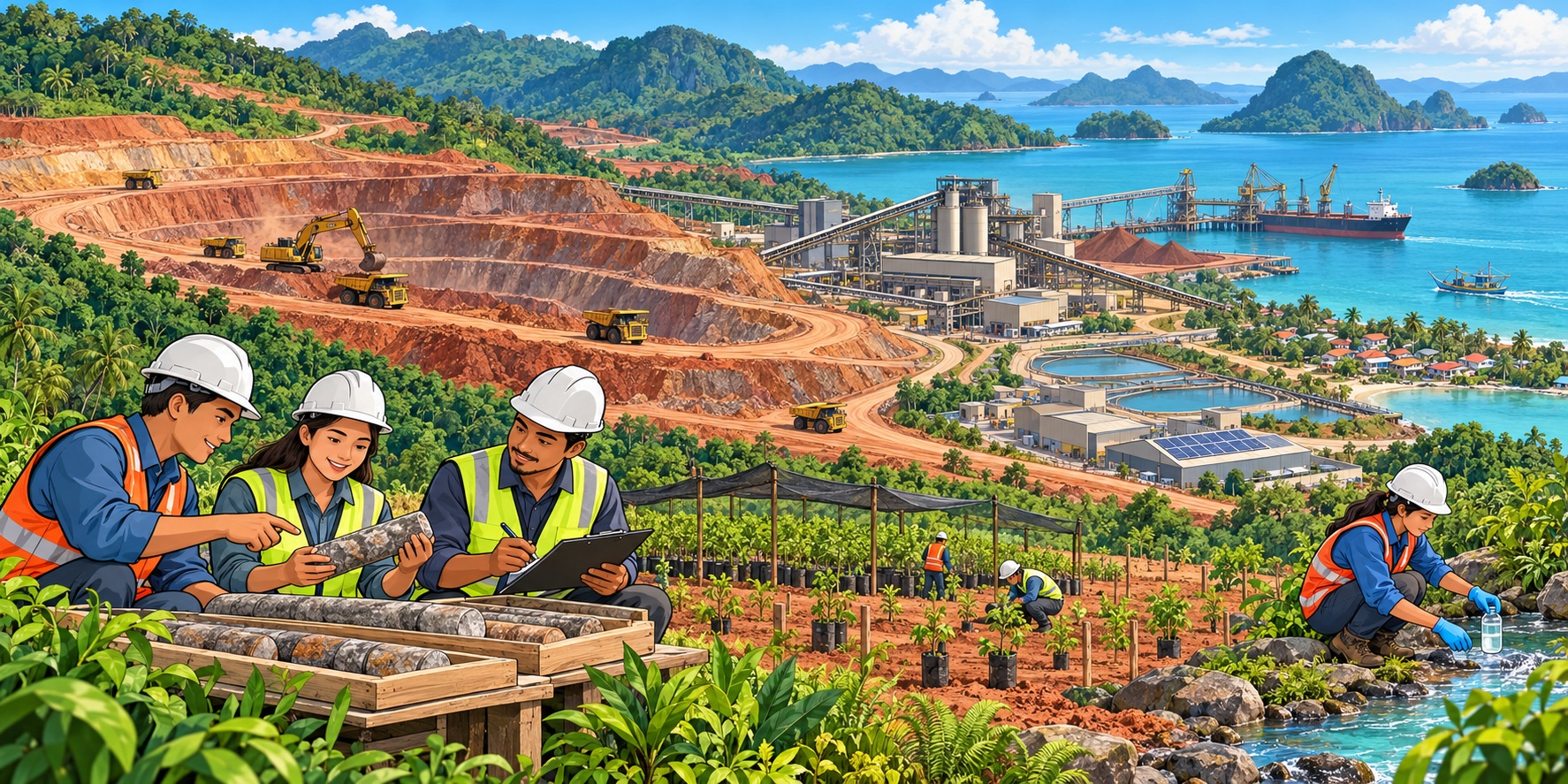
Mining decisions also shape economies outside the concession boundary. Forest clearance, erosion, contaminated runoff and poorly managed waste can affect farming, fishing and tourism. The precise risks depend on the ore, processing method, rainfall and quality of environmental management.
Raja Ampat brought those competing interests into public view. In June 2025, Indonesia revoked four mining permits in the island region following environmental concerns. The decision highlighted the tension between mineral development and protecting landscapes associated with exceptional marine biodiversity and tourism.
Credible monitoring is essential to resolving such disputes. Communities need accessible information about water quality, land rehabilitation, employment conditions and responses to complaints.
“The biggest weaknesses lie in transparency, accountability, and responsiveness,” Associate Professor Ika Idris said in a May 2026 Monash University account of research into Indonesia’s critical-minerals sector. Her team’s work connected satellite monitoring and data analysis with questions of public trust and regulatory oversight.
Smaller mining operations require attention too. Artisanal mining is not automatically synonymous with illegal mining, and improving conditions requires recognising its role in livelihoods. The planetGOLD programme supports formalisation, financing and alternatives to mercury in small-scale gold production, illustrating an approach that combines environmental protection with practical assistance.
Southeast Asia’s mineral wealth offers a powerful foundation for industrial development. Its lasting value will depend on the skills, businesses and public benefits built around extraction—and on whether communities retain healthy land and water when the mining ends.


