On the islands of the southern and central Philippines, a terrestrial bird species lives on the forest floor. The bird is known as the Mindanao bleeding-heart, scientifically named Gallicolumba crinigera. The bird species belongs to the Columbidae family, the pigeon and dove family.
Although classified within the pigeon family, the lifestyle of the Mindanao bleeding-heart centers on the forest floor. Daily activities such as searching for food take place across the forest understory. Its presence in the wild is bound to lowland forest ecosystems.
A Distinct Crimson Patch on a Pale Breast
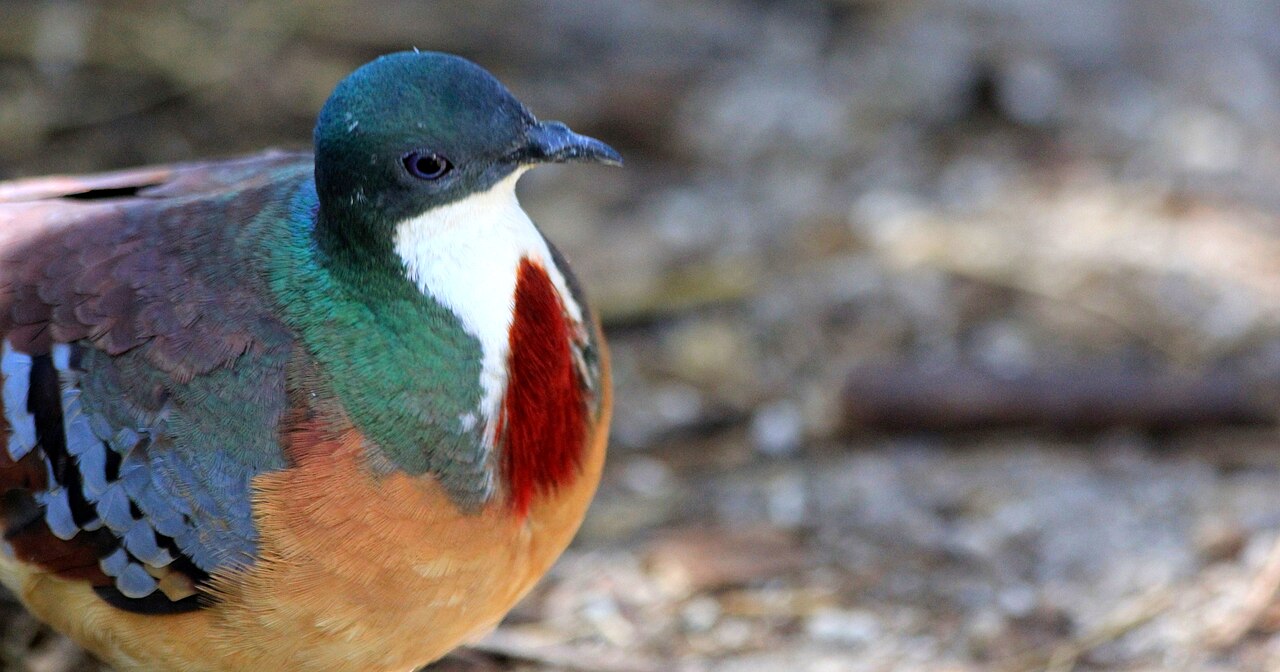
The body size of the Mindanao bleeding-heart is medium, which measures approximately 30 centimeters in length. Its physical structure appears compact, and features a relatively short tail. The legs are sturdy and reddish, which are adapted to support movement along the ground.
The most prominent hallmark of the bird lies in the coloration of its breast plumage. The upper underparts of the bird are covered in pale gray to whitish feathers. Right at the center sits a distinct, contrasting crimson patch resembling a bleeding mark.
Feathers on the crown, nape, and mantle display an iridescent green and bronze sheen when catching light. The back and upperwing-coverts feature dark brown plumage glossed with chestnut tones.
The tips of the wing-coverts show pale gray markings that create subtle wing bars. The tail plumage displays dark brownish shades with paler tips. Such a color combination provides effective visual camouflage among fallen leaves and forest litter.
Ground-Dwelling Habits in Forest Ecosystems
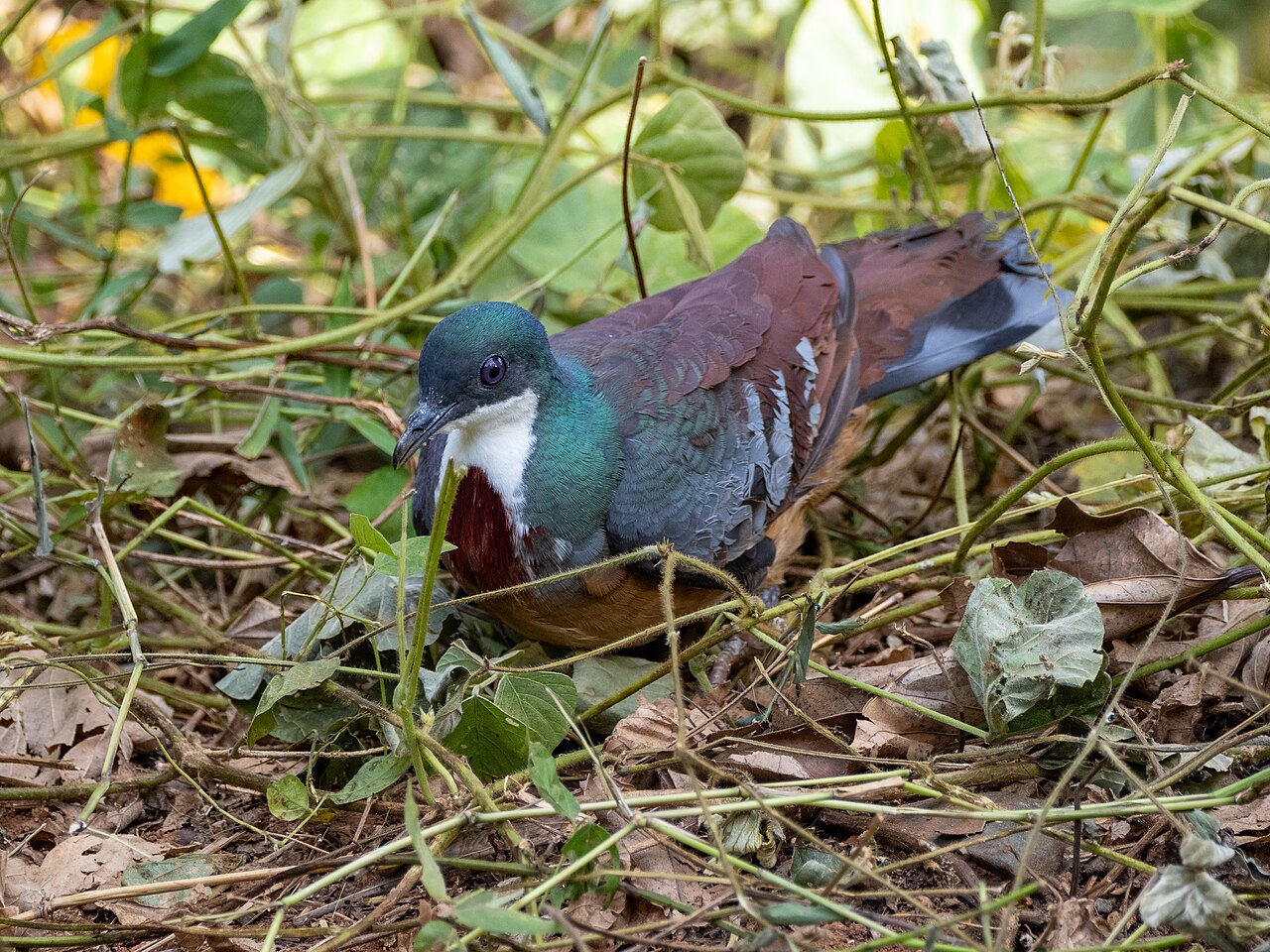
Gallicolumba crinigera exhibits a shy disposition and remains highly cautious of surrounding movement. When sensing potential danger, the bird does not immediately fly away. Its primary reflex action involves running swiftly across the forest floor to seek cover.
The flight capability of the Mindanao bleeding-heart remains limited to brief distances. The bird typically flaps its wings and flies low only when suddenly startled by threats. After traveling a short distance, the bird lands back onto the forest floor.
A lifestyle bound to the ground leaves the bird reliant on quiet forest surroundings. Foraging is conducted on the forest floor, where the bird feeds on fallen seeds, dropped fruits, and small invertebrates.
Reproduction occurs within shaded forest micro-habitats. The bird constructs simple platforms made of twigs and plant fibers. Nests are positioned low on understory vegetation or near ground level.
Lowland Forest Habitat Across Southern Philippine Islands
The habitat of the Mindanao bleeding-heart is centered within primary and secondary lowland forest ecosystems. It prefers dry forest substrates on gentle terrain. The elevation distribution extends from coastal lowlands up to lower mountain regions.
Within lowland forests, the species utilizes specific micro-habitat conditions. Favored locations include open forest floor areas underneath a closed canopy. The bird is also frequently observed in thick undergrowth, bamboo stands, and rattan thickets.
Locations near dry riverbeds containing small water pools serve as vital corridors for movement. A dense forest canopy provides necessary shade and humidity levels for daily activities.
Confirmed records of the bird cover several major islands in the Philippines. Documented locations include Mindanao, Samar, Leyte, Bohol, and Dinagat. Specific protected areas harboring the species include Mount Kitanglad Range Natural Park and Mount Malindang.
Reference:
BirdLife International. (2016). Gallicolumba crinigera. The IUCN Red List of Threatened Species 2016, e.T22690991A93298783. https://dx.doi.org/10.2305/IUCN.UK.2016-3.RLTS.T22690991A93298783.en