


In 2009, Malaysia and Brunei reached an agreement to settle a maritime dispute that had lasted for six years. The dispute involved two offshore areas believed to hold oil and gas reserves. Malaysia called them Blocks L and M, while Brunei referred to the same areas as Blocks J and K.
The agreement, signed on 16 March 2009, changed the status of the two areas. Malaysia would no longer manage them unilaterally. However, this development was later linked to a much older territorial issue: Limbang.
Limbang is a district in Sarawak, a Malaysian state that shares a border with Brunei. Its location also divides Brunei's territory into two separate parts. Brunei has long laid claim to the district, dating back to when the ruler of Sarawak took control of it in 1890.
A year after the 2009 agreement, allegations emerged that Malaysia had surrendered its rights to the two oil blocks in exchange for Brunei dropping its claim to Limbang. But were the two disputes really settled through a single agreement?
Limbang, a Territory Disputed Since 1890
The Limbang dispute began on 17 March 1890. On that date, Charles Brooke, the ruler of Sarawak, took control of Limbang from the Sultanate of Brunei and incorporated it into Sarawak.
The Sultan of Brunei at the time, Hashim Jalilul Alam Aqamaddin, rejected the takeover and demanded the territory's return.
The British government later stipulated that Sarawak could retain Limbang in exchange for paying Brunei annual compensation of 6,000 dollars. However, Sultan Hashim refused to accept the payments and continued protesting the decision until his death in 1906.
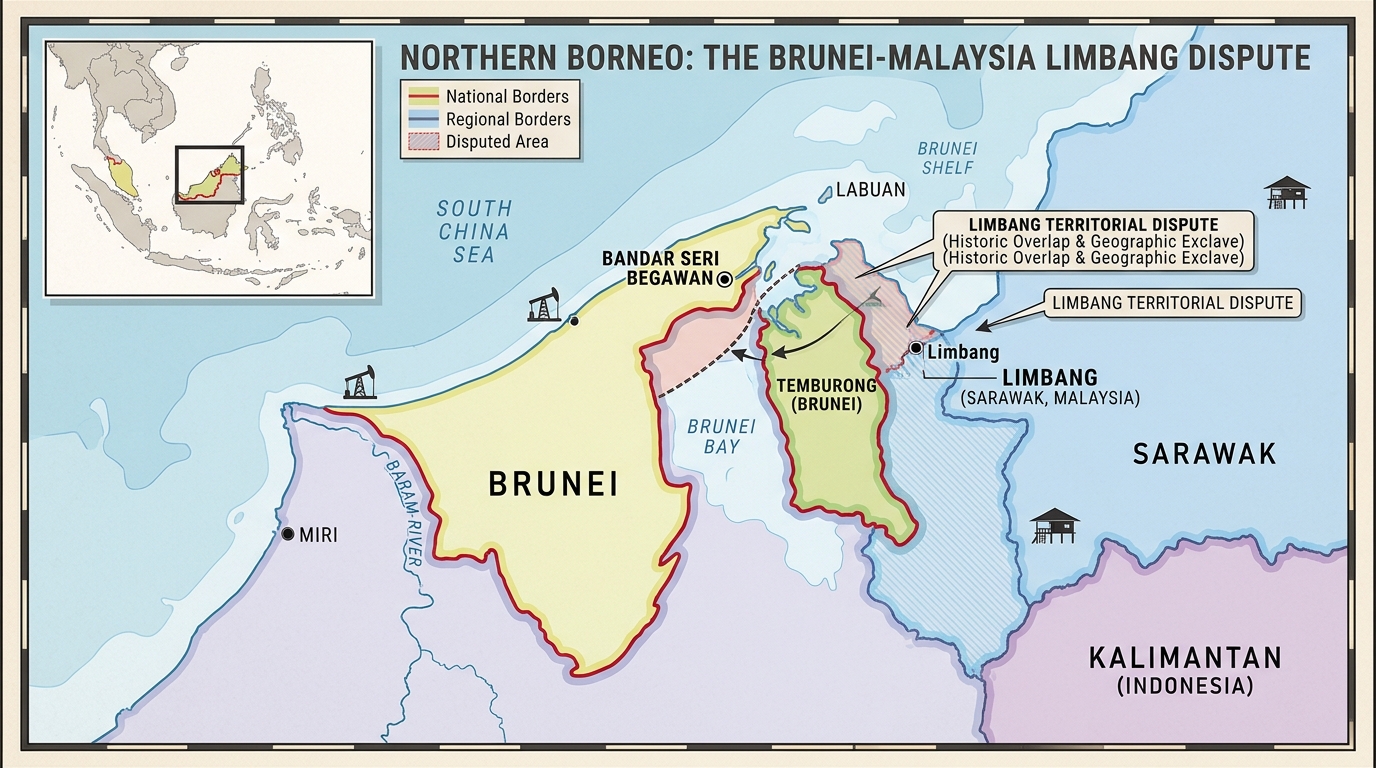
The dispute did not end with Sultan Hashim's death. Subsequent rulers of Brunei continued to assert their claim to the territory, including in 1951, 1963 and 1973.
When Sarawak joined Malaysia in 1963, Limbang became part of the country. Brunei, however, continued to contest Malaysia's control over the district.
Two Oil Blocks Disputed by Malaysia and Brunei
While the Limbang dispute dates back to the 19th century, the maritime dispute between the two countries only emerged in 2003. At the time, Malaysia's national oil company Petronas and Murphy Oil obtained licences to explore two offshore areas known as Blocks L and M.
The problem was that Brunei had also granted exploration licences for the same areas to energy companies Total and Royal Dutch Shell. The two countries used different names for these overlapping areas: Blocks L and M in Malaysia, and Blocks J and K in Brunei.
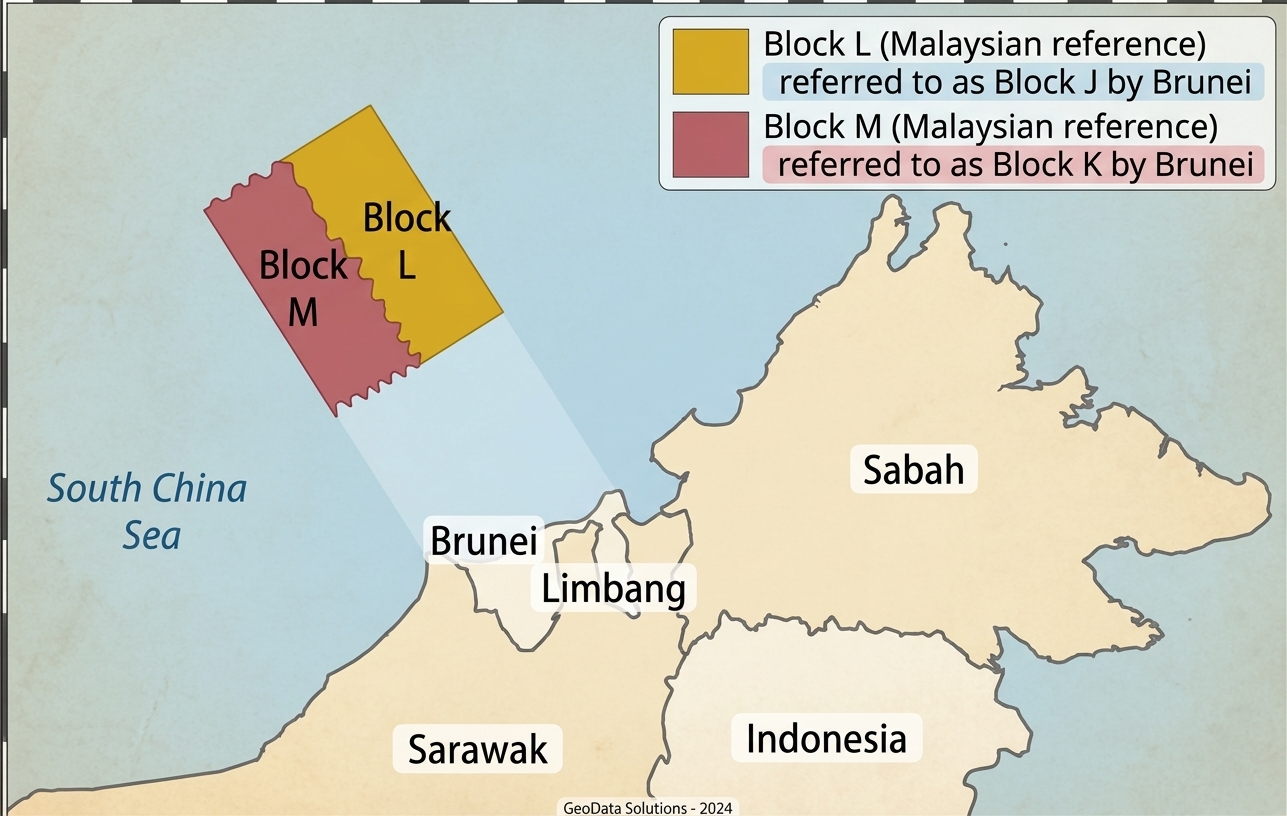
In effect, companies from both countries had received permission to explore for oil and gas in the same maritime areas, creating a dispute over their rights to develop the resources.
The dispute was subsequently addressed through an exchange of letters on 16 March 2009. According to Malaysia's Ministry of Foreign Affairs, the agreement established the final maritime boundaries between the two countries and created a Commercial Arrangement Area (CAA).
The CAA is a joint arrangement under which Malaysia and Brunei share revenue from oil and gas activities in the area. The agreement also granted Malaysian vessels passage rights through Brunei's waters.
Meanwhile, the two blocks previously known as L and M were no longer managed by Malaysia as they had been before.
Two Interpretations of the 2009 Agreement
Shortly after the agreement was signed, the Business Times reported in March 2009 that Brunei had dropped its claim to Limbang. However, Malaysia's foreign minister at the time said the territorial issue had not been discussed during negotiations between the two countries.
The debate intensified in 2010. Former Malaysian Prime Minister Mahathir Mohamad accused his successor, Abdullah Ahmad Badawi, who led Malaysia from 2003 to 2009, of negotiating an agreement with the Sultan of Brunei.
According to Mahathir, Abdullah had agreed to surrender Malaysia's rights to the two oil blocks in exchange for Brunei dropping its claim to Limbang.
In a blog post on 29 April 2010, Mahathir estimated that the decision could cost Malaysia at least US$100 billion, or approximately 320 billion ringgit, in potential revenue. His estimate was based on reports that the two blocks contained nearly one billion barrels of oil reserves.
However, this figure was Mahathir's own claim. He did not explain his calculations in detail, while the reserves in the two blocks had never been publicly audited.
The agreement also drew criticism from Malaysian opposition politicians. They questioned the decision-making process, including the lack of parliamentary involvement in an issue they considered related to the country's territory and sovereignty.
The Brunei government denied having dropped its claim to Limbang. According to its position, the territorial issue had not been discussed during the negotiations that led to the 2009 agreement.
Abdullah Ahmad Badawi also rejected Mahathir's allegations. He said the agreement did not disadvantage Malaysia and had been signed with Cabinet approval. He also maintained that Malaysia still had the opportunity to participate in developing the two offshore areas.
A further explanation came from Malaysia's Foreign Minister Anifah Aman during a parliamentary session on 9 June 2010. He said that, under a strict interpretation of the 1982 United Nations Convention on the Law of the Sea (UNCLOS), the two blocks clearly belonged to Brunei.
However, he also stated that Malaysia would continue to receive a share of the revenue generated from their development.
A 2016 report by The Star said Malaysia and Brunei had settled their land and maritime boundary issues around Limbang in 2009. However, the report did not clarify whether Brunei had formally withdrawn its claim to the territory.
In 2015, Malaysian Prime Minister Najib Razak and Brunei's Sultan Hassanal Bolkiah also discussed profit-sharing during their Leaders' Annual Consultation. The talks indicated that economic cooperation between the two countries continued after the 2009 agreement.
What Happened to the Two Oil Blocks?
Following the 2009 agreement, the management of the two oil blocks changed. On 1 May 2010, Petronas announced that Brunei had invited the Malaysian company to develop the two areas under a commercial arrangement.
The areas subsequently became known as Blocks CA1 and CA2, replacing their previous designations, Blocks L and M. The CA1 agreement was signed in Putrajaya on 21 September 2010, while the CA2 agreement was signed in Bandar Seri Begawan on 13 December 2010.
Under this arrangement, Petronas became the main operator. The development agreements have a term of 40 years and involve joint ventures between companies from both countries.
In October 2016, The Star reported that the cooperation was expected to generate billions of dollars in revenue for Malaysia and Brunei. However, the estimated oil reserves and revenue-sharing ratio between the two countries were not publicly disclosed.
These developments show how the dispute over the two oil blocks eventually evolved into a joint development arrangement between Malaysia and Brunei. The Limbang issue, however, remains a separate matter.
To this day, no official source has confirmed that Brunei formally withdrew its claim to the territory. At the same time, there has been no official clarification indicating whether the claim remained active after the 2009 agreement.
The 2009 agreement therefore changed how Malaysia and Brunei managed the maritime areas they had previously disputed. Whether that change was also connected to the settlement of the Limbang claim, however, remains an unresolved part of the two countries' shared history.


