Koh Ker is an ancient archaeological site located in Preah Vihear Province, Cambodia. The location was known to local people in the past as Chok Gargyar. The ancient name means the city of ironwood trees.
The historical site was built in the tenth century CE by the Khmer Empire. The remnant became part of Southeast Asian history when the center of power of the Khmer Empire temporarily shifted from the Angkor region.
Relocation of the Capital City by Jayavarman IV
Before the tenth century CE, the center of power of the Khmer Empire was located in the Angkor region. The seat of government was situated in the city of Yasodharapura. The city of Yasodharapura was founded by Yasovarman I and became the center of royal activities starting in the late ninth century.
The Khmer rulers made Yasodharapura their primary seat of government. All political and religious activities took place in the region. The city served as a center of settlement and governance for several decades.
The center of power of the Khmer Empire moved to a new location in 928 CE. Jayavarman IV relocated the capital from the city of Yasodharapura to Koh Ker. The relocation occurred due to a succession dispute over the throne between the king and his nephews within the royal family.
As the new ruler, Jayavarman IV built a capital at Koh Ker. The decision allowed Koh Ker to function as the new seat of government during his reign.
The city of Koh Ker served as the seat of government for nearly two decades. The area accommodated the center of court activities and new settlements for the people of the kingdom.
Construction of the Water Infrastructure at the Rahal Reservoir
Construction at Koh Ker began with the creation of water storage facilities. The royal government constructed a large-scale artificial reservoir named Rahal. The water storage structure was built to meet the water supply needs of the urban area.
The Rahal Reservoir was built with a length of 1,200 meters and a width of 560 meters. The massive water catchment was placed near the settlement areas of the people. The water structure collected rainwater during the rainy season.
The water supply from the reservoir was distributed through moat channels around the settlement. The channel network supplied water for the daily needs of the people and the irrigation of surrounding rice fields.
Construction of the Main Monument of the Prasat Thom Pyramid
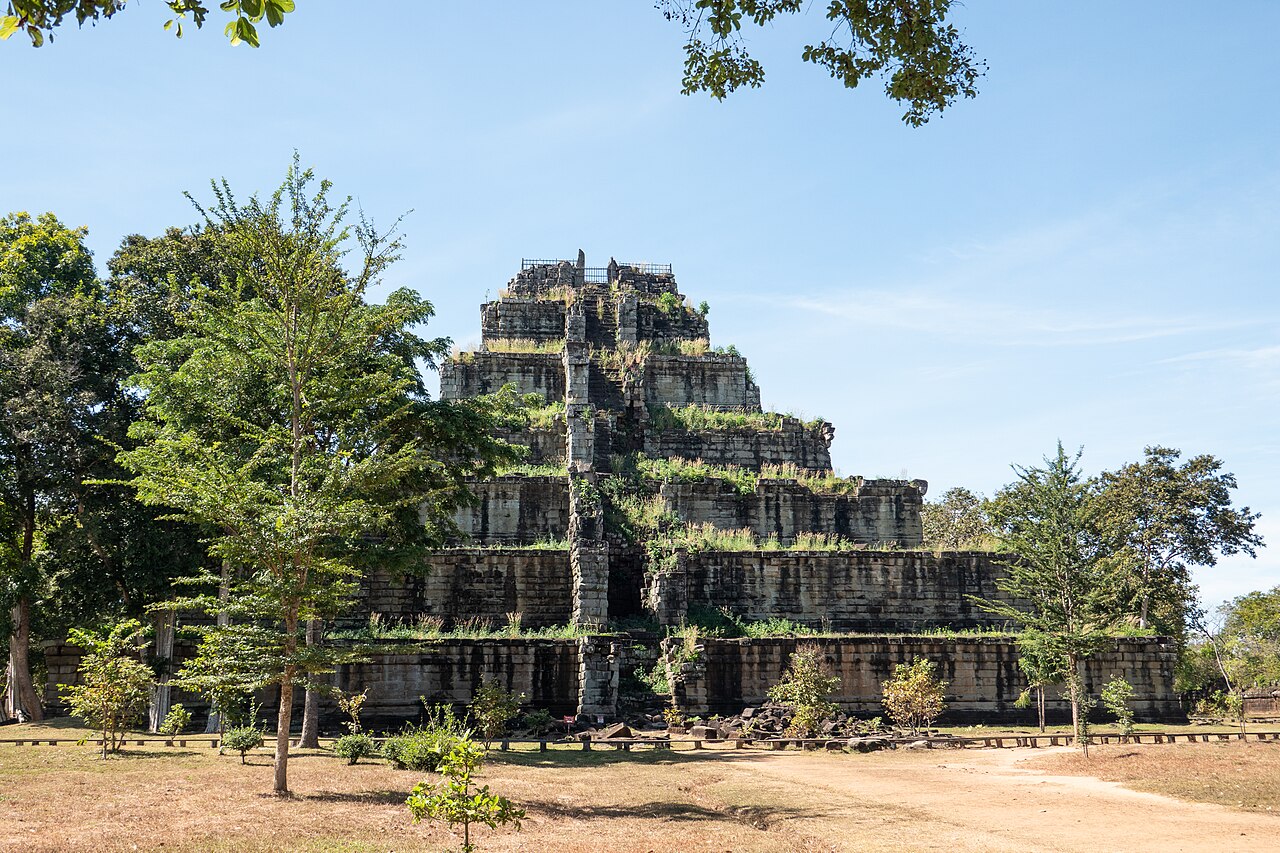
After the water reservoir was built, the kingdom erected the main structure named Prasat Thom. Before entering the main temple area, there is a red-brick gateway structure named Prasat Krahom. The main building of Prasat Thom itself takes the form of a seven-tiered stepped pyramid.
Prasat Thom was built to a height of 36 meters with a base measuring 55 meters. All tiers of the temple building were constructed using sandstone. The choice of sandstone differed from earlier structures that relied more heavily on red brick.
At the top of the pyramid stood a sanctuary structure. The summit was dedicated as the primary site of worship for Lord Shiva. The tiered pyramid design became a unique structure that was never replicated in the Angkor region.
Return of the Seat of Government to the Angkor Region
The period of Koh Ker as the seat of government continued under the rule of Harshavarman II. After his reign ended in 944 CE, the succeeding ruler, Rajendravarman II, relocated the capital back to Yasodharapura.
The decision led to the seat of government of the Khmer Empire operating once again from the Angkor region. The stone structures at Koh Ker were gradually abandoned until they were covered by forest vegetation.