The Atlas moth is an insect from the family Saturniidae. The scientific name of the nocturnal animal is Attacus atlas. The moth is recorded as having the largest wing surface area of all moths.
Its maximum recorded wingspan reaches 300 millimeters or 30 centimeters. The dimension exceeds the width of an adult human palm. The naming of the moth refers to the Titan Atlas in Greek mythology.
Broad Wing Anatomy That Deceives Predators
The wing dimensions of Attacus atlas show a clear difference in proportion between male and female individuals. The body size and wingspan of females are much larger than those of males. The size difference is related to the reproductive functions of each sex.
The female abdomen appears wider to store hundreds of eggs. In contrast, males have feathery antennae on their heads. The antennae function to detect the scent of a mate's pheromones from a long distance.
The wing surface of the moth is dominated by a reddish-brown color. The color blends with black and white line patterns along the margins. In the center of all four wings, there are transparent triangular patches without scales.
The tips of the moth's forewings have curved indentations resembling the shape of a snake's head. When threatened by predatory birds, the moth drops to the ground. The insect then moves its wings slowly to mimic the movements of a snake.
Surviving on Fat Reserves from the Larval Stage
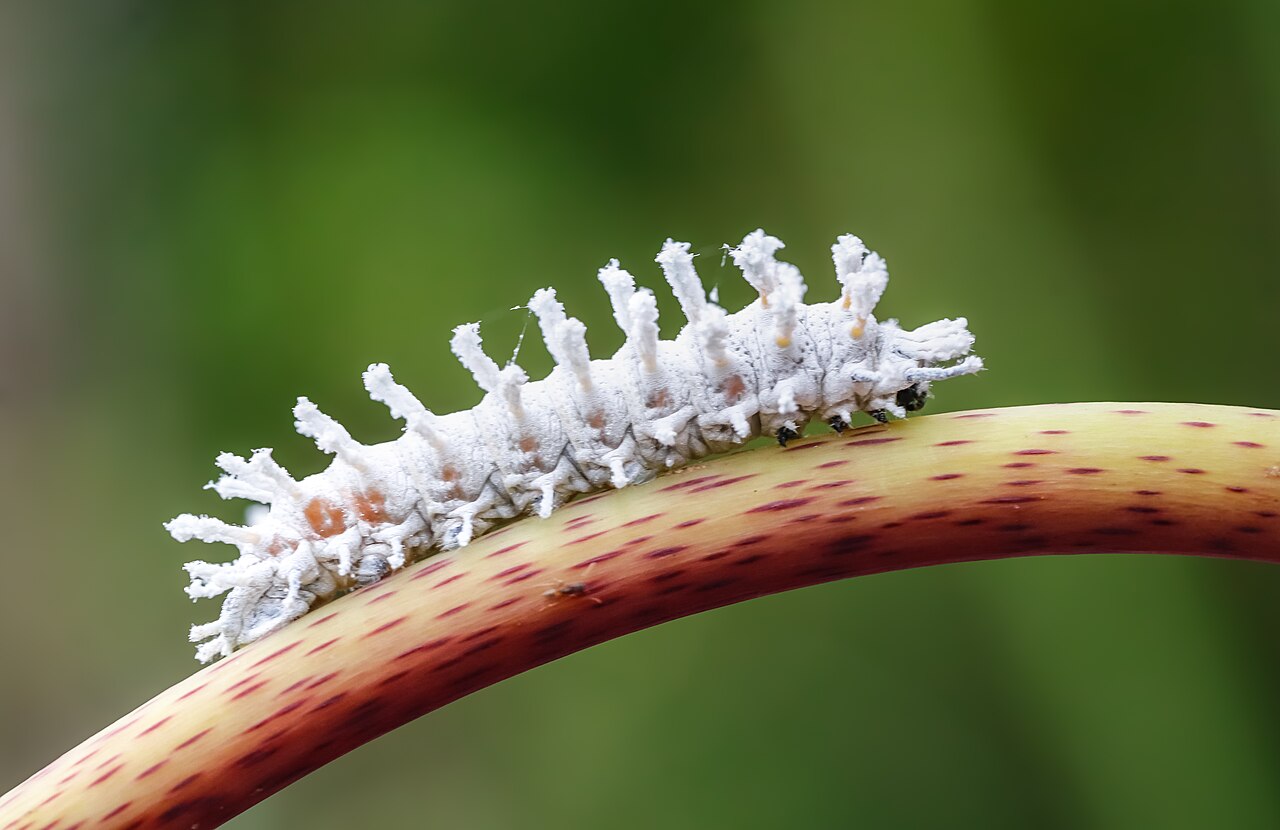
The energy supply for the adult stage is gathered entirely during the larval or caterpillar stage. The Attacus atlas caterpillar has a pale green body. The surface of its skin is coated with a white waxy powder resembling flour.
During the growth period, the caterpillar feeds on tree leaves continuously. The larva often moves from one plant to another during its development. Once energy reserves are sufficient, the caterpillar spins silk threads to form a cocoon.
Upon emerging as an adult moth, the insect lacks functional mouthparts. Its digestive tract is also undeveloped for digesting food. The adult moth never eats or drinks for the rest of its life.
All of its flight activity relies purely on fat reserves from the caterpillar stage. The absence of new nutrient intake makes the adult stage brief. Adult individuals survive for only one to two weeks to reproduce.
Dependence on Host Trees in Asian Forests
Populations of Attacus atlas are distributed across tropical rainforest areas in Southeast Asia to China. Their natural habitat lies at altitudes ranging from sea level to about 1,500 meters. In terms of taxonomic relationship, the moth belongs to the tribe Attacini alongside wild silkmoths of the genus Samia.
The continuity of the moth's life cycle depends on the presence of host trees in the forest ecosystem. Adult females lay eggs on the underside of leaves. Newly hatched caterpillars immediately feed on the leaves of the tree where the eggs were laid.
Host plants serving as primary food for the larvae include the citrus and guava genera. In addition to both fruit plants, the caterpillars also consume cinnamon and soursop leaves. Plants from the rambutan group also serve as a natural food source for the larvae.
The cocoons left behind by Attacus atlas hold practical value for people across its distribution area. The cocoon fibers are processed into a durable silk fabric known as Fagara silk. In Taiwan, the empty cocoon shells of the moth are utilized as material for making pocket purses.
Reference:
Chen, M.-M., Li, Y., Chen, M., Wang, H., Li, Q., Xia, R.-X., Zeng, C.-Y., Li, Y.-P., Liu, Y.-Q., & Qin, L. (2014). Complete mitochondrial genome of the atlas moth, Attacus atlas (Lepidoptera: Saturniidae) and the phylogenetic relationship of Saturniidae species. Gene, 545, 95–101. http://dx.doi.org/10.1016/j.gene.2014.05.002