

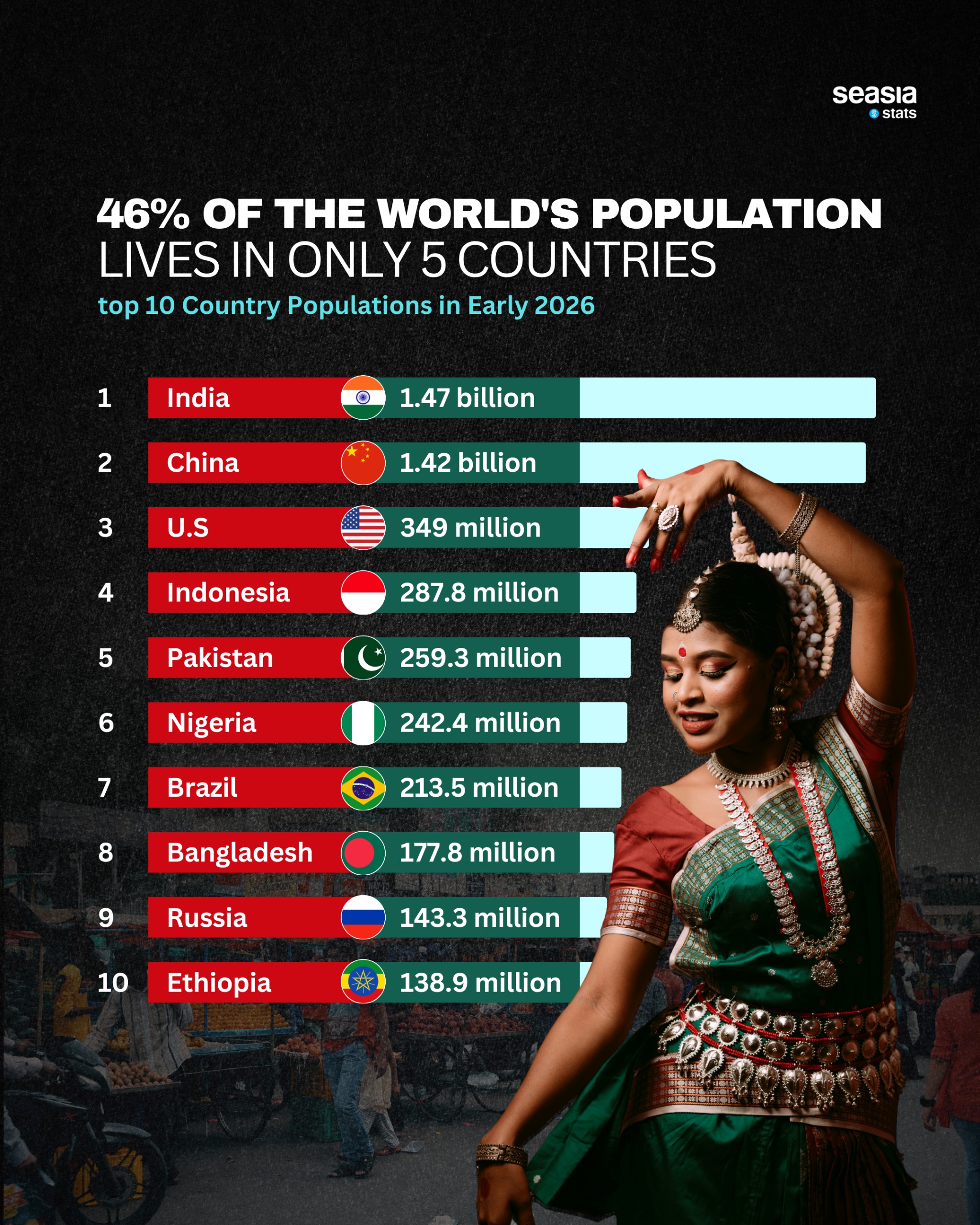
At first glance, the world map looks vast and evenly spread out. But the reality of global population tells a very different story. As of early 2026, a staggering 46% of the world’s population lives in just five countries, underscoring how human settlement is intensely concentrated in a handful of nations. This demographic imbalance carries profound implications for economics, urban planning, climate resilience, and global governance.
The Five Countries That Shape Global Demographics
The five most populous countries—India, China, the United States, Indonesia, and Pakistan—together account for nearly half of humanity, despite representing less than 3% of the world’s total number of countries.
India leads the world with approximately 1.47 billion people, having overtaken China, which now stands at around 1.42 billion. The United States ranks third with about 349 million, followed by Indonesia at 287.8 million, and Pakistan with 259.3 million. Each of these nations plays an outsized role in shaping global labor markets, consumption patterns, migration flows, and political influence.
Southeast Asia’s Demographic Giant: Indonesia’s Role
Among the top five, Indonesia stands out as the sole representative from Southeast Asia—and the region’s undisputed demographic heavyweight. As the world’s fourth-most populous country, Indonesia alone accounts for more than 40% of ASEAN’s total population. Its demographic scale gives it enormous regional influence, from consumer markets and digital adoption to workforce mobility across Southeast Asia.
Beyond Indonesia, other Southeast Asian nations may not crack the global top five, but they remain globally significant. The Philippines has surpassed 117 million people, while Vietnam recently crossed the 100 million mark—placing both among the world’s most populous nations. Thailand and Malaysia may have smaller populations, but their dense urban centers and aging trends introduce a different set of policy challenges.
Why Population Concentration Matters
When nearly half the global population is concentrated in just five countries, global risks and opportunities also become concentrated. Economic slowdowns, public health crises, or climate disasters in these nations can ripple across the world. At the same time, innovation, productivity gains, and poverty reduction in these countries can deliver outsized global benefits.
For Southeast Asia, this concentration highlights both opportunity and urgency. Rapid urbanization in cities like Jakarta, Manila, and Ho Chi Minh City mirrors the pressures seen in megacities across India and China—ranging from housing shortages to infrastructure strain. Yet it also fuels vibrant consumer economies and young labor forces that can drive future growth.
A Demographic Future Centered in Asia
One clear takeaway from the data is that Asia remains the center of global population gravity. Four of the five most populous countries are in Asia, and Southeast Asia alone is home to more than 680 million people. As fertility rates fall in some countries and remain high in others, demographic momentum will increasingly shape regional influence.
Ultimately, understanding where people live—and in what numbers—is key to understanding where the world is headed. With nearly half of humanity concentrated in just five nations, the choices these countries make will shape the global future for decades to come.


