

Across Southeast Asia, the skies are becoming a new frontier of strategic transformation. As regional economies grow and geopolitical tensions subtly shift, ASEAN nations are investing heavily in next-generation air power—signaling not just military upgrades, but a broader recalibration of national security priorities.
A New Era of Air Power in ASEAN
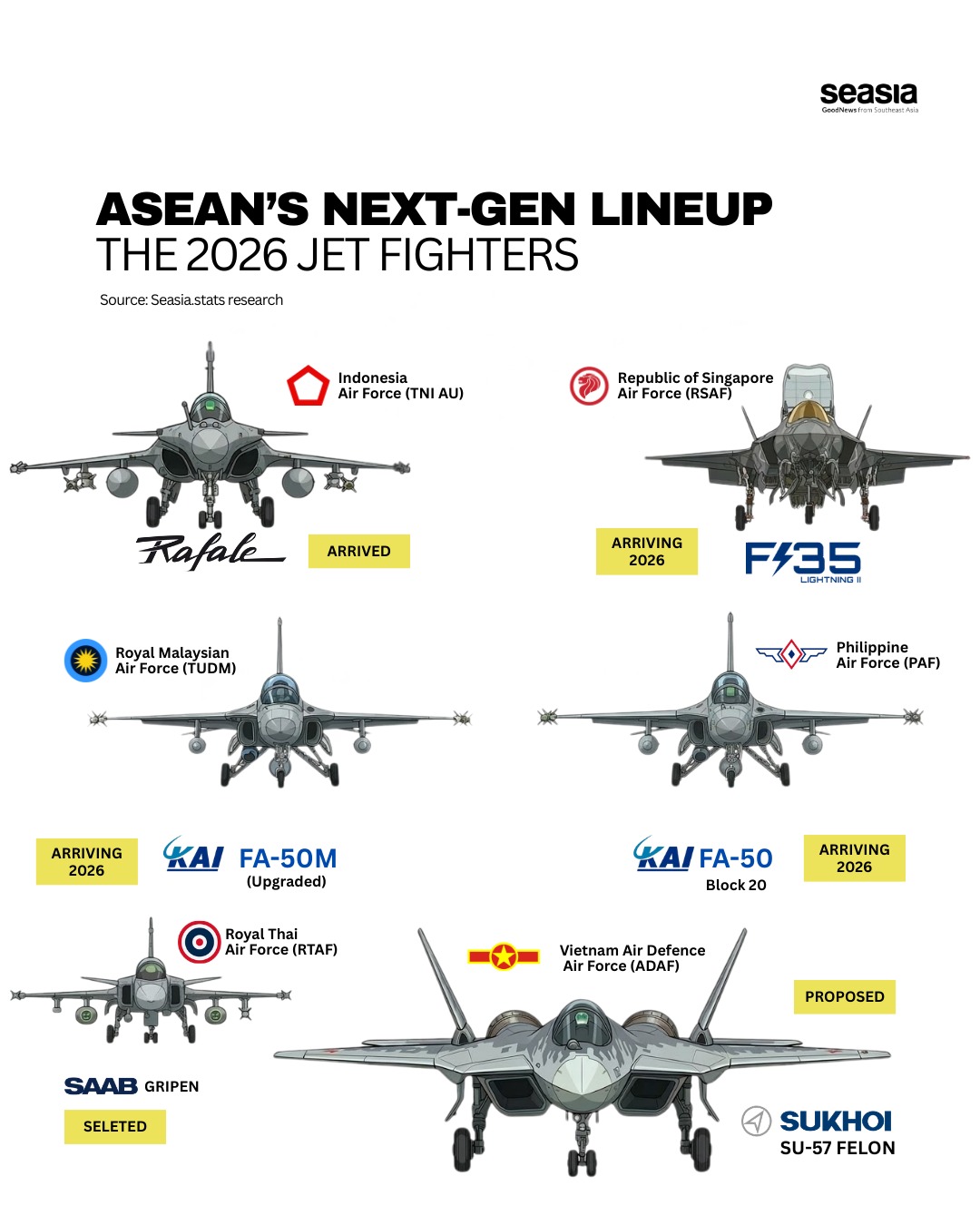
The 2026 landscape of Southeast Asia’s air forces reflects a decisive move toward modernization. According to Seasia Stats, Indonesian Air Force has already begun integrating the Dassault Rafale into its fleet. This acquisition marks one of Indonesia’s most significant defense upgrades in decades, enhancing both deterrence and operational flexibility across its vast archipelago.
Meanwhile, the Republic of Singapore Air Force is preparing to receive the F-35 Lightning II—a platform widely regarded as one of the most advanced combat aircraft in the world. With stealth capabilities, advanced sensors, and network-centric warfare systems, Singapore is reinforcing its long-standing reputation as Southeast Asia’s most technologically sophisticated military force.
As Defense News has noted, “the F-35 doesn’t just replace aircraft—it transforms how air forces fight and communicate in modern warfare.”
The Rise of Light Combat and Flexible Fleets
Not every country is pursuing high-cost stealth platforms. Instead, several Southeast Asian nations are opting for cost-effective, versatile aircraft that can handle both defense and everyday operational needs.
The Royal Malaysian Air Force is set to receive the upgraded KAI FA-50M, while the Philippine Air Force is bringing in the KAI FA-50 Block 20. These aircraft strike a balance between affordability and capability, making them ideal for countries managing both internal security and external defense.
This trend reflects a broader ASEAN reality: geography matters. With thousands of islands, long coastlines, and disaster-prone zones, air forces are often tasked with surveillance, humanitarian missions, and rapid response, not just combat.
According to FlightGlobal, “light combat aircraft are increasingly favored in emerging markets for their flexibility and lower lifecycle costs.”
Strategic Partnerships and Defense Diplomacy
Defense procurement in Southeast Asia is rarely just about hardware—it’s also about partnerships. Thailand’s decision through the Royal Thai Air Force to select the Saab JAS 39 Gripen continues a long-standing relationship with Sweden, emphasizing interoperability and technology transfer.
These choices often reflect diplomatic balancing acts, as ASEAN nations engage with Western, Russian, and regional defense suppliers simultaneously. The diversity of aircraft—from American stealth jets to Korean trainers and European fighters—underscores Southeast Asia’s multi-aligned strategic posture.
Vietnam’s Ambition and the Fifth-Generation Leap
Perhaps the most ambitious development comes from the Vietnam Air Defence Air Force, which has proposed acquiring the Sukhoi Su-57. If realized, this would mark Vietnam’s entry into the elite group of nations operating fifth-generation stealth fighters.
While still in the proposal stage, the move signals Vietnam’s intent to significantly elevate its air superiority capabilities, particularly in a region where maritime and airspace disputes remain sensitive.
As The Diplomat observed, “Vietnam’s modernization efforts reflect a careful but steady push to enhance deterrence without provoking escalation.”
A Region in Transition
Taken together, these developments point to a region undergoing quiet but profound change. Southeast Asia is not entering an arms race in the traditional sense—but it is clearly raising the baseline of military capability.
Each country is charting its own path:
– Indonesia strengthening sovereignty across its vast territory
– Singapore maintaining technological superiority
– Malaysia and the Philippines building flexible, multi-role forces
– Thailand reinforcing strategic partnerships
– Vietnam exploring next-generation deterrence
In the end, ASEAN’s next-generation fighter lineup is about more than jets. It is about preparedness, balance, and the evolving definition of security in one of the world’s most dynamic regions.


