

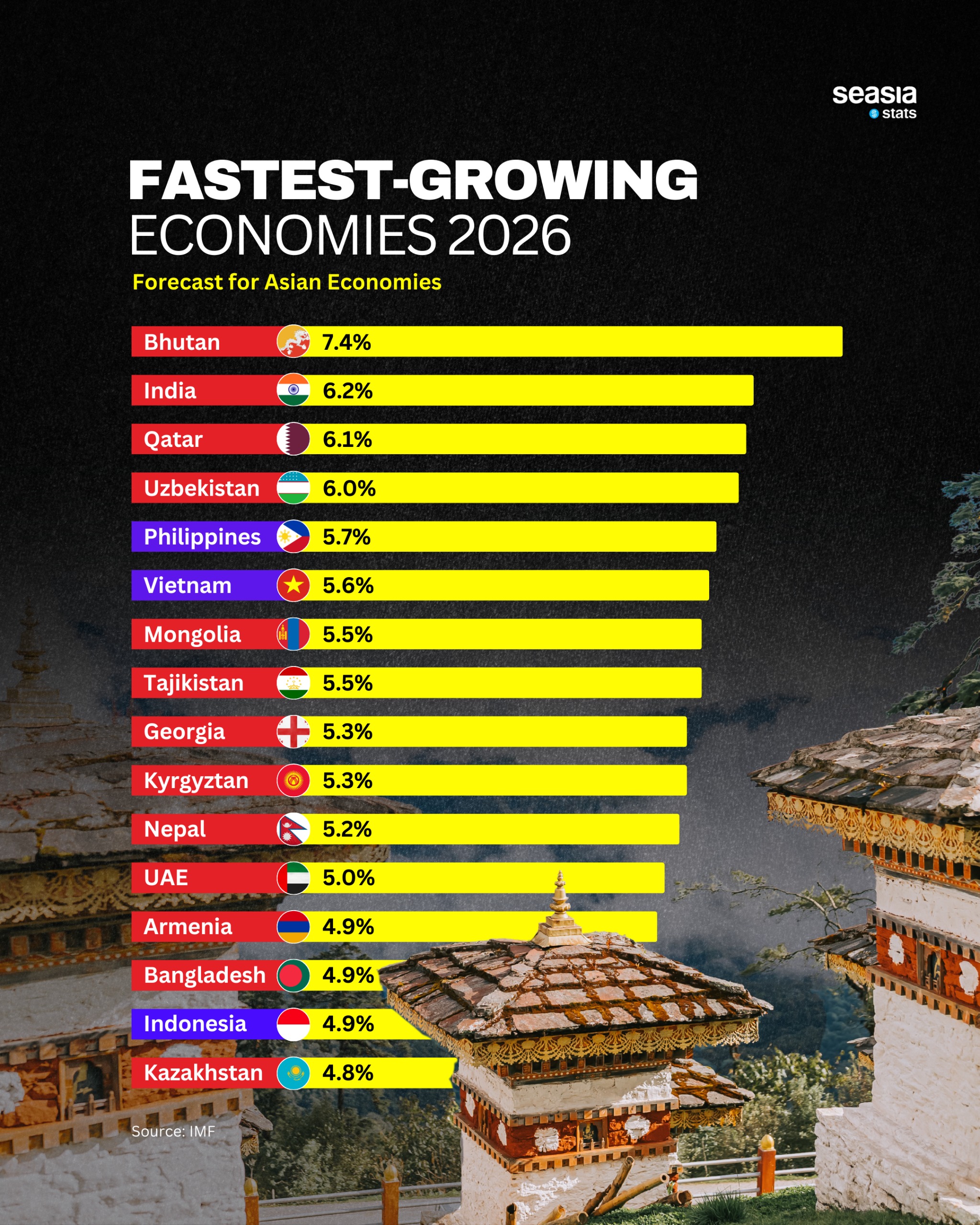
As the global economy searches for new engines of expansion, Asia once again stands out as the world’s most dynamic growth region. According to IMF forecasts compiled by Seasia Stats, 2026 will see a diverse group of Asian economies posting some of the fastest growth rates globally—driven by infrastructure investment, demographic dividends, manufacturing shifts, and rising domestic consumption.
Bhutan Leads a Surprising Growth Pack
Topping the list is Bhutan, projected to grow by an impressive 7.4% in 2026. While small in absolute size, Bhutan’s growth reflects major hydropower exports, public investment, and gradual economic diversification beyond tourism. Its performance underscores how smaller economies can post outsized growth when key sectors align.
Close behind is India at 6.2%, reinforcing its position as one of the world’s most important growth engines. India’s expansion is supported by strong domestic demand, large-scale infrastructure spending, and continued strength in services and manufacturing.
Energy and Central Asia Keep Pace
In West and Central Asia, Qatar (6.1%) and Uzbekistan (6.0%) highlight how energy wealth, reform momentum, and investment-led growth continue to fuel strong outlooks. These countries benefit from strategic positioning in energy markets and regional trade corridors.
Meanwhile, Mongolia and Tajikistan, both at 5.5%, show how resource extraction and remittance-supported consumption remain powerful growth drivers in landlocked economies.
Southeast Asia’s Consistent Growth Story
Southeast Asia features prominently among Asia’s fastest-growing economies, reflecting the region’s resilience and long-term potential. The Philippines is forecast to grow by 5.7%, supported by a young population, robust consumer spending, and continued infrastructure development.
Just behind is Vietnam at 5.6%, benefiting from export-oriented manufacturing, foreign direct investment, and its expanding role in global supply chains. Vietnam’s steady climb cements its reputation as one of Asia’s most reliable high-growth economies.
Further down the list, Indonesia posts a solid 4.9% growth outlook. While slower than its regional peers, Indonesia’s growth is underpinned by domestic consumption, resource processing, and long-term industrial policy aimed at moving up the value chain.
Broad-Based Growth Across Emerging Asia
Additional strong performers include Georgia and Kyrgyzstan (both 5.3%), Nepal (5.2%), and the United Arab Emirates at 5.0%, where diversification away from oil continues to pay dividends.
A three-way tie at 4.9% includes Bangladesh, Armenia, and Indonesia, while Kazakhstan follows closely at 4.8%.
Asia’s Growth Advantage Remains Clear
Together, these projections show that Asia’s growth story in 2026 is not driven by a single powerhouse, but by a wide constellation of emerging and developing economies. From Southeast Asia’s consumer-driven expansion to Central Asia’s reform momentum and South Asia’s demographic strength, the continent continues to set the pace for global economic growth.


