

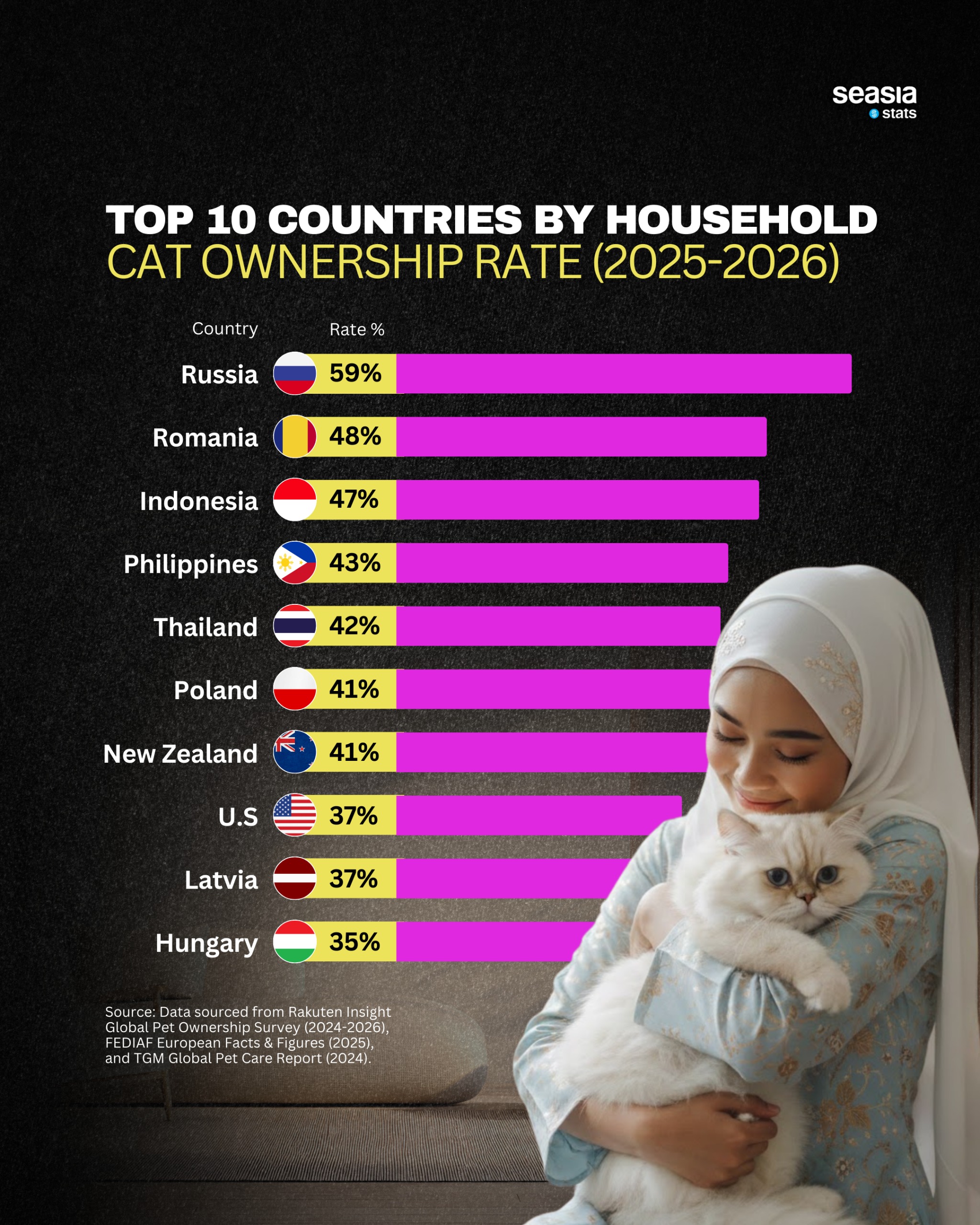
From apartment balconies to rural backyards, cats have quietly become one of the world’s most beloved companions. New global data from 2025–2026 reveals a striking pattern: while Europe still dominates the rankings, Southeast Asia has emerged as one of the fastest-growing regions for household cat ownership, reshaping global pet culture in unexpected ways.
Russia Leads the World in Cat Ownership
At the very top of the list is Russia, where an estimated 59% of households own at least one cat—the highest rate globally. Cats have long been favored in Russian homes, prized for their adaptability to apartment living and colder climates. Urban density, cultural familiarity, and relatively low upkeep compared to dogs all help explain Russia’s feline dominance.
Several Eastern European countries follow closely. Romania, Poland, Latvia, and Hungary consistently report high cat ownership rates, reflecting strong traditions of household pets and widespread acceptance of indoor–outdoor cats.
Southeast Asia’s Quiet Cat Boom
One of the most notable trends in recent surveys is the rise of Southeast Asia as a cat-loving region. Indonesia ranks among the top countries globally, with approximately 47% of households owning cats. In the Philippines, the figure stands at 43%, while Thailand follows closely at 42%.
Cats fit naturally into Southeast Asian lifestyles. They adapt well to smaller living spaces, tolerate warm climates, and are often viewed as independent, low-maintenance companions—ideal for urban households. In Indonesia and Malaysia, cultural and religious factors also play a role, with cats widely regarded as clean and welcome animals in many homes.
Across cities like Jakarta, Manila, Bangkok, and Kuala Lumpur, pet ownership has surged alongside rising middle-class incomes, apartment living, and social media–driven pet culture.
The United States and the Global Picture
In absolute numbers, the United States remains one of the world’s largest cat-owning nations, with approximately 46.5 million households owning cats in 2025—around 37–43% of households, depending on the survey. While the percentage is lower than in Russia or Southeast Asia, the sheer population size places the U.S. among the global leaders.
Countries such as Italy, Argentina, and New Zealand also show consistently high ownership rates, reflecting a broader trend across Europe and the Asia-Pacific region.
Why Cats Are Winning Globally
Several factors explain the global rise in cat ownership. Urbanization is key: cats require less space, are more independent, and often cost less to care for than dogs. Remote work and lifestyle changes since the pandemic have also made pet companionship more appealing.
In Southeast Asia specifically, veterinary services, premium pet food, and pet-friendly housing have expanded rapidly, making long-term cat ownership more accessible than ever before.
Ownership Rates vs. Total Cat Populations
It’s important to distinguish between ownership rates and total numbers. While countries like Russia, the U.S., and China lead in total cat populations, ownership rates are often higher in smaller or more urbanized countries—especially in Southeast Asia and Eastern Europe.
This explains why nations like Indonesia and the Philippines rank so highly despite lower overall incomes: cats simply fit better into everyday life.
A Global Love Affair With Cats
From Moscow to Manila, the numbers tell a clear story. Cats are no longer just pets—they are family members, cultural icons, and companions for modern living. As cities grow denser and lifestyles evolve, the world’s love affair with cats shows no sign of slowing down—especially in Southeast Asia, where the quiet cat boom is just getting started. 🐾


