

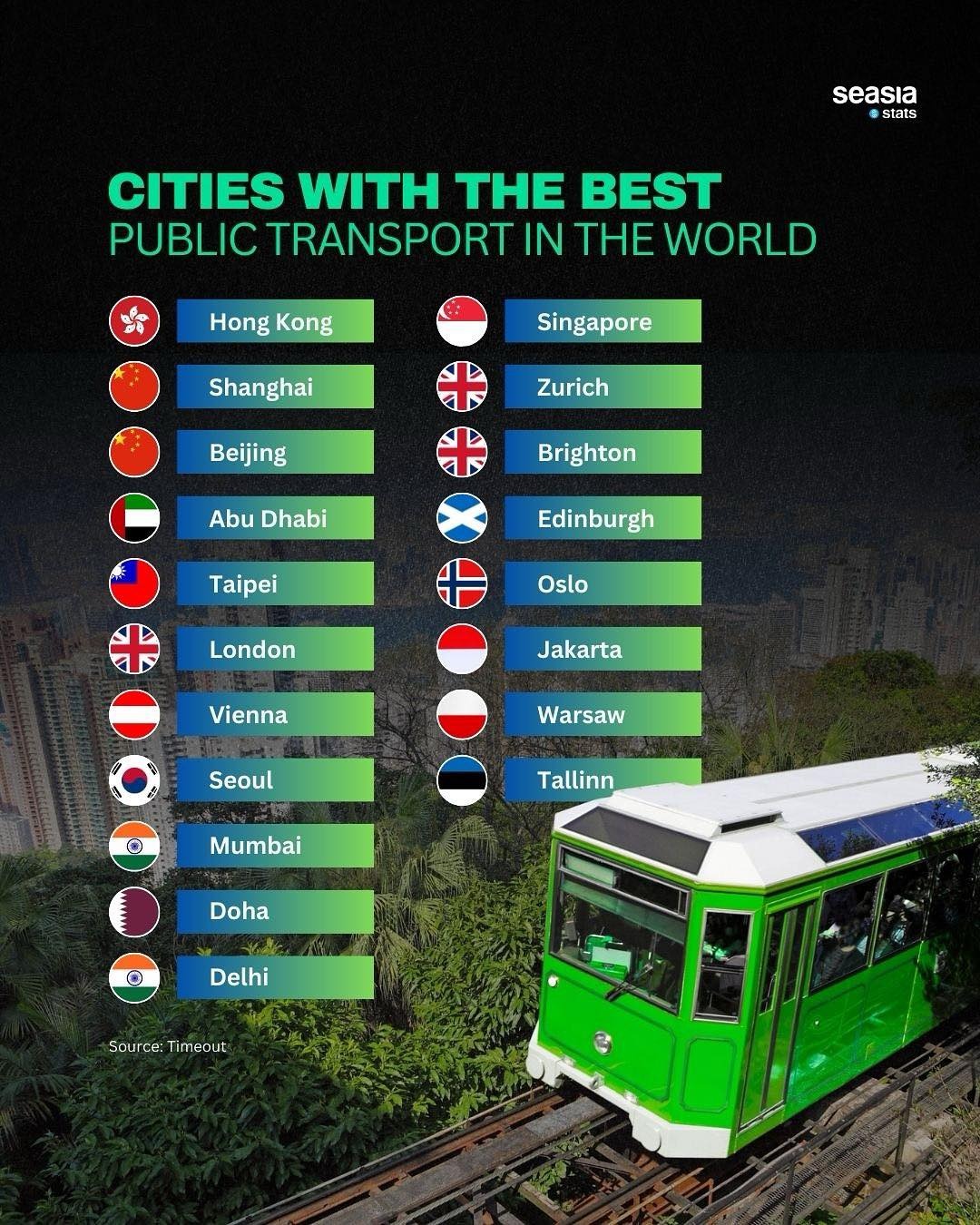
Across the globe, the best public transport systems are the ones that people barely have to think about—fast, reliable, clean, and seamlessly integrated into daily life. According to a 2025 global survey by Time Out, Hong Kong leads the world in public transport excellence, with nearly every resident praising its efficiency and affordability. But the story of global mobility is not just about one city—it’s about a rising network of urban systems, especially across Asia and Southeast Asia, that are redefining how cities move.
Hong Kong Sets the Global Gold Standard
Hong Kong’s Mass Transit Railway (MTR) has long been considered one of the most efficient systems in the world. With around 75% of residents living within one kilometer of a station, the network functions as the backbone of daily life. Trains run with near-perfect punctuality, while stations remain consistently clean and safe. The system’s affordability and integration with buses, ferries, and trams create a seamless urban mobility experience.
This success has made Hong Kong a benchmark city, studied by planners from across the world who aim to replicate its efficiency in their own growing urban centers.
Asia Dominates the Top Rankings
Asian cities dominate the top tier of global public transport rankings, reflecting the region’s rapid urbanization and heavy investment in infrastructure. Shanghai and Beijing, for example, operate some of the world’s largest metro systems, moving millions of passengers daily through expansive, digitally integrated networks.
Taipei also stands out for its exceptional cleanliness and reliability, while Abu Dhabi represents a newer entrant that has invested heavily in modern transit planning and sustainability. These cities demonstrate how technology, scale, and long-term planning can combine to create world-class mobility systems.
Europe’s Legacy of Reliable Transit
European cities remain strong contenders thanks to decades of investment and urban planning. London’s iconic Underground system continues to evolve with modern upgrades and integrated payment systems. Vienna and Zurich are widely praised for their punctuality and passenger experience, while smaller cities such as Brighton, Edinburgh, Oslo, Warsaw, and Tallinn consistently rank high for commuter satisfaction and sustainability.
These cities show that even older networks can remain world-class through smart modernization and strong public policy.
Southeast Asia’s Rapid Transit Revolution
Perhaps the most exciting story in recent years is unfolding in Southeast Asia. Singapore ranks among the world’s best systems thanks to its smart-city integration, efficient MRT network, and digital fare systems. The city-state has built a model of urban mobility that combines convenience, sustainability, and cutting-edge technology.
Meanwhile, Jakarta’s presence in the global top 20 marks a remarkable transformation. Once known for severe congestion, Indonesia’s capital has rapidly expanded its MRT, LRT, and TransJakarta bus networks. Today, millions of commuters rely on these systems daily, and the city continues to invest in new lines and improved connectivity.
Elsewhere in the region, Bangkok is expanding its BTS Skytrain and MRT networks, while Kuala Lumpur and Manila are also upgrading rail and bus infrastructure to meet growing demand. These developments signal a broader regional shift toward modern, integrated public transport.
The Future of Urban Mobility
As cities continue to grow, efficient public transport will become even more critical for economic productivity, environmental sustainability, and quality of life. From Hong Kong’s near-perfect efficiency to Jakarta’s rapid transformation, the global map of urban mobility is being redrawn—one metro line, one bus route, and one connected city at a time.


