

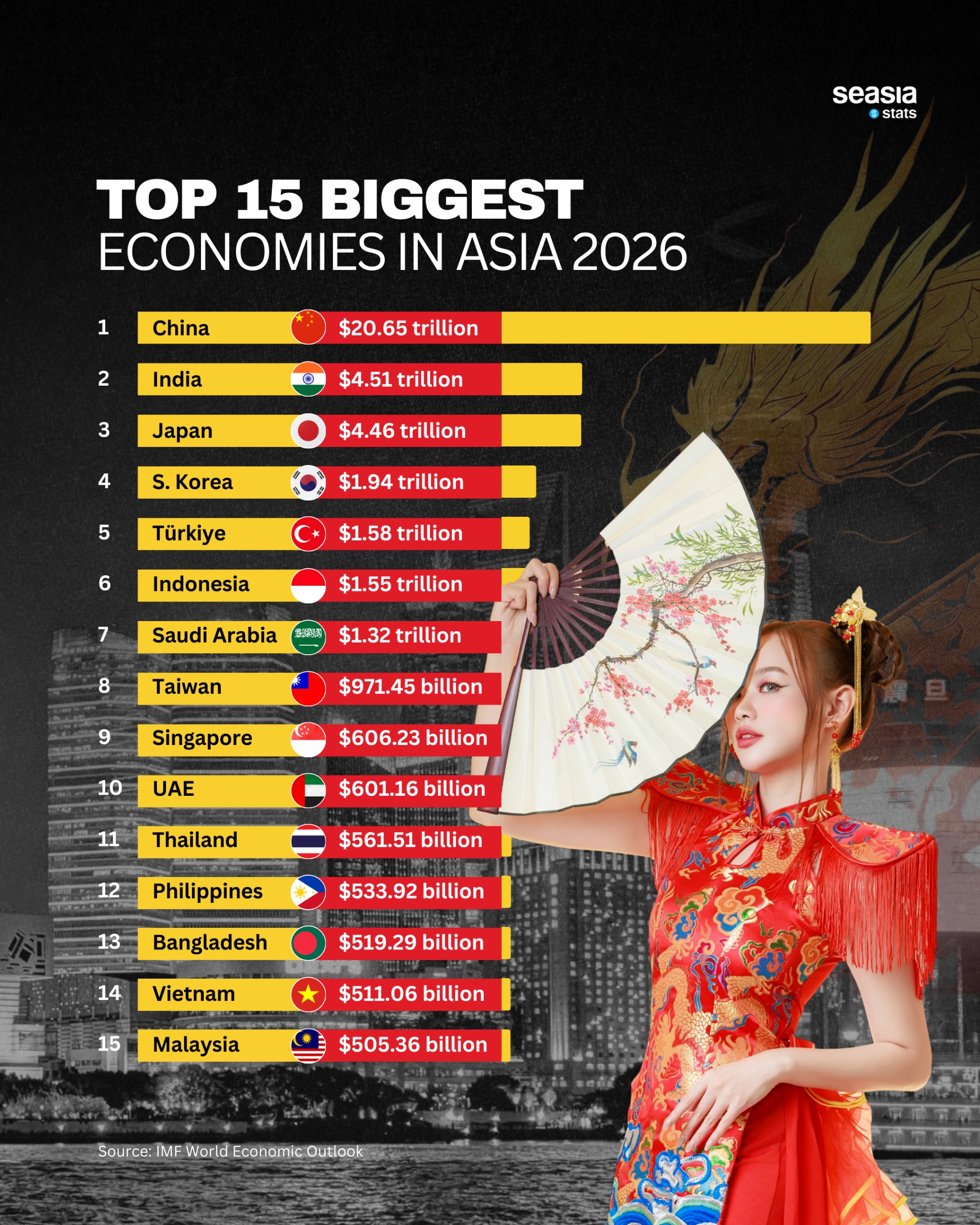
Asia’s economic map in 2026 tells a story of scale, speed, and shifting influence. From manufacturing giants to fast-growing consumer markets, the continent continues to anchor global growth. Based on IMF World Economic Outlook projections, the top 15 biggest economies in Asia highlight not only the dominance of long-established powers, but also the rising weight of Southeast Asia as a collective economic force.
China and India: Still in a League of Their Own
At the top of the ranking sits China, projected to reach a staggering $20.65 trillion in GDP. Despite slower growth rates compared to its peak decades, China’s massive industrial base, infrastructure depth, and export ecosystem keep it far ahead of the rest of the region.
In second place is India, with an estimated GDP of $4.51 trillion, narrowly edging out Japan at $4.46 trillion. India’s rise reflects its demographic advantage, expanding services sector, and rapid digital transformation, while Japan remains a high-income, innovation-driven economy despite slower population growth.
East Asia and West Asia’s Economic Pillars
The next tier includes South Korea at $1.94 trillion, underpinned by advanced manufacturing and global technology brands. Türkiye follows at $1.58 trillion, acting as a strategic bridge between Europe, Asia, and the Middle East.
Energy wealth and diversification strategies place Saudi Arabia firmly in the top ten at $1.32 trillion, while Taiwanapproaches the trillion-dollar mark on the back of its critical role in global semiconductor supply chains.
Southeast Asia’s Expanding Economic Footprint
One of the most striking features of the 2026 ranking is the strong showing from Southeast Asia. Indonesia leads the region at $1.55 trillion, making it the sixth-largest economy in Asia. Its size is driven by domestic consumption, natural resources, and large-scale infrastructure development.
Further down the list, Singapore stands out at $606.23 billion, punching far above its population size thanks to its status as a global financial, logistics, and innovation hub. Close behind is Thailand at $561.51 billion, supported by tourism, manufacturing, and agribusiness.
The Philippines follows with $533.92 billion, reflecting its fast-growing consumer market and remittance-driven economy. Vietnam ($511.06 billion) and Malaysia ($505.36 billion) round out the list, both benefiting from export-oriented manufacturing and strong trade integration.
A Continent Shaping the Global Economy
Also featured in the top 15 is Bangladesh at $519.29 billion, underscoring the rise of South Asia’s manufacturing and labor-driven growth model.
Taken together, the rankings show that while China and India dominate individually, Southeast Asia’s collective economic mass is becoming impossible to ignore. With multiple countries clustered around the half-trillion-dollar mark, the region is increasingly shaping supply chains, consumer demand, and investment flows across Asia—and the world.
As 2026 unfolds, Asia’s economic story is no longer about one or two giants alone, but about a broad and dynamic ecosystem powering global growth from multiple directions.


