

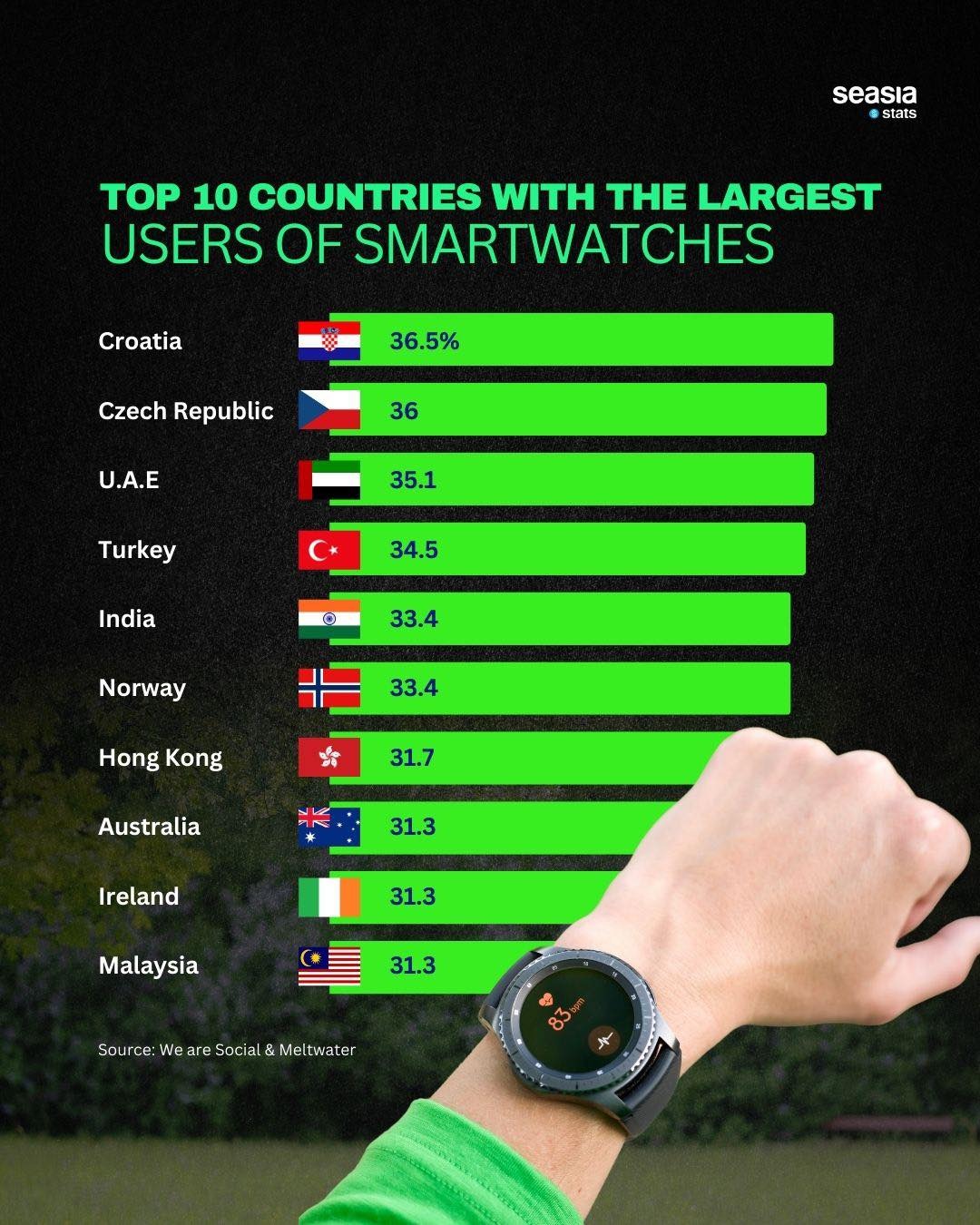
As wearable technology becomes a central part of everyday life, smartwatches have emerged as one of the fastest-growing consumer tech devices worldwide. From tracking heart rates and sleep cycles to receiving notifications and managing daily schedules, these wrist-worn gadgets have transformed how people interact with technology. According to data from We Are Social and Meltwater, highlighted by Seasia Stats for early 2026, several countries are leading the world in smartwatch adoption—revealing where digital lifestyles and health-focused technologies are advancing the fastest.
Croatia Tops the Global Smartwatch Rankings
Croatia currently leads the world in smartwatch usage, with 36.5% of its population owning or using a smartwatch. This surprisingly high adoption rate reflects the country’s growing interest in digital health monitoring and connected lifestyles.
Smartwatches in Croatia are widely used for fitness tracking, daily productivity, and seamless smartphone integration. As healthcare awareness increases globally, wearable devices that monitor heart rate, sleep quality, and physical activity have become essential tools for maintaining healthier routines.
Closely behind Croatia is the Czech Republic, where 36% of the population uses smartwatches. The United Arab Emirates ranks third with 35.1%, reflecting the region’s strong appetite for cutting-edge technology and luxury electronics.
Europe and Asia Drive the Middle Tier
A diverse group of countries occupies the middle of the rankings, showcasing how smartwatch adoption spans multiple regions and economic levels.
Turkey ranks fourth with 34.5% adoption, while India and Norway share fifth place with 33.4%. India’s position is particularly notable given its massive population and rapidly expanding consumer electronics market. Affordable smartwatch brands and locally produced wearables have fueled this surge, making smartwatches accessible to a much broader audience.
In many of these countries, wearable technology has evolved beyond luxury gadgets. Smartwatches are increasingly used for health monitoring, contactless payments, and even early detection of medical conditions such as irregular heart rhythms.
Global Tech Hubs Join the Top Ten
The final portion of the ranking features several well-known technology and economic hubs. Hong Kong appears in seventh place with 31.7% smartwatch usage, highlighting the city’s highly connected and tech-savvy population.
Australia, Ireland, and Malaysia share the final three positions in the top ten, each recording a smartwatch adoption rate of 31.3%. These figures show that nearly one in three people in these countries now relies on wearable technology as part of their daily routine.
In many cases, smartwatches are closely integrated into broader digital ecosystems—from smart homes to health apps—making them an essential extension of the smartphone.
Southeast Asia’s Expanding Wearable Tech Market
Among Southeast Asian nations, Malaysia stands out as the region’s highest-ranked country in smartwatch adoption. Its strong digital economy, high smartphone penetration, and widespread interest in fitness technology have helped drive wearable device usage.
However, the trend is growing across the entire region. In Singapore, a highly connected population and strong health-tech ecosystem have made smartwatches increasingly popular. Thailand and Vietnam are also seeing rapid growth, driven by younger consumers and expanding e-commerce platforms offering affordable wearable devices.
Indonesia, Southeast Asia’s largest digital market, is another emerging hotspot for smartwatch adoption. As middle-class incomes rise and digital lifestyles expand, wearable technology is becoming increasingly accessible to millions of new users.
The Rise of Wearable Technology
The rise of smartwatches reflects a broader global shift toward personal health technology and connected living. What began as a niche gadget has evolved into a multifunctional tool that supports wellness, productivity, and communication.
With advances in artificial intelligence, biometric sensors, and battery technology, future smartwatches are expected to play an even greater role in preventive healthcare and digital lifestyles.
As adoption continues to grow across regions—from Europe to Southeast Asia—smartwatches are rapidly becoming one of the defining technologies of the modern connected world.


