

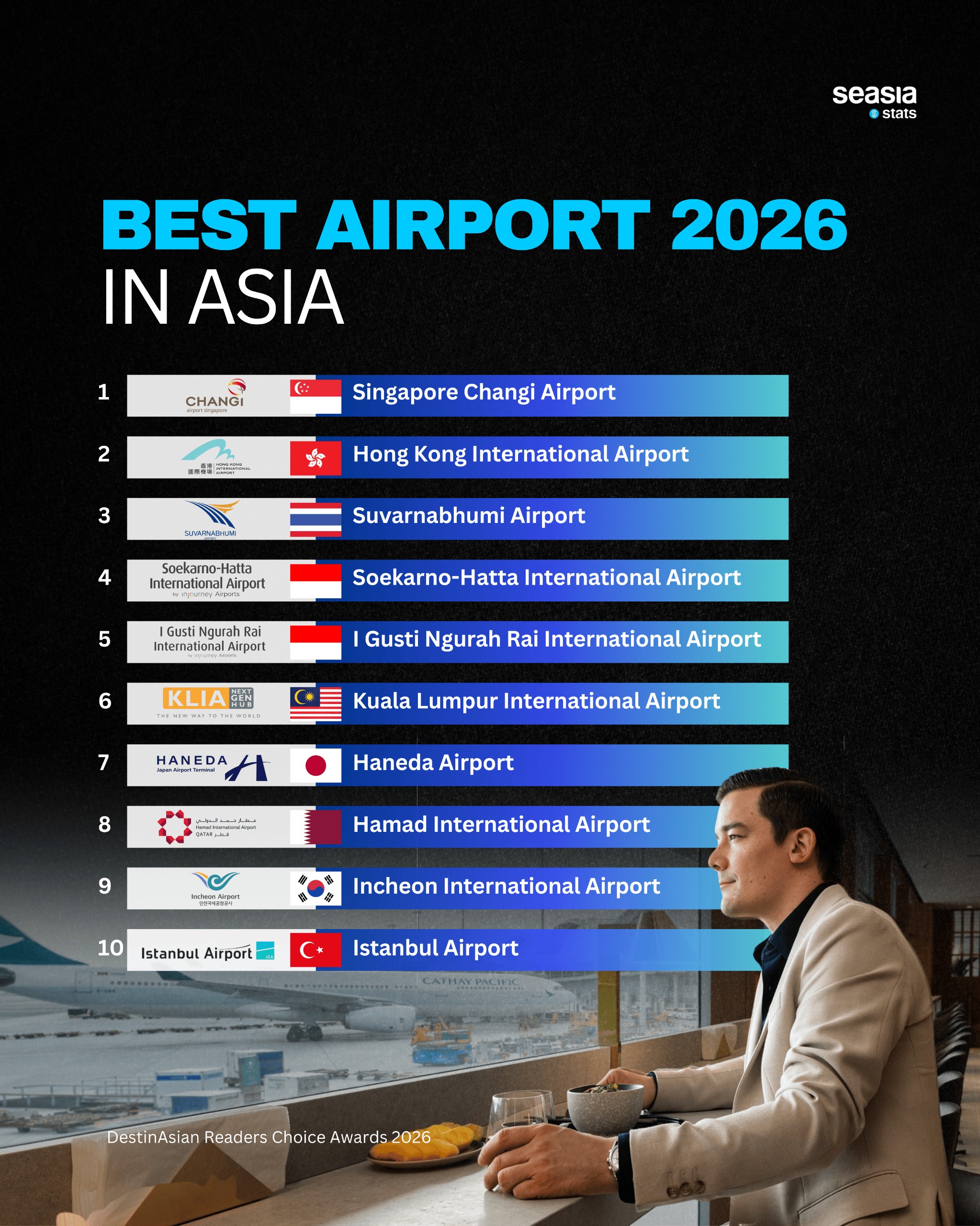
In Asia, airports are no longer just transit points. They have become statements of national ambition—part infrastructure, part hospitality showcase, part economic engine. The 2026 rankings from DestinAsian Readers’ Choice reflect that shift clearly: the continent’s best airports are not simply moving passengers efficiently, they are shaping how travel itself is experienced.
The Airport That Became a Global Benchmark
At the top once again is Singapore Changi Airport, a name that has become almost synonymous with modern airport excellence. Its continued dominance in Asia is hardly accidental. Changi has spent years redefining what passengers expect from an airport, turning waiting time into something closer to leisure. Gardens, art installations, family spaces, premium lounges, and a famously smooth passenger flow have made it less a terminal and more a destination in its own right.
As CNN Travel once put it, “Changi has turned the airport layover into an attraction.” That reputation matters because in a region increasingly dependent on connectivity, first impressions are no longer made at hotels or city centers—they begin at immigration, baggage claim, and boarding gates.
Just behind Changi is Hong Kong International Airport, a long-standing aviation heavyweight known for operational precision and its role as one of Asia’s most important global gateways. In third place sits Suvarnabhumi Airport, whose high ranking confirms Thailand’s enduring role as one of the region’s great tourism and transit powers.
Southeast Asia’s Strong Grip on Asian Aviation
One of the most striking stories in this year’s rankings is just how dominant Southeast Asia has become. Beyond Singapore and Thailand, the region fills much of the list with airports that are no longer just regional hubs, but increasingly global competitors.
Indonesia makes a particularly strong showing with Soekarno-Hatta International Airport in fourth place and I Gusti Ngurah Rai International Airport in fifth. These two airports represent two very different faces of Indonesian aviation. Soekarno-Hatta is the country’s sprawling primary gateway, carrying the weight of Jakarta’s economic and political centrality. Ngurah Rai, by contrast, is Indonesia’s tourism front door, where Bali’s global brand begins the moment travelers step off the plane.
Malaysia’s Kuala Lumpur International Airport takes sixth place, reinforcing its long-standing reputation as one of Southeast Asia’s most efficient transit hubs. KLIA’s importance lies not only in service quality, but in its strategic role connecting Southeast Asia to the Middle East, East Asia, and beyond.
Taken together, these rankings tell a larger story: Southeast Asia is no longer just a fast-growing travel market. It is becoming one of the defining centers of aviation quality in the world.
More Than Architecture and Amenities
What makes a great airport in 2026 is not only beautiful design or luxury shopping. It is reliability, cleanliness, passenger psychology, and the ability to make a stressful journey feel manageable. Airports today compete on invisible details: shorter queues, intuitive signage, easier transfers, faster security, and the feeling that the system works.
That is why airports like Haneda Airport, Hamad International Airport, and Incheon International Airport continue to remain in the conversation. Each has built its reputation not just on scale, but on consistency.
As Forbes has noted in its travel coverage, “The best airports reduce friction. They make people feel looked after, even in motion.”
Airports as National Identity
In Asia, especially, airports have become symbols of how countries want to be seen. Efficient, polished, welcoming, globally connected. For Southeast Asia, this matters enormously. The region’s tourism, trade, labor mobility, and investment flows all depend on air infrastructure that can keep up with rising demand.
The 2026 rankings show that Southeast Asia is not merely participating in this race—it is helping define it. And in a century shaped by movement, the airport may be one of the clearest mirrors of a nation’s confidence.


