

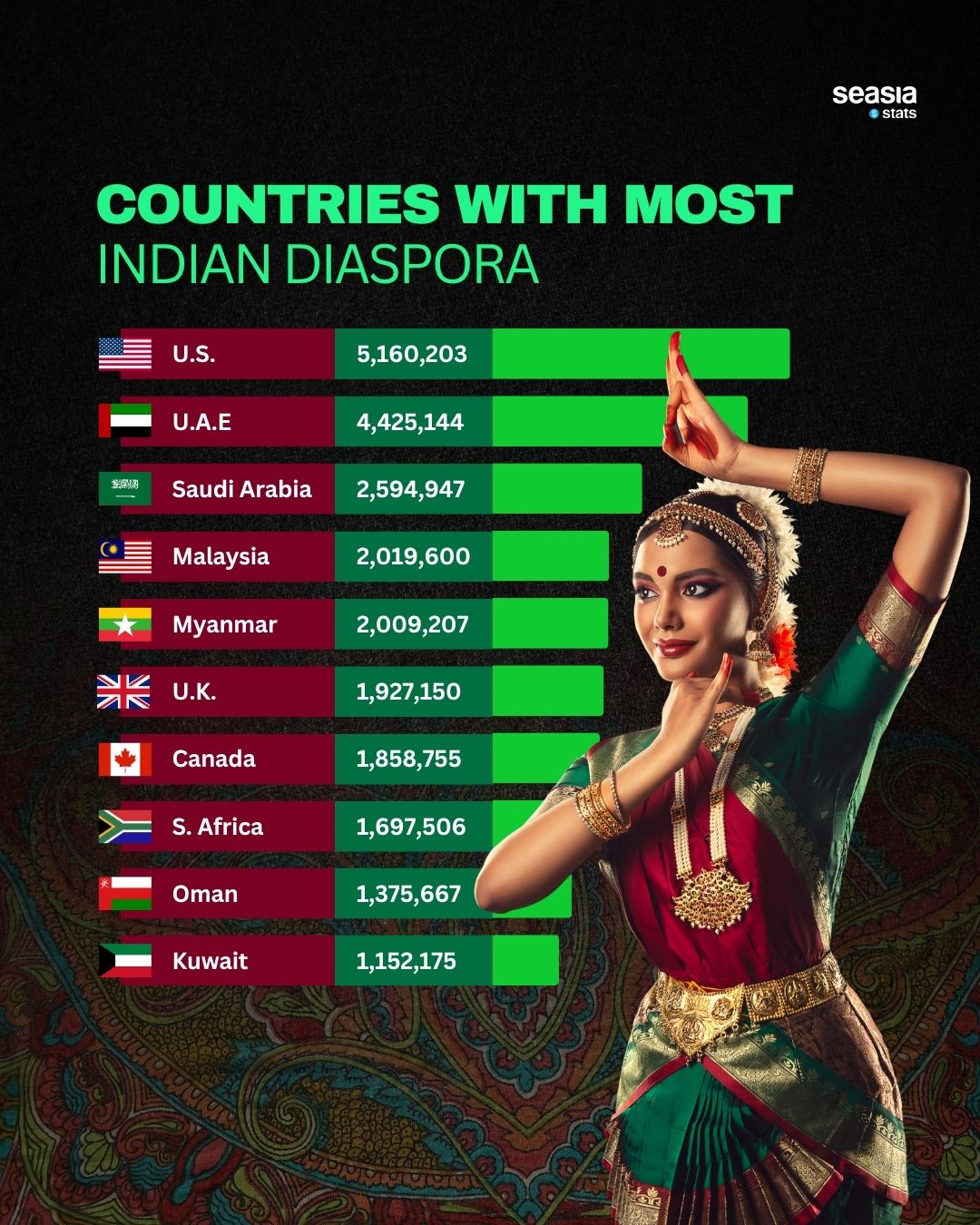
The Indian diaspora is not just vast — it’s one of the most influential in the world. From Silicon Valley boardrooms to Middle Eastern labor hubs, Indian-origin populations are leaving their mark globally. According to 2025 data compiled by Seasia Stats, over 5 million people of Indian descent live in the United States alone, making it the country with the largest Indian diaspora population in the world.
But the U.S. is just the beginning. This vibrant and mobile global community spans across continents, representing a powerful force in global business, diplomacy, and cultural exchange.
The United States: The Largest Host of the Indian Diaspora
With 5,160,203 Indian-origin individuals, the United States ranks first as the top destination for the Indian diaspora in 2025. Over the past few decades, the U.S. has seen a consistent rise in Indian immigration — primarily driven by the pursuit of education, professional opportunities in technology and medicine, and entrepreneurship.
Indian-Americans today are one of the most educated and economically successful ethnic groups in the U.S., with growing political influence and cultural visibility. From NASA engineers to top CEOs and Hollywood actors, their contribution continues to expand across sectors.
The Gulf Connection: U.A.E. and Saudi Arabia
Coming in at second is the United Arab Emirates (U.A.E.), with 4,425,144 people of Indian descent. This significant population reflects India's long-standing labor migration relationship with the Gulf. Indian workers in the U.A.E. span various sectors — from construction and retail to finance and medicine.
Saudi Arabia, with 2,594,947 Indians, holds third place. Much like the U.A.E., Saudi Arabia has relied heavily on Indian labor since the oil boom of the 1970s. Despite evolving labor laws and shifting demographics, Indians continue to play a central role in the Gulf economies.
Southeast Asia: Malaysia and Myanmar’s Deep Roots
In Southeast Asia, the Indian diaspora has a much longer historical presence. Malaysia, with 2,019,600 Indian-origin residents, is home to a deeply rooted Tamil community — many of whom trace their migration back to British colonial times when Indian laborers were brought to work in rubber plantations and railways.
Similarly, Myanmar (2,009,207) has long-standing Indian communities, though many faced political and economic challenges in the mid-20th century. Nevertheless, the cultural and economic footprint of Indians in both countries remains strong — reflected in everything from cuisine to commerce.
Legacy of Empire: The U.K., Canada, and South Africa
The United Kingdom, home to 1,927,150 Indians, has a well-documented historical connection with India, dating back to colonial rule. Today, British Indians are among the most visible ethnic minorities in the UK, holding influential roles in government, education, business, and media.
Canada, with 1,858,755 Indian-origin residents, is another major destination — particularly appealing to young professionals and students due to its liberal immigration policies, strong university system, and multicultural society.
In South Africa (1,697,506), the Indian community traces back to the 19th century when indentured laborers were brought to work in sugar plantations. Today, they are a prominent force in South African politics, business, and civil society — most famously represented by Mahatma Gandhi’s early activism in the country.
The Gulf Continues: Oman and Kuwait
Other Gulf nations like Oman (1,375,667) and Kuwait (1,152,175) also feature in the top ten. These populations reflect the ongoing significance of Indian labor and service professionals in the region. Despite temporary worker status, many have lived in the Gulf for generations, contributing significantly to both the local economy and remittances back to India.
A Global Community with Local Roots
What makes the Indian diaspora remarkable is not just its size, but its adaptability, influence, and enduring cultural identity. Whether as first-generation migrants or citizens several generations removed from India, members of the diaspora maintain ties through festivals, cuisine, language, and often, economic remittances.
In 2025, this diaspora is not merely surviving — it’s thriving. From New York and London to Dubai and Kuala Lumpur, Indian-origin communities continue to build bridges between cultures, shaping the world in visible and invisible ways.


