

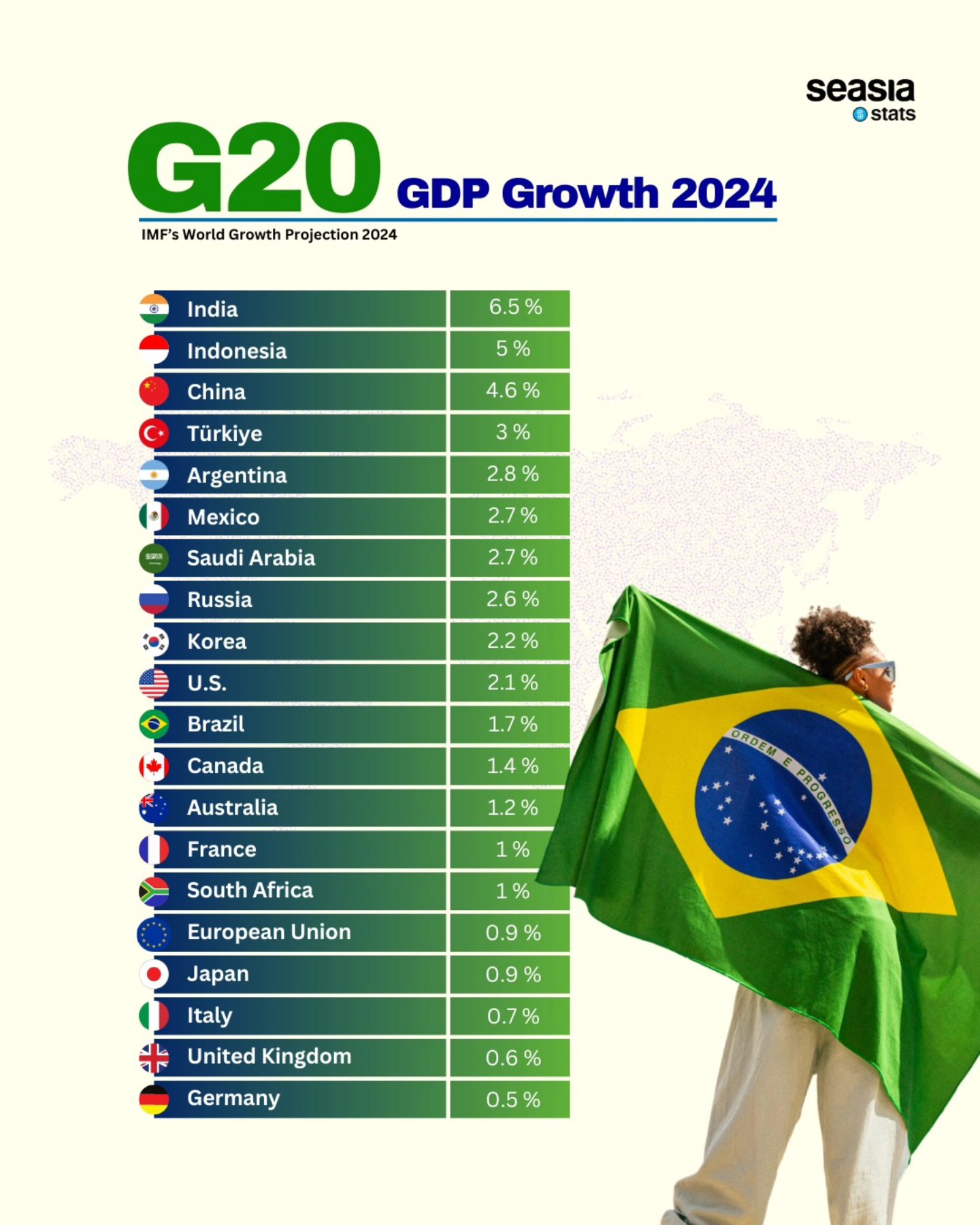
As the G20 Summit convenes in Brazil, the International Monetary Fund (IMF) has provided a comprehensive forecast for GDP growth rates among member nations in 2024. These projections highlight the disparities in economic recovery and growth potential, with significant implications for global collaboration and policy-making.
Leading Economies in Growth
India stands out as the fastest-growing economy among G20 nations, with an impressive growth rate of 6.5%, driven by domestic demand, infrastructure development, and a thriving service sector. Indonesia follows closely with a projected growth of 5.6%, reflecting strong consumer spending and government-backed investments in infrastructure and renewable energy.
China and Türkiye, with growth rates of 4.6% and 4.5% respectively, demonstrate robust recovery strategies. China’s focus on technological advancements and urbanization continues to drive its economy, while Türkiye’s diversified economic activities have bolstered its resilience amid global uncertainties.
Moderate Performers
Several G20 nations are expected to grow at moderate rates. Argentina, Mexico, and Saudi Arabia are forecasted at 2.8%, 2.7%, and 2.7% respectively, indicating steady progress. South Korea, the U.S., and Brazil follow with growth rates of 2.2%, 2.1%, and 1.7%. These figures reflect a mix of economic stability and challenges tied to global trade dynamics and domestic policies.
Slower Growth in Advanced Economies
Advanced economies such as Canada (1.4%), Australia (1.2%), and France (1%) face relatively slow growth, influenced by tighter monetary policies and subdued global demand. Similarly, Japan and Italy are forecasted at 0.9%, while Germany and the United Kingdom lag with growth rates of 0.5% and 0.6%, respectively, signaling challenges in industrial output and energy dependencies.
Implications for Global Collaboration
The varying growth trajectories among G20 nations underscore the importance of coordinated policy measures to address global economic disparities. Collaboration on trade, climate action, and technological innovation will be critical in fostering inclusive and sustainable growth.
These projections serve as a reminder of the need for strategic partnerships and adaptive policies to navigate the challenges and opportunities of a complex global economy. The G20 nations, representing the world's largest economies, have a pivotal role in steering global growth toward resilience and equity.


