

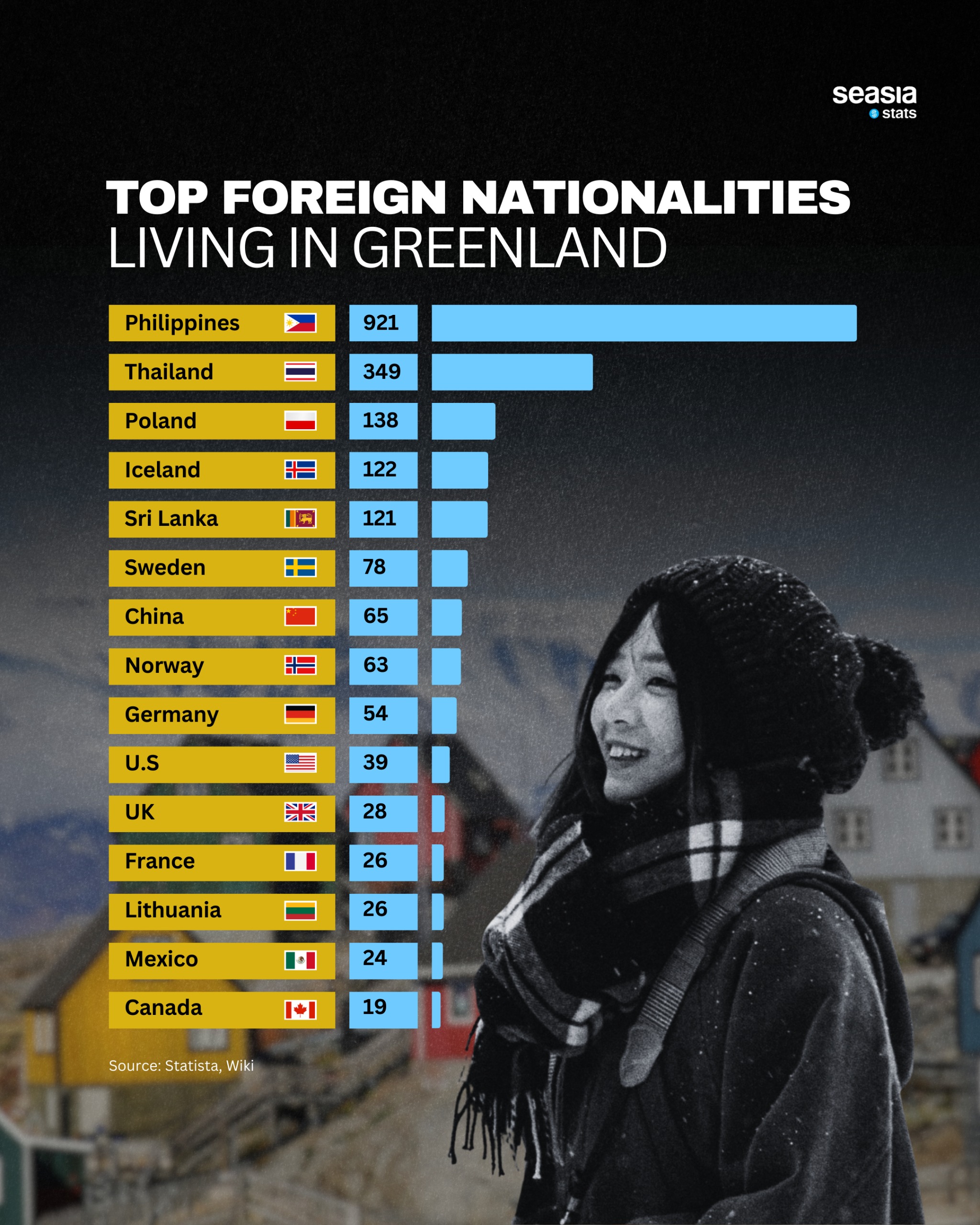
At first glance, Greenland seems an unlikely destination for migrants. Remote, sparsely populated, and defined by ice and sea, the Arctic territory feels worlds away from global migration routes. Yet recent data from Statista and Wiki reveals a surprisingly diverse foreign population—one where Southeast Asian communities stand out alongside European neighbors.
Filipinos: Greenland’s Largest Foreign Community
Topping the list by a wide margin are residents from the Philippines, with 921 people living in Greenland. This makes Filipinos the largest non-native nationality in the territory by a significant margin.
Their presence reflects a broader global pattern: Filipino workers are highly mobile and in demand, particularly in sectors such as healthcare, hospitality, cleaning services, and maritime work. In Greenland, many Filipinos are employed in hospitals, elder care, hotels, and fish-processing facilities—industries that struggle to attract sufficient local labor.
Thailand and Sri Lanka: Smaller but Visible Asian Communities
The second-largest foreign nationality comes from Thailand, with 349 residents. Thai migrants often work in food services, small businesses, and caregiving roles, continuing a trend seen across Northern Europe and the Nordic region.
Also notable is the presence of Sri Lanka, with 121 residents. Though not Southeast Asian, Sri Lanka’s appearance alongside the Philippines and Thailand highlights how Asian labor migration reaches even the Arctic, driven by niche employment opportunities and long-term work contracts.
Europe’s Arctic Neighbors
Unsurprisingly, nearby European countries make up much of the remaining list. Poland ranks third with 138 residents, reflecting Poland’s strong labor migration links across Europe.
Iceland follows with 122 residents, a logical presence given its geographic and economic proximity to Greenland. Smaller populations from Sweden, Norway, Germany, France, Lithuania, and the UK round out much of the European contingent.
A Broader Southeast Asian Footprint
Beyond the Philippines and Thailand, smaller numbers of migrants from other Asian countries also appear. China has 65 residents, while Southeast Asian nations such as Indonesia and Vietnam—though not topping the list—are part of Greenland’s wider Asian migration story, often linked to maritime trades and seasonal labor.
These figures align with broader trends across the Arctic and Nordic regions, where Southeast Asian migrants frequently fill essential roles in fisheries, ship maintenance, caregiving, and service industries.
Why People Move So Far North
Greenland’s foreign residents are not driven by climate or lifestyle allure alone. Migration is largely job-driven, supported by relatively high wages, stable contracts, and labor shortages in critical sectors. For many migrants from Southeast Asia, Greenland represents opportunity rather than destination—a place to work, save, and support families back home.
A Global Community at the Edge of the World
Though Greenland’s total population is small, its foreign communities tell a powerful story of globalization reaching even the planet’s most remote corners. From Manila and Bangkok to Warsaw and Reykjavik, the Arctic territory has quietly become a crossroads—where ice, opportunity, and global labor meet.


