

Brunei Darussalam
The Land of Unexpected Treasures
Search
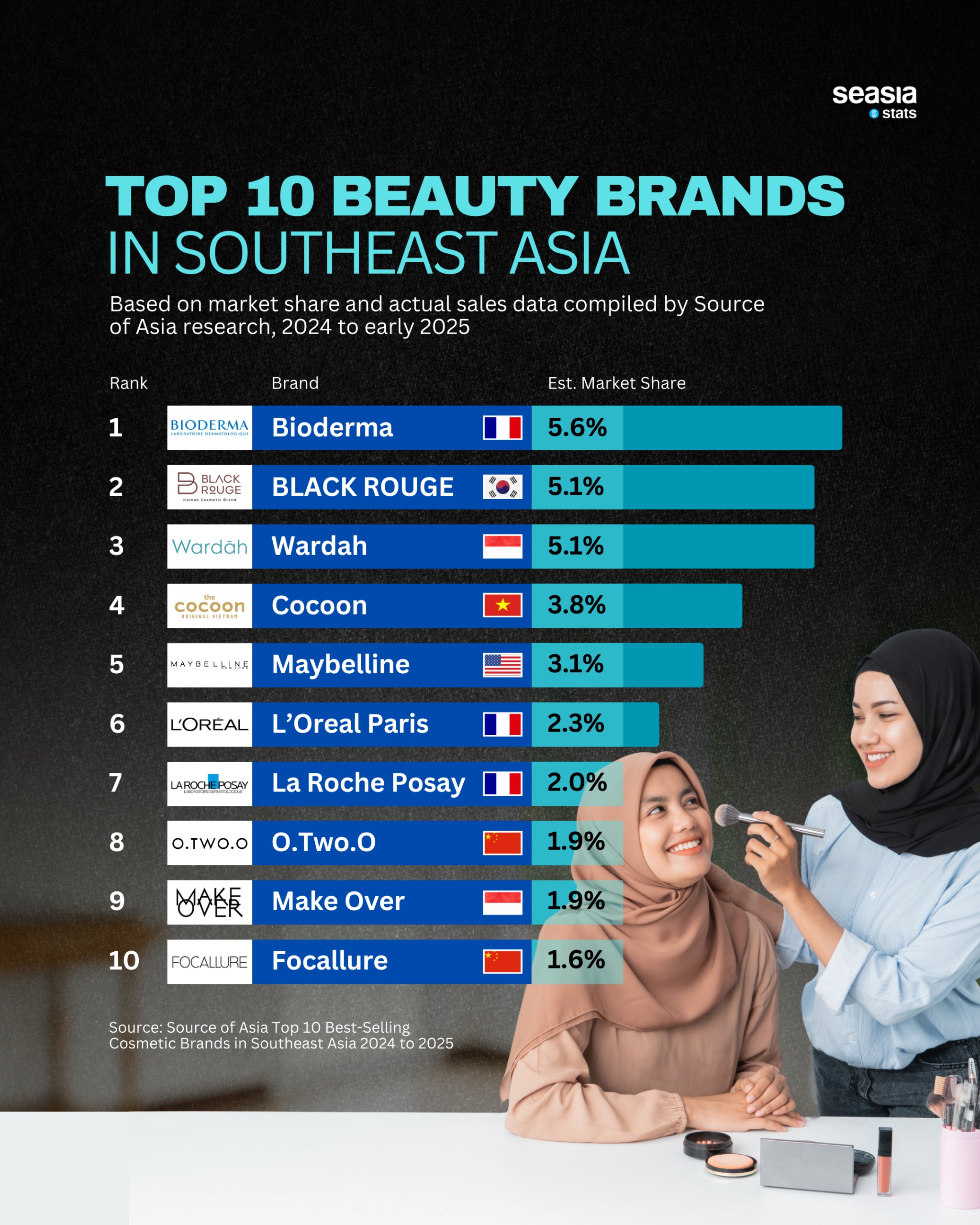
Southeast Asia’s beauty industry is experiencing a vibrant transformation, driven by a mix of global giants, K-beauty innovators, and powerful local brands. In 2024 and early 2025, the region’s cosmetics market reflects not only strong consumer demand but also a shift toward inclusive, affordable, and culturally resonant beauty products. From skincare rooted in dermatological science to halal-certified cosmetics and digital-first makeup labels, Southeast Asia has become one of the most competitive and dynamic beauty landscapes in the world.
Leading the region is Bioderma, the French skincare brand that holds the number one position with an estimated market share of 5.6%. Known for its dermatological formulations and sensitive-skin focus, Bioderma has built strong trust among Southeast Asian consumers, particularly in urban markets where skincare awareness continues to grow rapidly.
Close behind are BLACK ROUGE from South Korea and Indonesia’s Wardah, each with a 5.1% market share. BLACK ROUGE represents the enduring appeal of K-beauty—trend-driven, high-performance, and widely shared across social media—while Wardah’s success underscores the growing demand for halal-certified and locally relevant beauty products. Wardah’s rise also reflects Indonesia’s position as Southeast Asia’s largest cosmetics market.
Vietnam’s Cocoon takes the fourth spot with a 3.8% market share, standing out for its commitment to vegan and eco-conscious beauty. As sustainability becomes more important to younger consumers, Cocoon’s plant-based formulas and ethical branding resonate strongly across Vietnam and neighboring countries.
Global mass-market brands continue to play a significant role. Maybelline, with 3.1%, remains a staple for accessible makeup across Southeast Asia, especially among younger consumers. Meanwhile, French heritage brands L’Oreal Paris (2.3%) and La Roche-Posay (2.0%) maintain their positions by combining scientific credibility with strong retail distribution networks across major cities like Bangkok, Jakarta, Manila, and Kuala Lumpur.
The lower tier of the top ten reflects the growing power of e-commerce and social media-driven beauty trends. China’s O.Two.O and Indonesia’s Make Over, both at 1.9%, have built strong followings through influencer partnerships and online retail platforms such as Shopee and Lazada.
Focallure, also from China, rounds out the list with a 1.6% share. Its rise highlights the region’s appetite for affordable yet high-quality cosmetics, especially among Gen Z consumers who value variety, affordability, and online accessibility.
Beyond the top ten, the Southeast Asian beauty market continues to diversify. Thailand’s Mistine, the Philippines’ Ever Bilena, and Malaysia’s SimplySiti are among notable local players strengthening their presence with culturally tailored products. Singapore, while smaller in scale, plays a crucial role as a regional hub for beauty innovation, retail, and logistics.
E-commerce platforms, influencer marketing, and cross-border retail are further accelerating growth across the region. Consumers are now more informed, digitally connected, and open to experimenting with both global and local brands, creating a marketplace where innovation and authenticity matter more than ever.
Ultimately, Southeast Asia’s beauty market is defined by its diversity. From French dermatological science to Korean trend-setting cosmetics and Southeast Asian heritage brands, the region offers a unique blend of global expertise and local identity.
As consumer preferences continue to evolve—toward sustainability, inclusivity, and digital convenience—Southeast Asia is set to remain one of the most exciting and influential beauty markets in the world.


The Land of Unexpected Treasures

Land of the Khmer

The Emerald of the Equator

The Land of a Million Elephant

Land of Indigenous Malay

The Land of the Golden Pagoda

Pearl of the Orient Seas

The Lion City

Southeast Asia Region

The Land of Smiles

A Nation of the 21st Century

The Land of Blue Dragon

Beyond Southeast Asia