

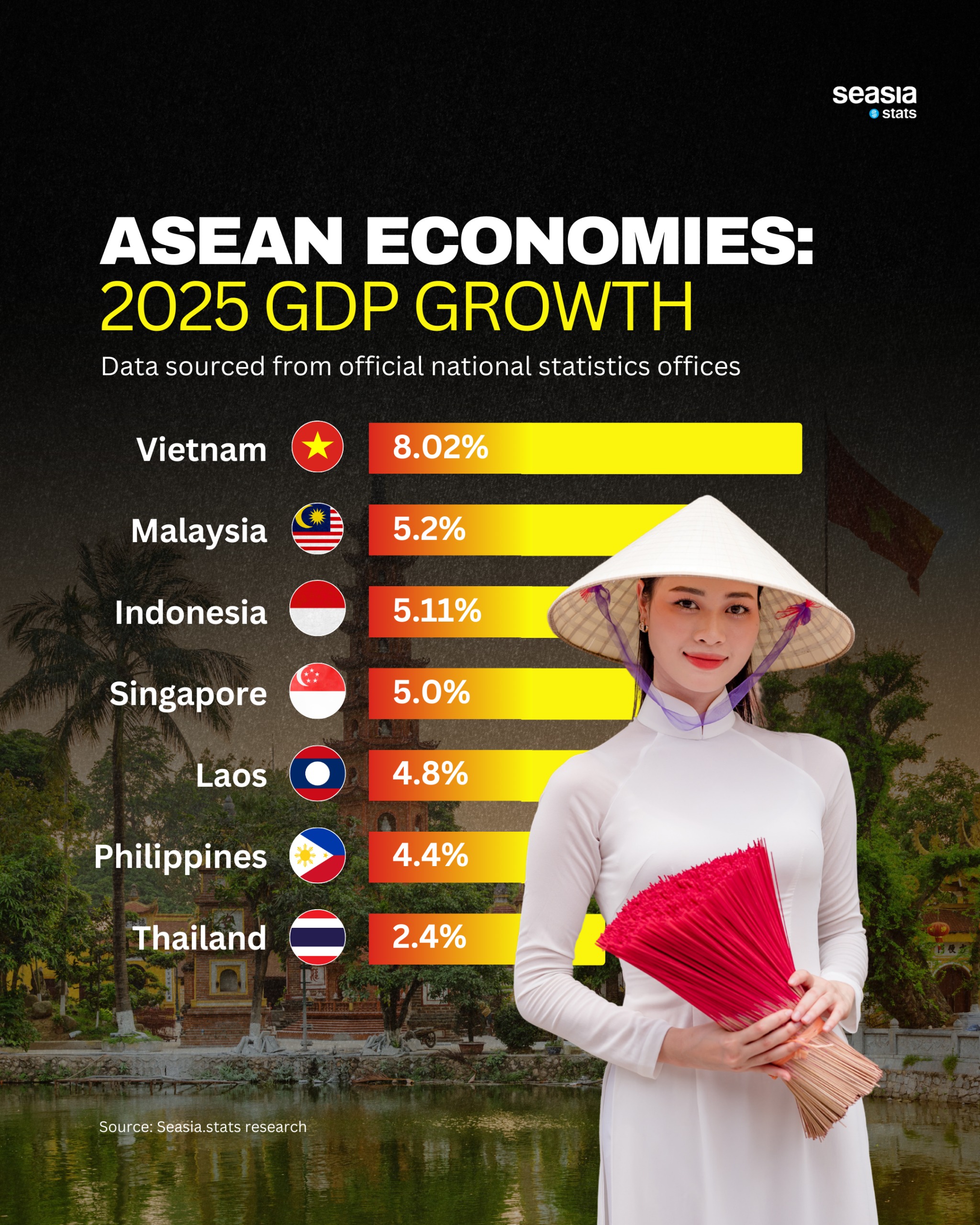
Southeast Asia’s economic story in 2025 is one of resilience, reinvention, and rising ambition. Across the ASEAN region, countries navigated a shifting global economy while capitalizing on their strengths in manufacturing, trade, and domestic consumption. The result is a dynamic growth landscape—one led decisively by Vietnam but supported by a diverse mix of expanding economies that together reinforce Southeast Asia’s position as one of the world’s most promising economic regions.
Vietnam Sets the Pace
At the top of the regional leaderboard is Vietnam, which recorded an impressive GDP growth rate of 8.02% in 2025. This standout performance is largely attributed to a strong rebound in exports, particularly in electronics and high-value manufacturing, as well as robust activity in construction and infrastructure.
Vietnam’s continued rise reflects its transformation into a key global manufacturing hub. Strategic trade agreements, competitive labor costs, and a rapidly modernizing industrial base have made it an increasingly attractive destination for international investors seeking alternatives in Asia.
The Strong Second Tier: Malaysia, Indonesia, Singapore
Behind Vietnam is a closely matched group of economies—Malaysia, Indonesia, and Singapore—each demonstrating steady and resilient expansion.
Malaysia posted growth of around 5.2% during peak periods before settling at 4.9% for the full year. Its performance was driven by strong domestic consumption and sustained exports in electronics and commodities.
Indonesia followed closely with a solid 5.11% growth rate, supported by government spending, infrastructure investment, and resilient household consumption. As Southeast Asia’s largest economy, Indonesia continues to benefit from its large domestic market and growing middle class.
Singapore, meanwhile, achieved full-year growth of about 4.8%, outperforming earlier projections. Its late-year surge was fueled by high-tech manufacturing, artificial intelligence-related industries, and strong financial services activity, reinforcing its status as a global innovation hub.
Stable Performers: Laos and the Philippines
Further down the ranking, Laos and the Philippines delivered moderate but stable growth.
Laos recorded around 4.8% growth in 2025, supported by a recovery in tourism, energy exports, and service-sector activity. Despite ongoing structural and fiscal challenges, the country’s strategic location along regional trade routes continues to support its economic prospects.
The Philippines posted a growth rate of 4.4%, its slowest pace in five years but still a sign of resilience amid global trade pressures and domestic fiscal tightening. The country’s large consumer base and remittance-driven economy remain key pillars of long-term growth.
Thailand’s Slower but Steady Expansion
Thailand rounded out the group with a growth rate of 2.4%. While this marks a continuation of economic expansion for the fifth consecutive year, it also reflects structural constraints such as an aging population and slower manufacturing output.
Nevertheless, Thailand continues to play a central role in regional supply chains, tourism, and automotive manufacturing, positioning it for potential future recovery as global demand strengthens.
A Region of Opportunity
Beyond the headline figures, the broader ASEAN picture remains compelling. Countries such as Cambodia and Myanmar, though not included in the ranking, continue to attract investment in garments, agriculture, and emerging manufacturing sectors. Meanwhile, Brunei’s energy-driven economy and Timor-Leste’s development initiatives add further diversity to the region’s economic landscape.
Taken together, Southeast Asia’s 2025 growth performance underscores a powerful narrative: ASEAN is not defined by a single economy, but by a network of interconnected markets, each contributing to a shared trajectory of development. As global supply chains evolve and new industries emerge, Southeast Asia is poised to remain one of the world’s most important engines of growth in the years ahead.


