

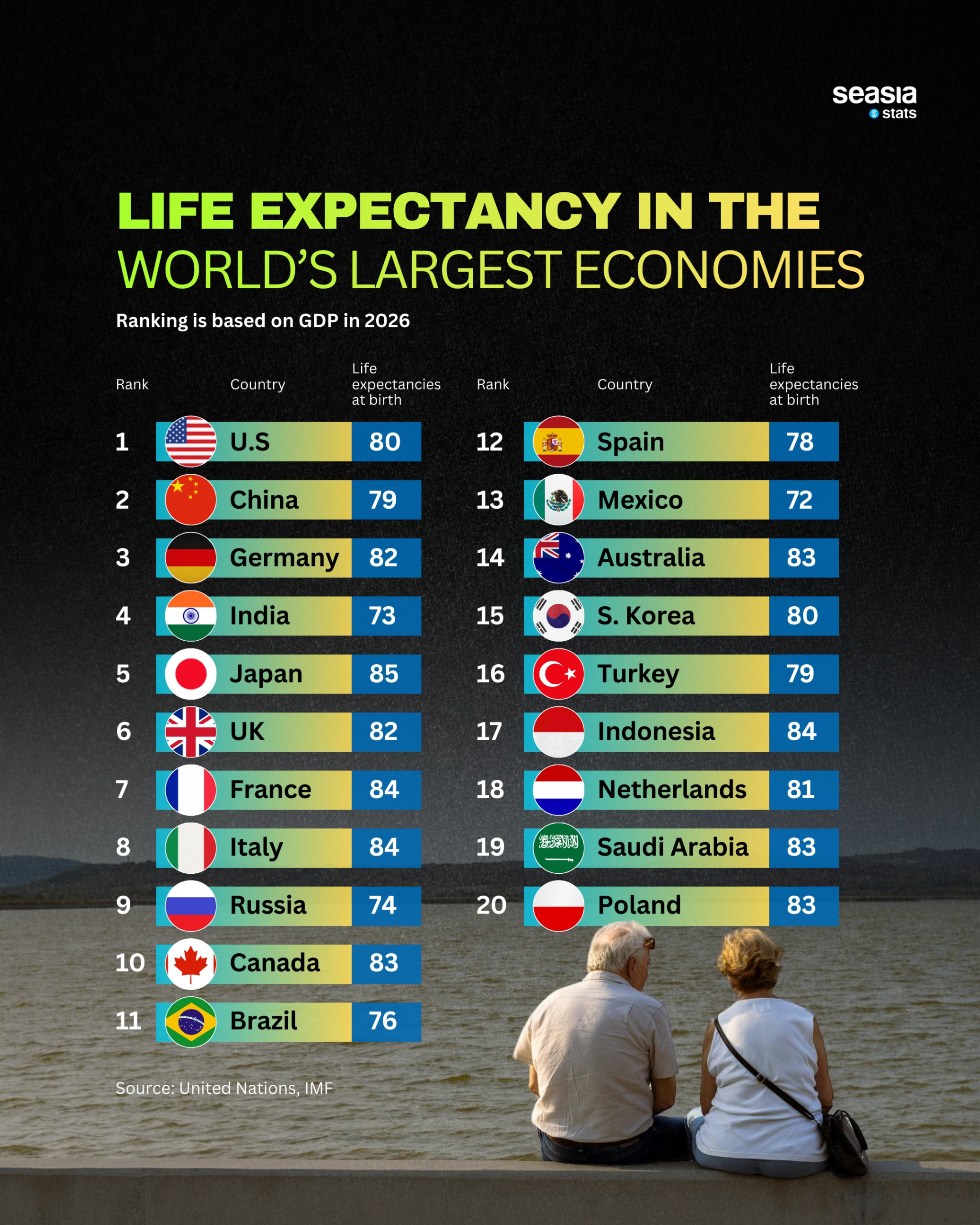
In 2026, the world’s largest economies are not only competing in GDP rankings—they are also being measured by how long their citizens live. A new dataset compiled from global sources such as the United Nations and IMF, highlighted by Seasia Stats, reveals striking differences in life expectancy across the world’s economic giants. While wealth often correlates with longevity, the data shows that healthcare systems, lifestyle, and public policy all play equally decisive roles in shaping how long people live.
Japan Sets the Gold Standard for Longevity
At the top of the list stands Japan, with an average life expectancy of 85 years—the highest among the world’s 20 largest economies. Japan’s success is widely attributed to its strong preventive healthcare system, universal insurance coverage, and a culture that promotes balanced diets, active aging, and community engagement.
Close behind are France and Italy, both at 84 years, demonstrating how Europe’s robust healthcare frameworks and high living standards continue to support long, healthy lives. Notably, Indonesia also reaches 84 years in this dataset, placing it alongside these advanced European economies and marking a remarkable achievement for Southeast Asia’s largest nation.
Strong Performers Across the Developed World
Several other developed economies show consistently high life expectancy levels. Australia, Canada, Saudi Arabia, and Poland each record averages of around 83 years, reflecting strong healthcare access and rising standards of living. Germany and the United Kingdom both stand at 82 years, maintaining their position among the world’s healthiest major economies.
Meanwhile, South Korea and Spain demonstrate solid longevity performance with 80 and 78 years respectively, benefiting from strong healthcare infrastructure and improving public health awareness.
The U.S. and China: Economic Giants with Mixed Outcomes
The world’s two largest economies—the United States and China—record life expectancies of 80 and 79 years respectively. While China has steadily improved its figures through expanded healthcare coverage and disease prevention programs, the United States continues to lag behind several European peers despite its economic strength.
This gap highlights an important reality: economic power alone does not guarantee better health outcomes. Access to healthcare, social inequality, and lifestyle factors all significantly shape national longevity.
Lower-Tier Results and Development Challenges
At the lower end of the ranking are India (73 years), Mexico (72 years), Russia (74 years), and Brazil (76 years). These countries face a range of structural challenges, from uneven healthcare access to disparities in rural and urban services. While they remain economic powerhouses in their own right, improving life expectancy remains a key policy priority for their long-term development.
Southeast Asia’s Rising Health Profile
One of the most compelling insights from the data is Southeast Asia’s growing presence in global longevity rankings. Indonesia’s strong performance at 84 years signals improvements in healthcare delivery, nutrition, and economic conditions.
Elsewhere in the region, countries such as Singapore—though not listed among the top 20 economies in this dataset—are widely recognized for even higher life expectancy levels globally, often exceeding 84–85 years due to world-class healthcare systems. Malaysia, Thailand, and Vietnam have also made steady gains over the past decade, supported by expanding healthcare access, urban development, and rising incomes.
These trends suggest that Southeast Asia is not only catching up economically, but also making meaningful progress in public health outcomes.
Longevity as a Measure of Development
Ultimately, life expectancy offers a powerful lens through which to understand development beyond GDP figures. It reflects not just wealth, but how effectively nations invest in their people’s health, well-being, and quality of life.
As the world’s largest economies continue to grow and evolve, the challenge ahead is clear: sustaining economic expansion while ensuring that citizens everywhere live longer, healthier, and more fulfilling lives.


