

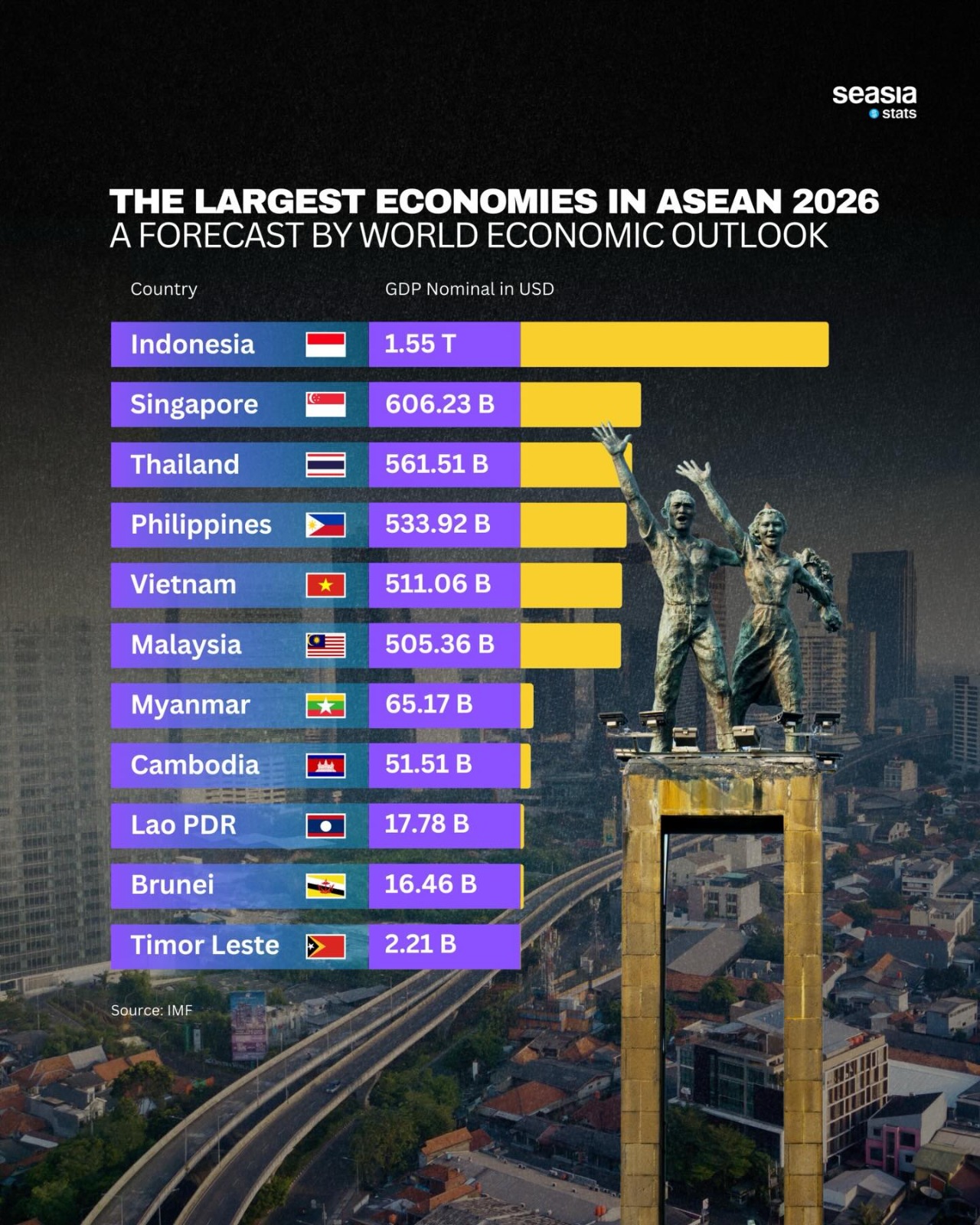
Southeast Asia’s economic story is one of momentum, resilience, and diversity. As global growth recalibrates in the mid-2020s, ASEAN continues to stand out as one of the most dynamic regional blocs in the world. According to the latest International Monetary Fund projections for 2026, the region’s largest economies reflect both long-standing industrial strength and the rapid rise of new economic engines.
Indonesia: The Region’s Undisputed Powerhouse
At the top of the list is Indonesia, forecast to reach a nominal GDP of approximately $1.55 trillion. As the fourth most populous country in the world, Indonesia’s strength lies in its vast domestic market, abundant natural resources, and expanding industrial base. Infrastructure investment, downstream processing of minerals, and a growing digital economy continue to fuel its expansion. With its scale and strategic reforms, Indonesia is expected to remain one of the most influential contributors to global growth in the coming years.
Singapore and Thailand: High-Value Economies at the Top
Singapore ranks second with a projected GDP of $606.23 billion, an impressive achievement for a city-state of its size. Its advanced financial sector, world-class logistics network, and leadership in emerging industries such as fintech and artificial intelligence ensure its continued global relevance.
Thailand follows in third place at $561.51 billion. Long known as Southeast Asia’s manufacturing hub, Thailand’s economy benefits from strong automotive, electronics, and agricultural exports. The steady return of tourism has also provided a powerful boost to its post-pandemic recovery, reinforcing its position as a regional economic anchor.
The $500 Billion Club: A Rising Middle Tier
A striking feature of ASEAN’s economic landscape is the emergence of a strong middle tier. The Philippines, Vietnam, and Malaysia are all projected to exceed the $500 billion mark in 2026.
The Philippines, at $533.92 billion, continues to thrive on domestic consumption, remittances from overseas workers, and a rapidly growing services sector, including business process outsourcing and digital platforms.
Vietnam, with a projected GDP of $511.06 billion, has become one of the world’s most attractive manufacturing destinations. Its integration into global supply chains—particularly in electronics and textiles—has accelerated its transformation into an industrial powerhouse.
Malaysia, at $505.36 billion, rounds out this tier with its diversified economy spanning manufacturing, commodities, finance, and technology. The country’s focus on high-value industries and digital innovation is helping it remain competitive in an increasingly complex global economy.
Emerging Economies: Growth Beyond the Headlines
Beyond the top six, ASEAN’s smaller economies continue to play vital roles in the region’s development story. Myanmar ($65.17 billion) and Cambodia ($51.51 billion) are steadily expanding their industrial and tourism sectors, while Laos ($17.78 billion) is leveraging hydropower exports and regional connectivity projects to strengthen its economy.
Brunei, with a GDP of $16.46 billion, remains heavily dependent on energy exports but is gradually exploring diversification strategies. Meanwhile, Timor-Leste, at $2.21 billion, represents one of the region’s youngest economies, still in the early stages of development but rich in long-term potential.
A Region Moving Forward Together
The 2026 outlook highlights ASEAN as a region of contrasts—but also of shared ambition. From trillion-dollar giants to emerging frontier markets, Southeast Asia’s economies are increasingly interconnected through trade, investment, and digital integration.
As global supply chains continue to shift and new technologies reshape industries, ASEAN’s economic diversity may well become its greatest strength. Together, these nations form a powerful collective force—one that is set to play an even larger role in the global economy in the decade ahead.


