

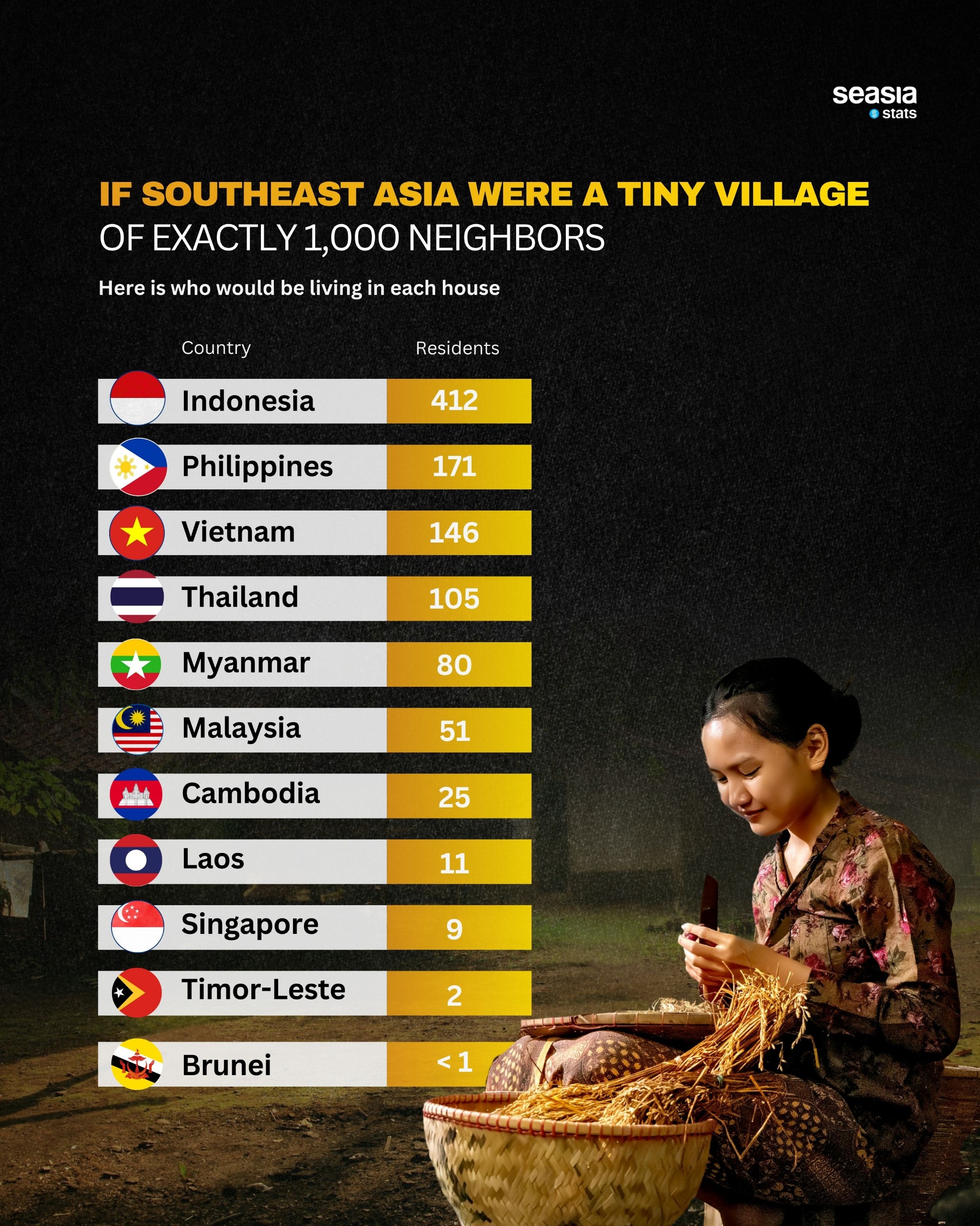
Southeast Asia is often spoken of as a single region, but in human terms, it is a neighborhood of striking contrasts. One way to understand that imbalance is to shrink the region down into a single imaginary village of exactly 1,000 people. Suddenly, the abstract becomes personal: you can picture who lives where, which homes are crowded, and which sit quietly at the end of the lane.
A Village Dominated by One Giant Household
If Southeast Asia were reduced to a village of 1,000 neighbors, the largest house by far would belong to Indonesia. It would be home to 412 people—more than two out of every five residents in the entire village. That single figure says a great deal about the scale of Indonesia itself: an archipelagic nation spread across thousands of islands, with a population so large it shapes the demographic and political weight of ASEAN almost by default.
The next two largest households would belong to the Philippines and Vietnam, with 171 and 146 residents respectively. Together with Indonesia, these three countries would account for nearly three-quarters of the village. In other words, if Southeast Asia were a dinner table, these three would dominate the conversation simply by how many seats they occupy.
This also explains why labor migration, consumer markets, elections, education systems, and urbanization in Southeast Asia are so often driven by these countries. When Indonesia, the Philippines, or Vietnam changes, the whole region feels it.
The Middle Houses of the Neighborhood
Then comes Thailand, with 105 residents, and Myanmar, with 80. These are not small households by any means, but in the context of Southeast Asia, they occupy a middle tier—large enough to matter enormously, yet overshadowed by the demographic giants ahead of them.
Thailand’s position is especially notable because its influence in Southeast Asia often exceeds its population share. It punches above its demographic weight through tourism, manufacturing, cuisine, media, and regional diplomacy. Myanmar, by contrast, has long held demographic significance but remains underrepresented economically due to decades of political turmoil and conflict.
Malaysia, with 51 villagers, reflects another Southeast Asian reality: population is not everything. Though smaller than many of its neighbors, Malaysia remains one of the region’s most economically influential countries, thanks to higher income levels, industrial capacity, and strategic trade positioning. Cambodia, with 25 residents, represents a country that is still relatively small in numbers but increasingly important in the region’s manufacturing and development story.
The Quietest Corners of the Region
The smallest houses in the village belong to Laos, Singapore, Timor-Leste, and Brunei. Laos would have just 11 residents, Singapore 9, Timor-Leste 2, and Brunei less than one person in this simplified model. Yet these tiny households are far from irrelevant.
Singapore, despite its miniature demographic footprint, would still likely own the village’s busiest port, most efficient airport, and perhaps the strongest banking system. It is the clearest reminder that population size does not automatically determine influence. Brunei, too, remains economically significant because of its energy wealth, while Timor-Leste, though tiny, represents one of Southeast Asia’s youngest and most symbolically important nations.
More Than a Numbers Exercise
What makes this village analogy so powerful is that it humanizes regional inequality. Southeast Asia is not just a bloc of flags and GDP charts—it is a living community where some nations carry enormous demographic weight while others exercise influence through finance, geography, diplomacy, or culture.
Seen this way, Southeast Asia is not a uniform neighborhood. It is a crowded, uneven, fascinating village—one where every house matters, but not every house is the same size.


