

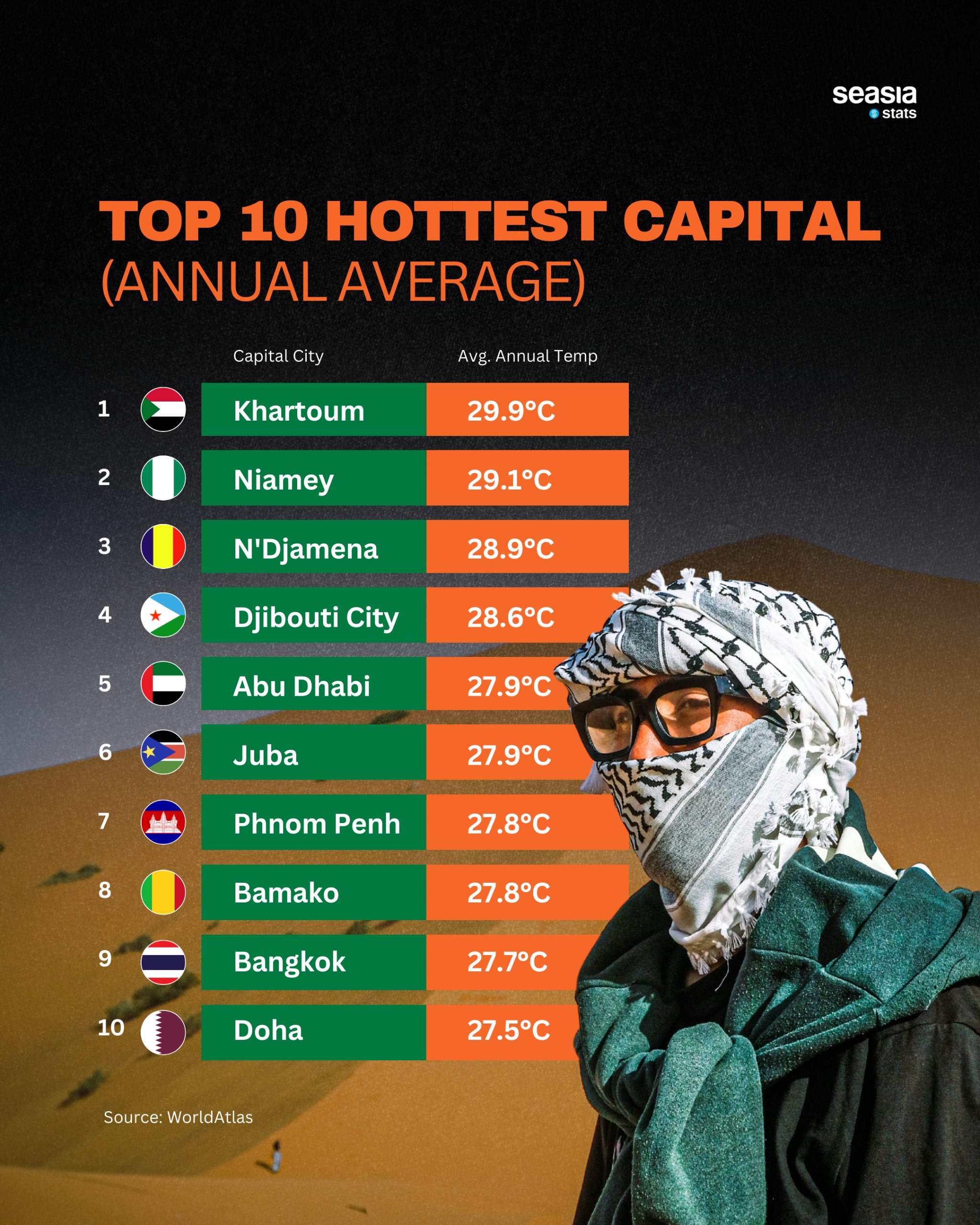
As global temperatures continue to rise, some cities feel the heat more than others—quite literally. A recent ranking compiled from WorldAtlas data and visualized by Seasia Stats highlights the top 10 hottest capital cities in the world by annual average temperature. Dominated by Africa and the Middle East, the list also includes Southeast Asian capitals where tropical climates and urban density keep temperatures consistently high year-round.
Africa’s Sahel: Where Extreme Heat Is the Norm
At the top of the list is Khartoum, the capital of Sudan, with an average annual temperature of 29.9°C. Located at the confluence of the Blue and White Nile, Khartoum sits squarely within a hot desert climate zone. Minimal rainfall, intense solar radiation, and long dry seasons make extreme heat a daily reality rather than a seasonal anomaly.
Close behind is Niamey, averaging 29.1°C annually. As the capital of Niger, Niamey exemplifies the Sahel’s harsh climate—long dry periods punctuated by short, intense rainy seasons.
Third place goes to N'Djamena in Chad, with an annual average of 28.9°C. The city’s inland location and semi-arid surroundings trap heat year-round.
Desert and Gulf Heat: The Middle East’s Hot Capitals
In fourth place is Djibouti City, averaging 28.6°C. Sitting near the Red Sea, high humidity compounds the heat, making temperatures feel even more oppressive.
The Middle East enters the list with Abu Dhabi, averaging 27.9°C. Rapid urbanization, glass-heavy architecture, and surrounding desert landscapes contribute to persistent heat, particularly during summer months.
Completing this tier is Juba, also at 27.9°C, where tropical savanna conditions combine with limited infrastructure to amplify heat exposure.
Southeast Asia’s Tropical Capitals Under Pressure
Southeast Asia makes a notable appearance with Phnom Penh, ranked seventh at 27.8°C. Unlike desert capitals, Phnom Penh’s heat is driven by high humidity, limited seasonal variation, and expanding urban development along the Mekong River.
Just below is Bangkok, averaging 27.7°C annually. Bangkok’s combination of tropical climate, concrete-heavy urban sprawl, and traffic congestion creates a pronounced urban heat island effect. Other Southeast Asian capitals such as Manila, Hanoi, and Kuala Lumpur—while not in the top 10—face similar challenges due to humidity and rapid urban growth.
Rounding Out the Top Ten
The list concludes with Doha, averaging 27.5°C. Though slightly cooler on average than some African capitals, Doha experiences extreme summer peaks that regularly exceed 45°C.
Heat, Cities, and the Climate Future
This ranking underscores how geography, climate zones, and urban design converge to shape daily life in the world’s hottest capitals. For Southeast Asia, the challenge is less about desert heat and more about humidity, density, and climate resilience. As global warming accelerates, these cities—whether in the Sahel or along the Mekong—are becoming frontlines in the fight to adapt urban life to a hotter world.


