

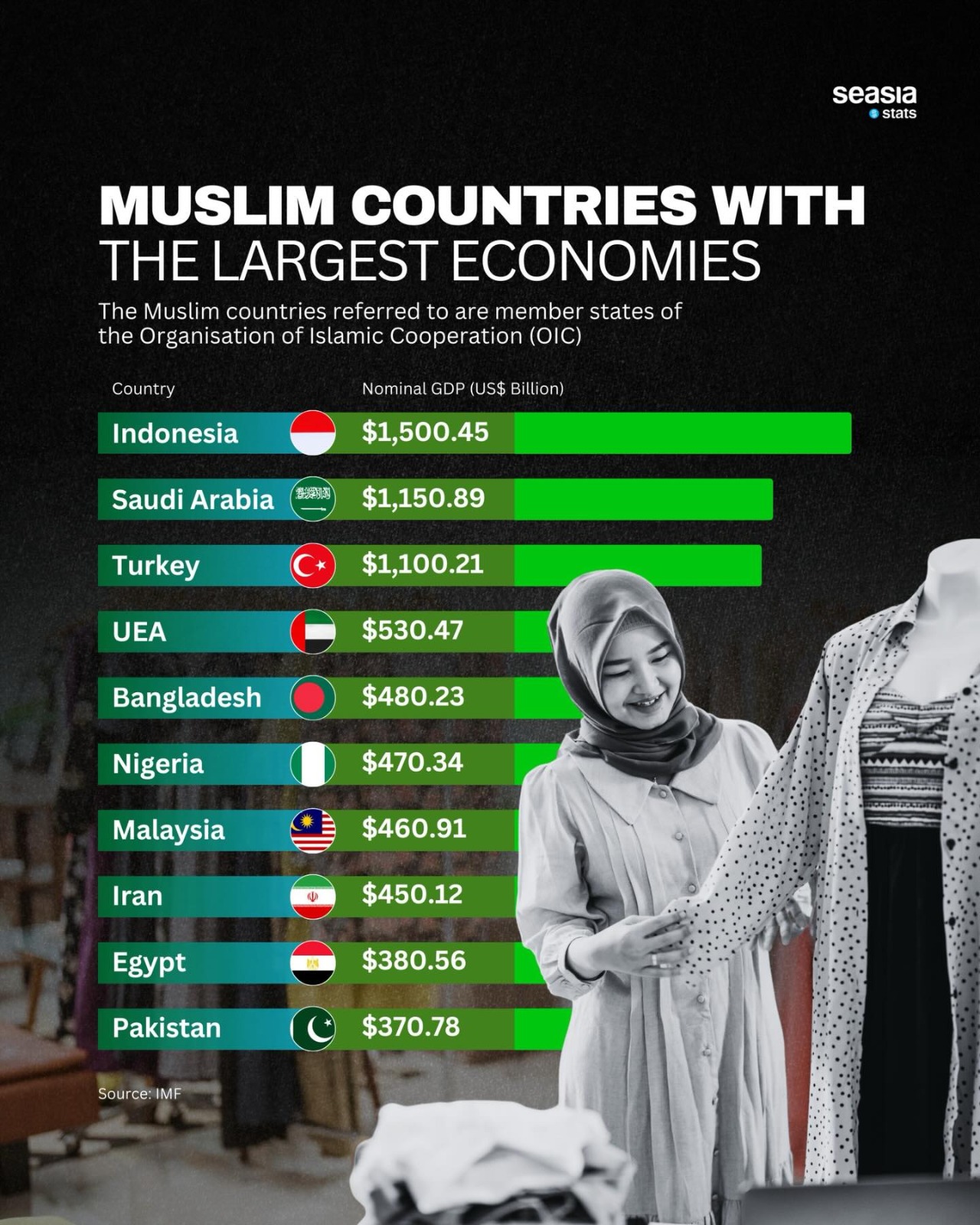
Across the Muslim world, economic power is becoming increasingly diverse and dynamic. From energy-rich Gulf states to rapidly industrializing Asian economies, countries within the Organisation of Islamic Cooperation (OIC) represent a wide range of development models. According to data compiled from the International Monetary Fund (IMF) and highlighted by Seasia Stats, several Muslim-majority nations stand out as the largest economic engines in the Islamic world, collectively shaping global trade, investment, and development.
Indonesia Leads the Muslim World’s Economy
At the top of the ranking stands Indonesia, the world’s largest Muslim-majority country, with a nominal GDP of approximately $1.50 trillion. This milestone places Indonesia firmly as the largest economy among OIC members and the only Southeast Asian nation in the trillion-dollar category.
Indonesia’s economic strength is built on a broad and diversified base. Its large domestic market—home to more than 270 million people—drives strong consumption, while industries such as manufacturing, mining, digital services, and agriculture contribute to sustained growth.
The country has also become a major hub for the global halal economy, including halal food, Islamic finance, modest fashion, and halal tourism. Cities like Jakarta, Bandung, and Surabaya are increasingly influential in shaping Muslim consumer markets across Southeast Asia and beyond.
Saudi Arabia and Turkey Complete the Trillion-Dollar Club
Following Indonesia, Saudi Arabia ranks second with a GDP of $1.15 trillion, driven largely by its powerful energy sector. As one of the world’s leading oil exporters, Saudi Arabia continues to play a central role in global energy markets while simultaneously pursuing economic diversification through its ambitious Vision 2030 reforms.
Third place belongs to Turkey, with a GDP of approximately $1.10 trillion. Turkey’s economy is characterized by strong industrial output, a robust manufacturing sector, and its strategic position bridging Europe and Asia. Istanbul remains a major financial and commercial hub connecting multiple global markets.
These three countries—Indonesia, Saudi Arabia, and Turkey—are currently the only OIC members whose economies exceed the $1 trillion threshold, highlighting their outsized influence in the Muslim world.
A Diverse Middle Tier of Economic Powers
The middle segment of the ranking showcases the economic diversity of Muslim-majority nations. The United Arab Emirates (UAE) ranks fourth with $530.47 billion, reflecting its transformation into a global center for finance, aviation, tourism, and logistics.
Three countries follow closely with similar economic sizes. Bangladesh ranks fifth with $480.23 billion, driven by its powerful textile and garment industry. Nigeria, Africa’s most populous nation, follows with $470.34 billion, supported by both energy production and a growing services sector.
In seventh place is Malaysia, Southeast Asia’s second-largest Muslim-majority economy, with a GDP of $460.91 billion. Malaysia’s economy benefits from advanced manufacturing, strong electronics exports, and one of the world’s most developed Islamic finance systems.
Key Economies in South Asia and the Middle East
The final three positions in the top ten belong to Iran, Egypt, and Pakistan. Iran ranks eighth with a GDP of $450.12 billion, despite facing significant international economic challenges. Its economy remains supported by energy resources, manufacturing, and a large domestic market.
Egypt, with $380.56 billion, continues to serve as a major economic hub in North Africa and the Arab world, supported by tourism, agriculture, and the strategic importance of the Suez Canal.
Completing the list is Pakistan, whose economy totals $370.78 billion. With a population exceeding 240 million, Pakistan possesses substantial long-term economic potential driven by industry, agriculture, and infrastructure development.
Southeast Asia’s Growing Influence
Beyond Indonesia and Malaysia, Southeast Asia continues to emerge as one of the most dynamic economic regions in the Muslim world. Countries such as Brunei, Thailand, and the Philippines also participate in the expanding halal economy through tourism, food production, and financial services.
As global Muslim consumer markets continue to grow, Southeast Asia’s role in shaping the future of Islamic finance, halal trade, and Muslim lifestyle industries is expected to become even more significant.
Together, these leading economies demonstrate the evolving economic landscape of the Muslim world—one that spans continents and reflects a powerful blend of resources, innovation, and demographic strength.


