

Railways are more than just transport—they are the arteries of economic growth, urban mobility, and regional integration. Across Southeast Asia, governments are investing heavily in rail infrastructure to support booming populations, growing cities, and expanding trade networks. As of 2026, the region’s railway landscape shows a clear hierarchy, with several countries emerging as leaders in building modern, functional networks that link communities and economies together.
Indonesia: The Region’s Rail Giant
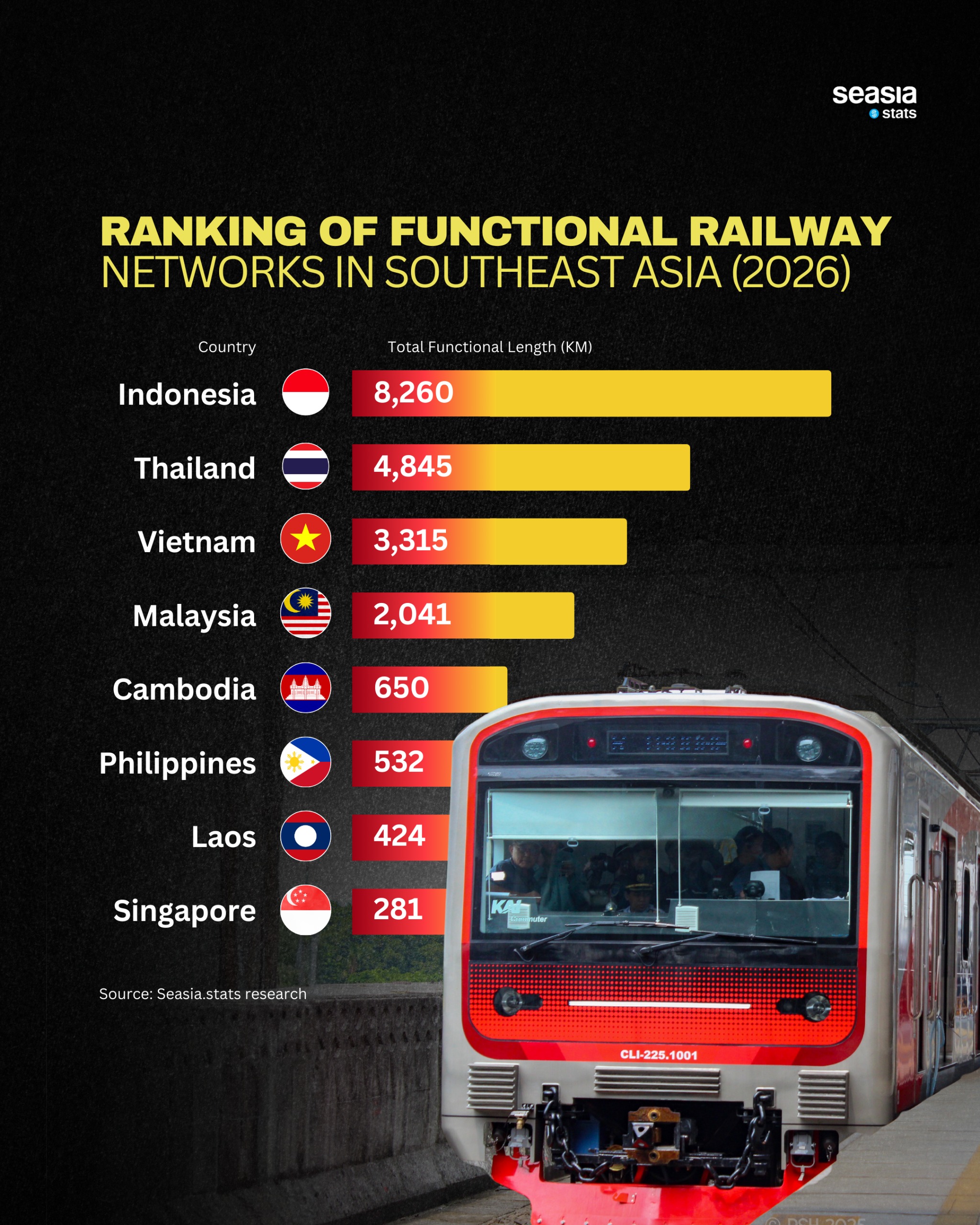
According to Seasia Stats research, Indonesia now leads Southeast Asia with an impressive 8,260 kilometers of functional railway lines. This expansive network stretches across major islands such as Java and Sumatra, serving both commuter and freight needs.
A major driver of this growth is modernization. The introduction of the Whoosh high-speed rail—Southeast Asia’s first—marks a milestone for the region. Combined with upgraded commuter lines in Jakarta and surrounding cities, Indonesia’s rail system is rapidly evolving into a backbone for sustainable urban mobility and intercity travel.
Thailand and Vietnam: Strong Regional Contenders
Thailand ranks second with 4,845 kilometers of track, reflecting its strategic focus on national connectivity and cross-border trade. The country’s railway system plays a key role in linking mainland Southeast Asia, with ongoing projects aimed at integrating regional corridors connecting Laos, China, and Malaysia.
Vietnam, with 3,315 kilometers, secures third place. Its historic north–south railway remains a vital lifeline, connecting Hanoi to Ho Chi Minh City along a scenic coastal route. Recent modernization plans and high-speed proposals aim to further enhance efficiency and capacity in the years ahead.
Malaysia’s Modern Middle Tier
Malaysia’s 2,041-kilometer network places it firmly in the region’s middle tier. The country has focused on electrified double-track systems such as the KTM ETS and urban rail expansions in Kuala Lumpur. These upgrades have improved speed, reliability, and commuter convenience, positioning Malaysia as one of Southeast Asia’s most efficient rail markets.
Emerging Networks Across ASEAN
Beyond the top four, several Southeast Asian nations are in earlier stages of rail development:
-
Cambodia (650 km) has been gradually restoring and expanding its lines, particularly for freight and tourism routes.
-
The Philippines (532 km) is undergoing rapid transformation, with major investments in Metro Manila’s MRT and LRT systems, as well as new intercity rail projects.
-
Laos (424 km) has gained international attention with the Laos–China Railway, a high-speed corridor boosting trade and tourism across the Mekong region.
-
Singapore (281 km), despite its small land area, maintains one of the most efficient and technologically advanced urban rail systems in the world through its MRT network.
A Region Moving Toward Integration
The disparities in network size highlight the region’s diverse stages of infrastructure development, but they also reflect a shared direction: greater integration. Projects such as the Singapore–Kuala Lumpur high-speed rail proposal, Thailand’s cross-border links, and Indonesia’s inter-island connectivity plans all point toward a future of seamless travel across ASEAN.
Railways are increasingly seen as a sustainable alternative to road and air transport, reducing congestion and emissions while supporting economic corridors.
The Tracks Ahead
Southeast Asia’s railway story is still being written. While Indonesia, Thailand, and Vietnam currently dominate in network length, smaller systems in countries like Laos, Singapore, and the Philippines are rapidly modernizing.
As investments continue and regional cooperation deepens, Southeast Asia is steadily building a connected rail future—one where cities, economies, and people are linked more closely than ever before.


