

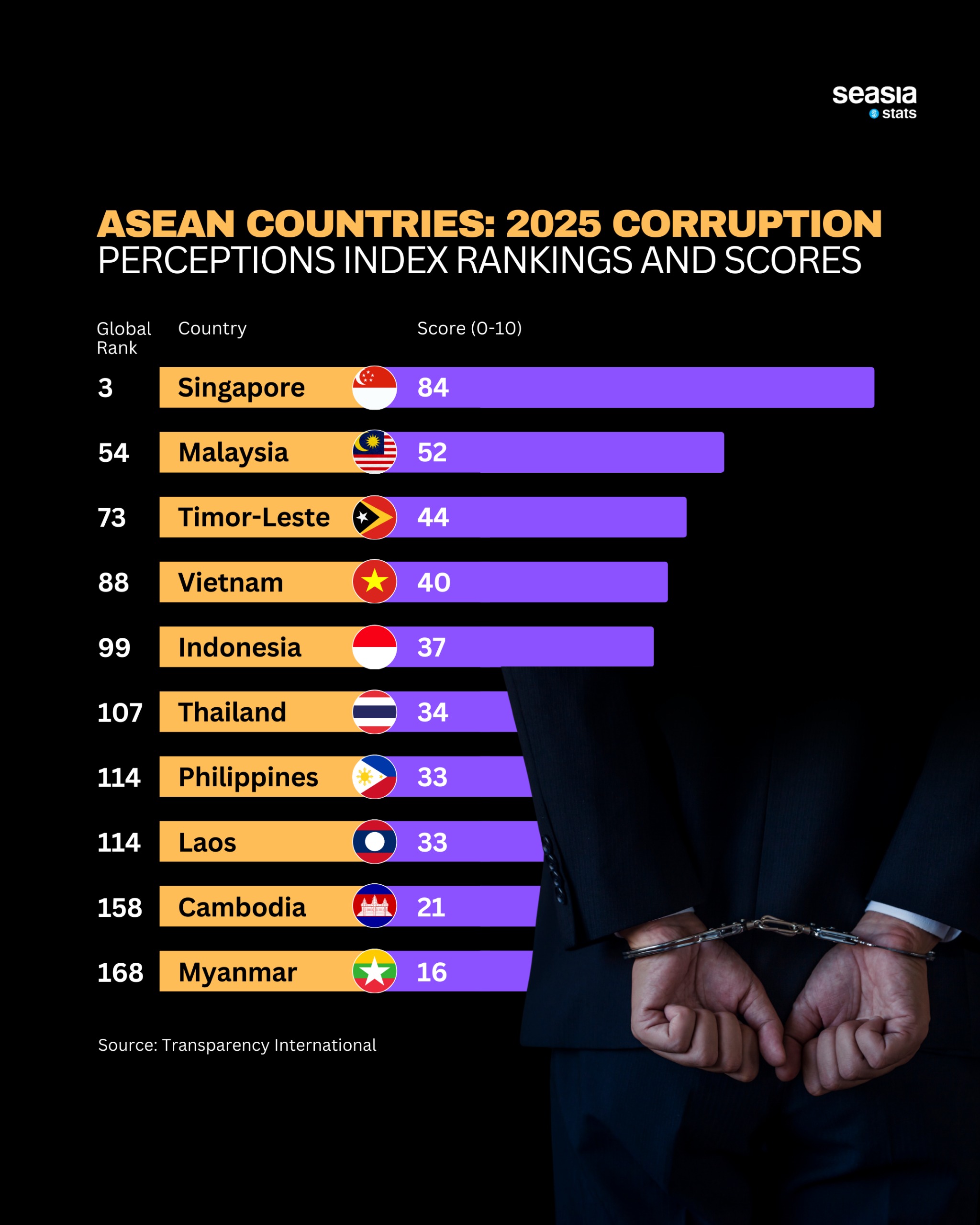
Corruption remains one of the most closely watched indicators of governance, investor confidence, and public trust worldwide. The 2025 Corruption Perceptions Index (CPI) published by Transparency International offers a revealing snapshot of how Southeast Asian countries are perceived when it comes to public-sector integrity. The results show a region of stark contrasts—ranging from global leaders in transparency to nations still grappling with deep structural challenges.
Singapore: ASEAN’s Gold Standard
Once again, Singapore stands far above the rest of the region. With a CPI score of 84 and a global rank of 3, Singapore is not only ASEAN’s cleanest government but also one of the least corrupt countries in the world. Its success is widely attributed to strong institutions, an independent judiciary, strict enforcement of anti-corruption laws, and high public-sector wages that reduce incentives for misconduct.
Singapore’s performance continues to reinforce its status as a global financial hub and a magnet for foreign investment, offering a benchmark that other Southeast Asian nations often aspire to emulate.
Malaysia: A Regional Runner-Up
In second place within ASEAN is Malaysia, scoring 52 and ranking 54th globally. Malaysia is the only other Southeast Asian country to surpass the 50-point threshold, reflecting moderate progress in governance reforms, institutional oversight, and public accountability.
While corruption scandals in recent years have tested public confidence, continued reforms and stronger enforcement mechanisms have helped Malaysia maintain its position in the regional middle-upper tier.
The Middle Tier: Gradual Progress, Persistent Gaps
A cluster of countries occupies the mid-range of the CPI, highlighting gradual improvement but ongoing challenges. Timor-Leste ranks third in ASEAN with a score of 44 (Global Rank 73), reflecting gains in transparency despite its relatively young institutions.
Vietnam follows with a score of 40 (Rank 88), supported by high-profile anti-corruption campaigns, though concerns remain around press freedom and political accountability. Indonesia, scoring 37 (Rank 99), continues to balance reform efforts with challenges linked to decentralization and political financing.
Just below them is Thailand, with a score of 34 (Rank 107), where political instability and institutional uncertainty have weighed on transparency perceptions.
Struggling at the Lower End
Further down the index, Philippines and Laos are tied at 33 (Global Rank 114). In both cases, weak enforcement, limited oversight, and constrained civic space continue to undermine progress against corruption.
At the bottom of the ASEAN ranking are Cambodia and Myanmar. Cambodia scores 21 (Rank 158), while Myanmar records just 16 (Rank 168), reflecting severe governance challenges, weak rule of law, and—particularly in Myanmar’s case—ongoing political turmoil that has eroded institutional integrity.
What the CPI Reveals About the Region
The 2025 CPI underscores a fundamental reality: Southeast Asia is not moving at a uniform pace when it comes to transparency and governance. While countries like Singapore and Malaysia demonstrate that strong institutions matter, others illustrate how political instability, limited accountability, and weak enforcement can stall progress.
As ASEAN economies grow more interconnected and compete for global capital, tackling corruption will remain a defining test—one that shapes not only economic prospects, but also public trust and long-term stability across the region.


