

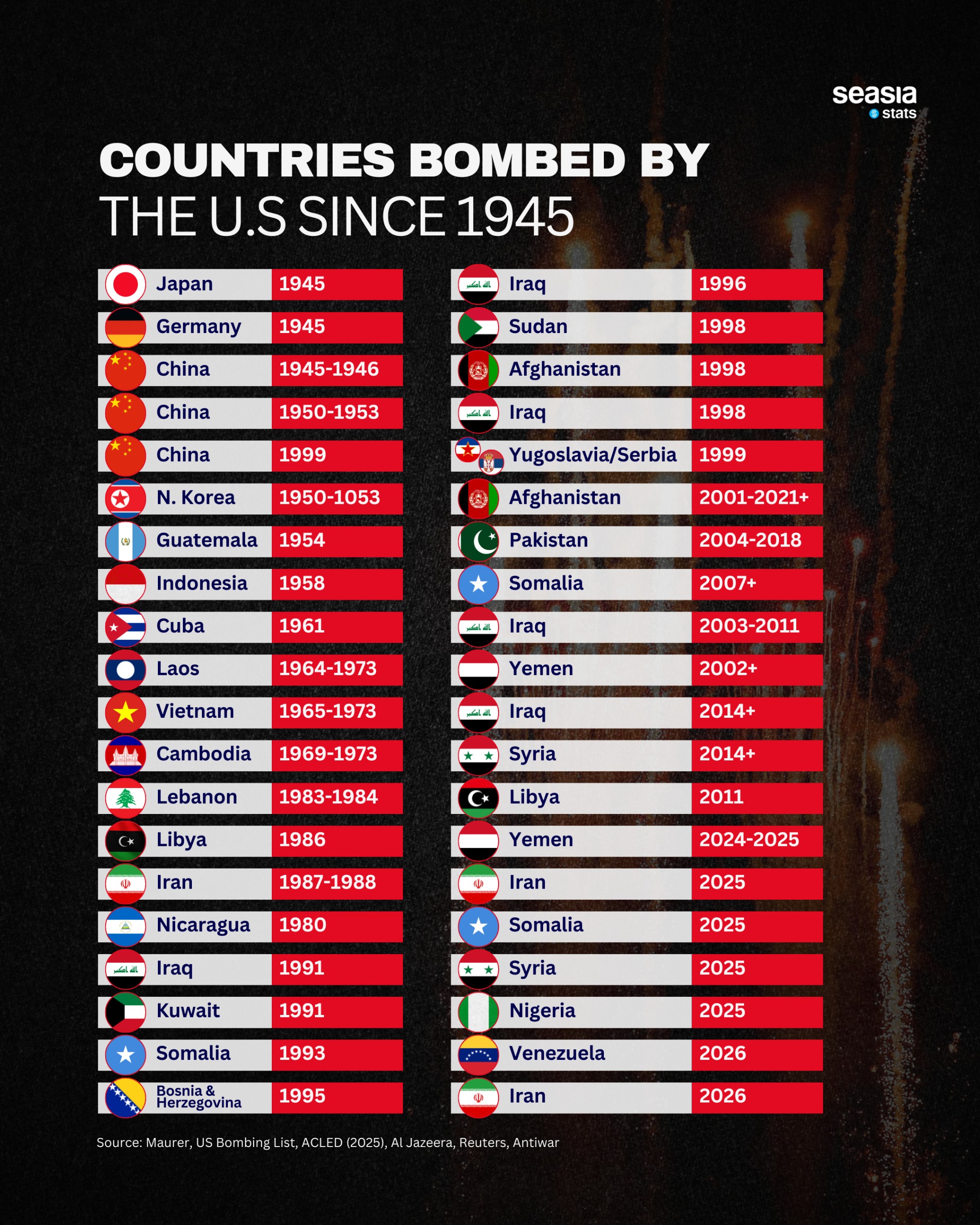
From the closing days of World War II to the conflicts of the 21st century, the use of U.S. air power has shaped global geopolitics in profound ways. A timeline compiled from sources such as ACLED, historical archives, and research by Seasia Stats shows that American aerial interventions have spanned nearly every continent, reflecting shifting strategic priorities across decades. What began in 1945 as part of total war evolved into a central tool of Cold War containment, counter-insurgency campaigns, and modern counterterrorism operations.
World War II and the Cold War Foundations
The modern era of U.S. aerial warfare began in 1945 with the atomic bombings of Japan and the final incendiary raids on Germany. These actions marked a decisive turning point in both military strategy and global history. In the early Cold War years, U.S. air operations continued in Asia, including interventions in China during the immediate postwar years and again during the Korean War (1950–1953), where extensive bombing campaigns were conducted over North Korea.
These early conflicts set a precedent for the use of air power as a key strategic instrument—capable of shaping outcomes even without large-scale ground deployments.
Southeast Asia as a Major Theater
Southeast Asia became one of the most heavily impacted regions during the mid-20th century. Long-running bombing campaigns in Laos (1964–1973), Vietnam (1965–1973), and Cambodia (1969–1973) remain among the most extensive aerial operations in modern history. These campaigns were deeply intertwined with Cold War politics and the broader effort to contain communism in the region.
Indonesia also appears briefly in the timeline, with reported U.S. involvement in 1958 during internal regional conflicts. The legacy of these operations continues to shape the political memory and historical discourse of Southeast Asia today, especially in Vietnam, Laos, and Cambodia where wartime remnants still affect communities decades later.
Expansion Across the Middle East and Beyond
From the 1980s onward, U.S. air campaigns expanded into the Middle East. Lebanon (1983–1984), Libya (1986), and Iran (1987–1988) marked early episodes of intervention in the region. Following the Gulf War in 1991, Iraq became a recurring focus, with air operations spanning multiple phases from 1991 through the 2000s and into the fight against ISIS after 2014.
In Europe, U.S.-led NATO campaigns in Bosnia (1995) and Yugoslavia (1999) also highlighted the continued use of air power in regional conflicts. One notable incident during this period was the 1999 bombing of the Chinese embassy in Belgrade, which the United States later described as accidental.
The War on Terror Era
After 2001, U.S. air operations became central to the global “War on Terror.” Afghanistan saw continuous strikes from 2001 through the early 2020s, while drone and air campaigns expanded into Pakistan, Yemen, Somalia, and Syria. According to ACLED data, U.S. airstrikes in the Middle East have continued to escalate in response to regional conflicts and security threats.
Recent Developments and Continuing Debates
More recent reports indicate continued U.S. air operations in the 2020s, including actions in the Middle East and Africa. These interventions highlight how air power remains a key instrument of modern military policy—rapid, far-reaching, and politically complex.
For Southeast Asia, the historical memory of past campaigns continues to influence regional perspectives on foreign military involvement, sovereignty, and security cooperation.
A Legacy Still Unfolding
Across more than eight decades, the record of U.S. aerial interventions reveals both technological evolution and shifting geopolitical priorities. From Southeast Asia’s jungles to the deserts of the Middle East, air power has left a lasting imprint on international relations—one that continues to evolve in today’s uncertain global landscape.


